Decadal Vostok temperature variablity

is defined as the absolute value of the 10-year
change in termperature.
We study only
(1) that part of the Eem (Eemian interglacial,
    termination 2) with CO2 above 260 ppm,
(2) the early Holocene,
(3) the late Holocene,
(4) the late Holocene up to about 250 ya.

We use the data developed by Petit, et al. from

ftp://ftp.ncdc.noaa.gov/pub/data/paleo/icecore/antarctica/vostok/deutnat.txt

with citation
Petit, J.R., et al., 2001,
Vostok Ice Core Data for 420,000 Years, IGBP PAGES/World Data Center
for Paleoclimatology Data Contribution Series #2001-076.
NOAA/NGDC Paleoclimatology Program, Boulder CO, USA.

The temperature data is given for every meter of ice
(to two decimal places).
This means that the most recent data is sampled at
about 15--20 year intervals while the older ice is
sampled at about 50 year intervals. The results are
expressed as the absolute value of temperature
differences per decade.  Call this decadal variablity.

In addition, a anti-persistence measure is included.  If
the trends always persisted, the value would be zero.
Since the mean value of the anti-persistence is slightly
larger than the mean value of the decadal variability,
the trends do not persist, showing that the decadal
variability tends to measure just oscillations.

(sD abbreviates standard deviation.)

(1) Eem.
Eem dates from 125989 ya to 131840 ya according to
their date assignment method. The Eem Climatic Optimum
is at 128357 ya.
vostok-petit.2 [108 temperature differences]
min=  0.00 @ 127310
max=  0.28 @ 129374
mean=  0.047 K per decade
sD=  0.044 K
skewness=  2.06
kurtosis=  7.07
anti-persistence (of trend into next measured interval):
mean=  0.041 K per decade
sD=  0.054 K
skewness=  2.10
kurtosis=  5.82

(2) Early Holocene
from 10564 ya to 6004 ya.  The maximum @ 8091 is
temporally associated with the eruption of the
Kurile super-volcano on the Kamchatka Pennisula
and with the "8.2 kya cooling event".
vostok-petit.early.holocene [94 temperature differences]
min=  0.00 @ 6631
max=  0.40 @ 8091
mean=  0.080 K per decade
sD=  0.077 K
skewness=  1.64
kurtosis=  3.32
anti-persistence (of trend into next measured interval):
mean=  0.108 K per decade
sD=  0.101 K
skewness=  2.86
kurtosis= 14.40

(3) Late Holocene
from 2171 ya to 0 ya (mean recent time).  The maximum
@ 190 is temporally associated with the eruption of
Tambora in 1815 CE.
vostok-petit.late.holocene [71 temperature differences]
min=  0.00 @ 0
max=  0.62 @ 190
mean=  0.146 K per decade
sD=  0.141 K
skewness=  1.16
kurtosis=  0.79
anti-persistence (of trend into next measured interval):
mean=  0.195 K per decade
sD=  0.198 K
skewness=  1.67
kurtosis=  2.98

(4) Late Holocene, not recent
from 2171 ya to 281 ya.
vostok-petit.not.recent [57 temperature differences]
min=  0.00 @ 848
max=  0.50 @ 375
mean=  0.139 K per decade
sD=  0.119 K
skewness=  1.13
kurtosis=  0.60
anti-persistence (of trend into next measured interval):
mean=  0.183 K per decade
sD=  0.163 K
skewness=  1.84
kurtosis=  5.53

=========================================================================
From

http://en.wikipedia.org/wiki/Holocene_Climatic_Optimum

we learn that the average temperature has changed
little for the past 2000 years (until very recently).
Nonetheless, it appears that the decadal variability
is greater, unless diffusion of deuterium through the
ice explains the differences between the newer and the
older variations.

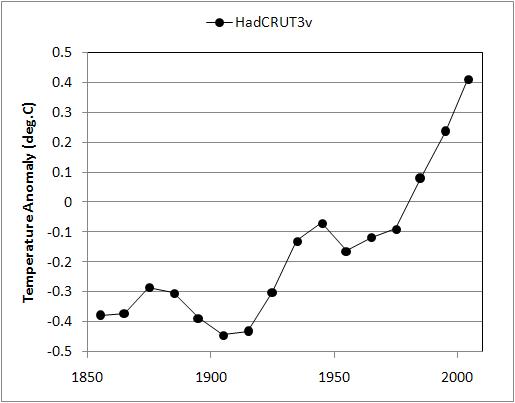
I would like to then compare these results to

http://tamino.files.wordpress.com/2008/04/10yave.jpg

to state that the warming since about 1970 CE is
statistically highly improbable without anthropogenic
forcings.

Anybody know what correction to apply to translate
from Vostok deuterium-derived temperature differences
to the HadCRUT3v delta temperatures?

Or alternatively, has something similar to this
preliminary study already been done?

--~--~---------~--~----~------------~-------~--~----~
You received this message because you are subscribed to the Google Groups
Global Change ("globalchange") newsgroup. Global Change is a public, moderated
venue for discussion of science, technology, economics and policy dimensions of
global environmental change.

Posts will be admitted to the list if and only if any moderator finds the
submission to be constructive and/or interesting, on topic, and not
gratuitously rude.

To post to this group, send email to [email protected]

To unsubscribe from this group, send email to [EMAIL PROTECTED]

For more options, visit this group at
http://groups.google.com/group/globalchange
-~----------~----~----~----~------~----~------~--~---