Decadal GISP2 Variability during the Holocene

I take the Holocene as beginning 9900 ypb (years
before present), the draining of Galcial Lake
Aggassiz, to 1850 CE, 100 ypb.
[dates before present (1950 CE)]
from -9902.24    -30.6752
to     -95.1409  -31.5913
with the central Greenland ice core temperatures.

The extreme temperatures and measurement
intrvals in the data from [1] are
minT=~32.442  maxT=~28.702 range=  3.740
minI=  2.700  maxI= 79.670
meanI= 13.38 y
sD=  5.15 y
for the 734 measurements.  Via linear interpolation
derived data at each 10 year intervals provides
981 points from 9900 ypb to 100 ypb.  The change in
temperature from each data point to the next is
used to form a Markoff matrix of the transitions
from one temperature bin to the one at the next time.
The maximum temperature transsition is 0.48 K.

We also have the maximum length run of nothing but
transitions to higher temperature bins:

maximum length up-run = 7
from -8200.00 to -8130.00 up 1.50 K,
the recovery from the "8.2 kya event" which is
associated with the super-eruption (VEI 7) of
Kurile Lake and other volcanic activity either
somewhat earlier or later:

http://www.volcano.si.edu/world/largeeruptions.cfm

The Markoff matrix gives the probability of the
transition from the temperature bin for the row to
the temperature bin for the column.

Markoff matrix (as percentages) [bin interval =   0.20 K]

bin| 00 01 02 03 04 05 06 07 08 09 10 11 12 13 14 15 16 17 18
---+---------------------------------------------------------
00 | 86 14 00 00 00 00 00 00 00 00 00 00 00 00 00 00 00 00 00
01 | 05 74 21 00 00 00 00 00 00 00 00 00 00 00 00 00 00 00 00
02 | 00 07 82 11 00 00 00 00 00 00 00 00 00 00 00 00 00 00 00
03 | 00 00 23 61 16 00 00 00 00 00 00 00 00 00 00 00 00 00 00
04 | 00 00 00 13 70 17 00 00 00 00 00 00 00 00 00 00 00 00 00
05 | 00 00 00 03 08 73 14 03 00 00 00 00 00 00 00 00 00 00 00
06 | 00 00 00 00 03 08 68 20 00 00 00 00 00 00 00 00 00 00 00
07 | 00 00 00 00 00 00 15 70 15 00 00 00 00 00 00 00 00 00 00
08 | 00 00 00 00 00 00 00 18 61 21 00 00 00 00 00 00 00 00 00
09 | 00 00 00 00 00 00 00 00 17 68 15 00 00 00 00 00 00 00 00
10 | 00 00 00 00 00 00 00 00 00 14 70 16 00 00 00 00 00 00 00
11 | 00 00 00 00 00 00 00 00 00 00 17 71 12 00 00 00 00 00 00
12 | 00 00 00 00 00 00 00 00 00 00 00 17 71 12 00 00 00 00 00
13 | 00 00 00 00 00 00 00 00 00 00 00 00 23 64 10 03 00 00 00
14 | 00 00 00 00 00 00 00 00 00 00 00 00 00 17 70 10 03 00 00
15 | 00 00 00 00 00 00 00 00 00 00 00 00 00 00 26 63 11 00 00
16 | 00 00 00 00 00 00 00 00 00 00 00 00 00 00 00 16 68 11 05
17 | 00 00 00 00 00 00 00 00 00 00 00 00 00 00 00 00 20 67 13
18 | 00 00 00 00 00 00 00 00 00 00 00 00 00 00 00 00 00 20 80

The main feature to note is that the matrix is almost
tridiagonal:  the temperature most probably stays in the
same bin for the next decade, but with small probabilities
may transitiion either up or down one bin.  There are a few
cases, bins 05, 06, 13, 14 and 16, where the temperature,
with quite low probability, went down or up two bins.

The recovery from the 8.2 kybp event is from bin 00 to bin
07 with a a probability of 0.000002462.  This exemplifies
the fact that the climate is not actually a Markoff chain,
i.e., a random process.  There is a definite cause, sulfate
aerosols and the subsequent climate recovery thereafter,
(NGRIP data).

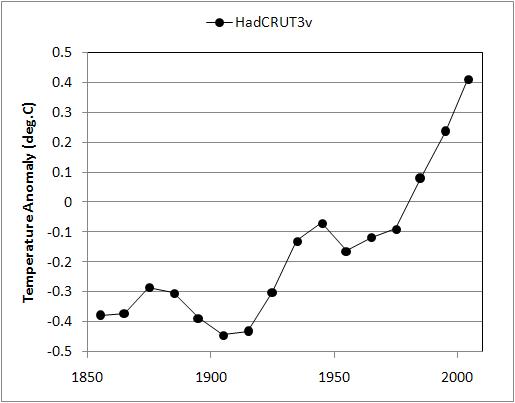
But it is instructive to use the Markoff chain, random
process, concept to consider the following run up in
temperaturesi since the 1950s:

http://tamino.files.wordpress.com/2008/04/10yave.jpg

to ask how probable this is, given the data.  To do
requires converting the certral Greenland GISP2 bin
size of 0.20 K to the temperature anomaly for the
HadCRUTv3 data.

Based on a statement that the 8.2 kybp event depressed
temperatures in the tropics about 3 K, it appears that
1 K GISP = 1.5 K HadCRUT3v
might be about right.

I welcome discussion, especially regarding the
conversion factor.

--~--~---------~--~----~------------~-------~--~----~
You received this message because you are subscribed to the Google Groups
Global Change ("globalchange") newsgroup. Global Change is a public, moderated
venue for discussion of science, technology, economics and policy dimensions of
global environmental change.

Posts will be admitted to the list if and only if any moderator finds the
submission to be constructive and/or interesting, on topic, and not
gratuitously rude.

To post to this group, send email to [email protected]

To unsubscribe from this group, send email to [EMAIL PROTECTED]

For more options, visit this group at
http://groups.google.com/group/globalchange
-~----------~----~----~----~------~----~------~--~---