If there are serious problems with the Tsonis methodology that are
addressed in the peer reviewed literature - I am not aware of it and
you have not enlightened me.  For one thing - Tsonis et al use NH
winter averages in an 11 year window - not an 11 year moving
average.
Let's have a look at SAM.  The SAM index is on based on sea level
pressure (SLP)at a number of sub-Antactic sites.  SLP is a function of
downwelling which in turn is dependent on UV warming of ozone in the
stratosphere.  Higher temps produce less downwelling air feeding into
the polar vortex and thus lower SLP.  So the SAM index captures some
pretty basic processes.  The storm tracks in the SH are the result of
complex interactions of equatorial and sub-Antartic SLP.

But these are subsystems - of which there are legion - of what Tsonis
calls the grand climate system.  Dynamical systems theory as applied
to climate is not concerned with forcings as such.  Forcings of all
sorts are small changes in initial conditions that trigger large
changes in complex systems.  It is not simple cause and effect - which
does not apply in the grand complex and dynamic climate system.  We
are concerned with the behaviour of the system.  Complex and dynamic
systems behave in certain ways - so if it is demonstrated that climate
behaves in the same ways at interannual to decadal and beyond scales
it provides a new way of analysing climate.

'Dynamical systems theory and chaos theory deal with the long-term
qualitative behavior of dynamical systems. Here, the focus is not on
finding precise solutions to the equations defining the dynamical
system (which is often hopeless), but rather to answer questions like
"Will the system settle down to a steady state in the long term, and
if so, what are the possible steady states?", or "Does the long-term
behavior of the system depend on its initial condition?"'

In this perspective, the current lack of warming is emergent behaviour
of climate as a dynamical complex system.  It is a steady state that
tends to persist - qualitative behaviour - for a couple of decades
until perturbed by more small changes in initial conditions (or
climate forcings as they are known).  I understand that people are
reluctant to accept a conclusion that is based on some fairly esoteric
science.  Many activists would want to label me a 'denialist' and send
me to the salt mines. But it provides at least a metatheory for lack
of warming over the last decade - if the details are still very
unclear.  And please - who was it in the leaked emails who said that
the lack of explanation for non warming was a
travesty?

Once the application of dynamical systems theory to climate is
understood it provides a new way of looking at climate that integrates
both forcings and dynamic Earth system responses.


On Jan 10, 3:23 am, Eric Swanson <[email protected]> wrote:
> Again, you are apparently missing my point.  The analysis of Tsonis et
> al. and the follow on work by Swanson et al. (not me) don't predict or
> explain the slight reduction in the rate of warming seen since the
> rather warm year in 1998.  Correlations between indices do not capture
> the forcing.  While some think otherwise, the NAO only captures the
> pressure differences, not the cause of those pressure differences.
> The changes in the Icelandic Low are the result of the storm paths,
> not the cause of those storms moving closer to or farther away from
> Iceland.  From physics, the atmosphere, being a fluid, can not "pull",
> only "push".
>
> On Jan 9, 5:11 am, Robbo <[email protected]> wrote:
>
> > I think the evidence for climate shifts on decadal scales is evident
> > in science of all sorts.  Global shifts in temperature, rainfall, the
> > 'Great Pacific Climate Shift' of 1976/1977, the instrumental
> > temperature record.  As indicated in the 2002 panel discussion of the
> > National Academy.  Tsonis et al have the virtue (in peer reviewed
> > studies) of using numerical techniques to quantify.  The numerical
> > technique was not concerned with cause and effect - or cross
> > correlation in the accepted sense - but in detecting patterns in
> > signals.  A network methodology as in the quote I provided earlier.
> > Show me the papers disputing Tsonis - not simply your frankly silly
> > claim that because they didn't factor out ENSO and volcanos from ENSO
> > and other signals that the studies are invalidated.
>
> The ENSO index is not a force, it's a result.  Volcanos, solar
> variability, AGE, the lunar cycle, are external forces.  The changes
> to the THC from AGW might also be considered "external" as in, Not
> Natural.
>
> > I sure I don't have a clue what you mean by 'speeding up'.  The
> > concept is that small changes in initial conditions triggers large
> > flucuation in climate which then oscillates about a new state for a
> > while.  The oscillations tend to damp out (but not neccessarily)in
> > complex systems providing a signal of the next shift.
>
> There is evidence that the Antarctic Polar Vortex has increased in
> strength, i.e., speeded up, as one result of ozone depletion.  Also,
> if the THC slows, it's likely that tropic to pole circulation would
> increase to take up the slack in the tropic to pole heat transfer,
> especially in winter.
>
> > I link to the UNESCO site that provides ready access to indices that
> > are updated by thousands of scientists around the world.  And you
> > simply accuse me of provising unjustified claims - a knee jerk no it
> > just ain't so.  Show me the science damn it.
>
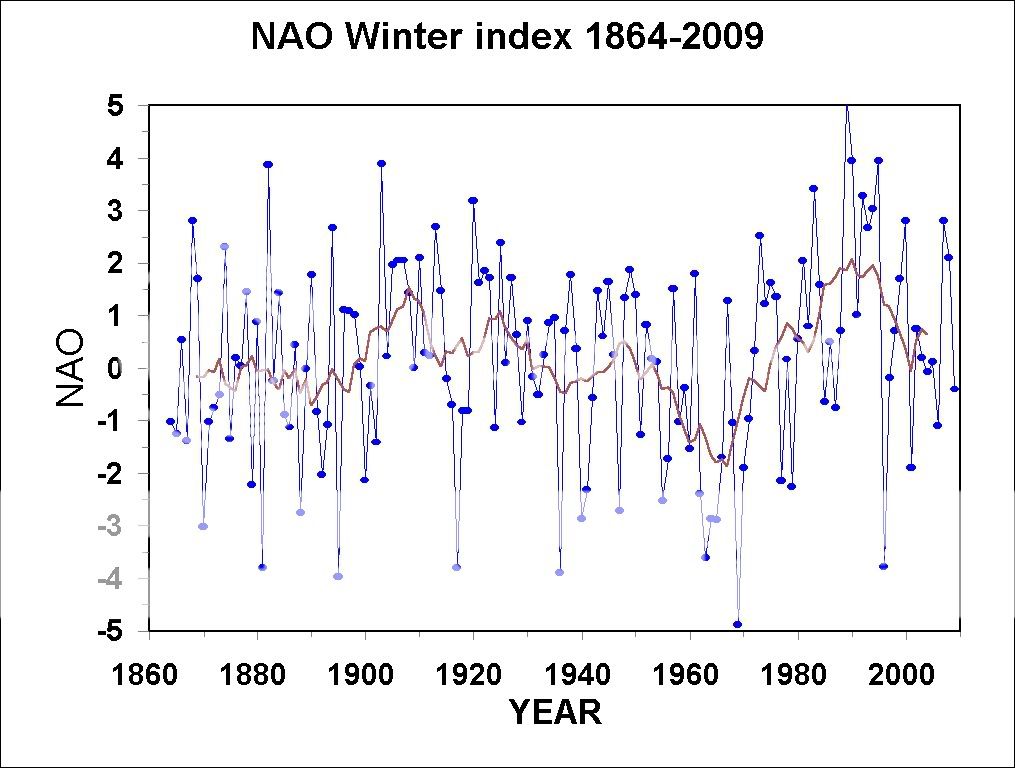
> OK, Here's a graph of the Winter NAO data from Hurrell plotted with a
> curve from the application of an 11 year centered moving average:
>
> http://i454.photobucket.com/albums/qq268/Know_body/NAO_Win1.jpg
>
> And here's a cross plot of the two curves:
>
> http://i454.photobucket.com/albums/qq268/Know_body/NAO_Win2.jpg
>
> The straight line in this second graph is just the NAO curve plotted
> against itself, ie., a 100% correlation.  Notice how poorly the MA
> follows the straight line.  I'll leave it to you to do the correlation
> calculation and explain why you think Tsonis' use of time series so
> filtered is valid.
>
> >...Your claim that these
> > indices are not relevant because of global warming is unreflective
> > nonsense.  Somehow ENSO and the like have no relevance for
> > understanding climate?  Please.
>
> Where did I claim that ENSO had no relevance for understanding
> climate??  My claim was that the technique of Tsonis is not
> predictive.
>
> > You are just being foolish now.
>
> No, I think you are grasping at straws.  Anyway, here's a comment
> regarding ENSO which just appeared.  You can read the paper, if you
> have AGU access.
>
> http://dotearth.blogs.nytimes.com/2010/01/08/a-rebuttal-to-a-cool-cli...
>
> E. S.
> ---
--
You received this message because you are subscribed to the Google Groups
Global Change ("globalchange") newsgroup. Global Change is a public, moderated
venue for discussion of science, technology, economics and policy dimensions of
global environmental change.

Posts will be admitted to the list if and only if any moderator finds the
submission to be constructive and/or interesting, on topic, and not
gratuitously rude.

To post to this group, send email to [email protected]

To unsubscribe from this group, send email to
[email protected]

For more options, visit this group at
http://groups.google.com/group/globalchange