E House wrote:
1530-40 is 5-15 years after my personal cut-off period, but a lot of
what I've learned studying pre-1525 stuff carries over, so hopefully I
can help a little.
<lots of snips>
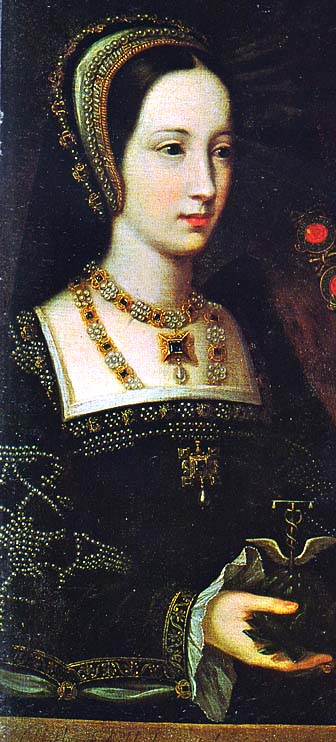
Mary Tudor by unknown (wedding portrait to Charles Brandon), 1515 -
http://www.uvm.edu/~hag/sca/tudor/marytudor.jpg
- What I want to take from this is the french hood, despite the fact
that you don't see many french hoods in portraits until nearly 1540.
Anne Boleyn was already active in court before 1530, and this
portrait was from 1515, so I'm assuming it was definitely there. I
like this shape, as opposed to the transitional angled one I see in
portraits around 1530, like the portraits of the More family or Anne
Cresacre.
This sort of French hood was all over the place in western Europe
starting around 1500; if you study the paintings you can see it
developing from half-circle and tailored veils with a flipped-back
edge, over increasingly decorative coifs. Anne de Bretagne, who seems
to have been the fashion-plate of the continent, wore a dizzying
variety of them, but died about 15 years before your time. However,
they're still worn in the 1530s--a couple of the miniatures of Anne
Boylen of the early-mid 1530s, for example, show her wearing a French
hood. She's credited with popularizing them in England, so as long as
you're planning an outfit from the time after Anne Boylen returned
from France, you're golden; they start popping up all over the place
in England then. (Although Mary and Margaret Tudor wore them long
before AB.) In other words, while the gable hood may have been a
little more popular for a while, the French hood was definitely
fashionable enough to be worn by the rich & noble of the 1530s.
And speaking of French hoods, there was a discussion of them here
recently. You may want to visit the archives and search for it--it
couldn't have been more than a few months ago, and 'french hoods' was
in the title. And since I think I forgot to post about it at the
time: everything I've ever seen supports the idea that the top of the
French hood did NOT stick up like a sun visor worn funny, but rather
laid pretty much flat against the head. Or at least, it only stuck up
in the way that any flat thing wrapped around something vaguely
spherical would.
Thank you. I dimly remember that discussion - I will have to go back
and find it.
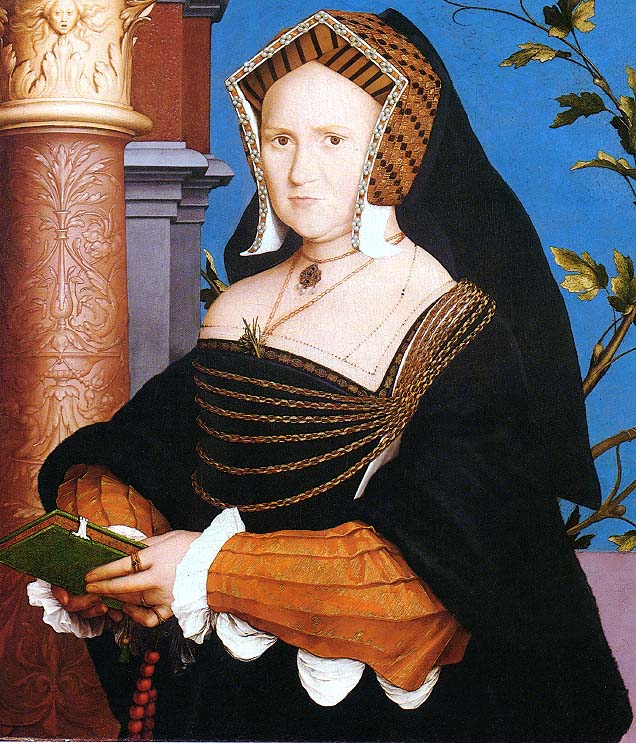
Lady Guildford by Holbein, 1527 -
http://www.uvm.edu/~hag/sca/tudor/guildford.jpg
- I like the fact that she's not a wisp of a woman. I like the look
of the foldback sleeves matching the rest of the gown, even though it
is plain, and I might end up using the idea of using a brocade trim
around the dress in case my time or budget won't accommodate the
jewels. I also like the pleated false sleeves in that iridescent
fabric (especially in that it isn't tapestry). Is that cloth of
gold? It doesn't appear that her gown has a split skirt. I also
like her paternoster (could that be red coral?).
Lucky me--this portrait lives about 45 minutes away, so I got to go
study it. I was very disappointed to find out that the black parts on
the portrait are really, really black--you can see more light/dark
detail on the dress in that picture that you posted than on the
portrait itself. (That doesn't mean that the detail the web image
shows doesn't exist; the detail just stands out clearer in that image
than on the portrait itself.)
The false sleeves didn't look like cloth of gold to me; they were a
plain, non-iridescent copper made out of some sort of ribbed silk,
like faille. The painted detail of the fabric's ribs is what makes it
look iridescent at a distance, and the fabric definitely has that silk
sheen to it. The opening at the bottom of the false sleeve is held
together with self-fabric ties. I couldn't tell what the paternoster
was made of; it looked most to me like painted wood! I couldn't
detect any sign of a split skirt; I couldn't detect any sign of a
waist seam either (which is what I really wanted to learn by studying
it in person) but that could have easily been obscured by the dark
paint or by her arms. The lining of the turned-back sleeves could have
been a dark fur, or velvet--they look too black to be a natural fur
color, but fur was dyed at that period; however, I remember thinking
that they could have been velvet, even though the pile would be longer
than I'd expect of 1527 velvet. That trim at the neckline, by the
way, is almost certainly a trim on either her undergown or her
chemise; notice that the sprig of herbs at her neckline goes between
the dress and the trim. The only other thing I can think of about this
portrait off the top of my head is that the white puffs of fabric
poking through the sleeves look a lot sheerer on the portrait itself
than in any of the web images I've seen of it; they could even be of
the same super-sheer fabric as the edging of the chemise.
Are the sleeves truly ribbed? When I look at it, the ribs just look
like the folds from pleating to me. I'll have to look again when my
eyes aren't so tired.
I'm pretty sure it the rosary was red coral - it's too orangy to be ruby
and red coral was one of the favorite expensive materials. Too bad the
real stuff today is still expensive and I haven't found the substitute
dyed coral in large enough beads yet (especially not as large as hers
are pictured).
So do you think that the turn-back sleeves are a different material
then? I thought it looked the same as her gown fabric, but that's the
problem with black. I've since seen a few more images of turn-back
sleeves matching the overgown, but they're of a later date. I think I'm
going to go ahead and plan to do it that way.
Undergarments:
My first dilemma is whether or not I need a set of bodies and a
farthingale. I've read opinions that say yes you need them and I've
read opinions that say no, you can live with a stiffly lined bodice
and a petticoat(s) and that evidence in wardrobe accounts didn't show
these undergarments until after 1540-1550. If I can avoid the corset
and farthingale with period justification, I would be thrilled, as
this would cut a week off the project. I'm a size 28/30 woman
(depends on the clothing) with only a C cup chest, so breast support
is not something I have a great need for, but I do have a couple of
fat rolls at my sides. Is this an automatic "make a corset"
proposition then? I think my canvas-lined Venetians did very well
for a smooth line when they fit (they're both currently too loose to
provide any support) and I will have two gown layers. Anyone here
have any experiences with plus-sized late period garb and corsets or
the lack thereof?
Studying corsets and their origins is another one of my passions, and
I can tell you with as much certainty as I dare muster about anything
without access to a time machine that they did notnotnot NOT use
corsets at this point. The bodice of the gown (or the undergown, or
both) was stiffened using various techniques, including canvas and
buckram. This is true well into the Elizabethan era, and the 'Tudor
corset' (read: pre-Eliz) as we know it is a complete fallacy! I
haven't looked into the subject of farthingales too much, but 'hoopes
from the wast douneward' were mentioned in England as early as 1519.
However, you can certainly get the look of the portraits without a
farthingale if you use a relatively stiff fabric in your undergown.
Thank you, thank you, thank you for confirming my greatest hope. Now
more about the stiffening - how would I construct this? My Italian
dresses have a layer of canvas on the inside with the fashion fabric on
the outside (no lining). Is this enough, or should I be planning for
more? I think I would prefer canvas because it would be a little easier
to clean when that time comes, I think.
I have my Italian chemise, but the sleeves are very full, so I will
likely have to make a new one. I plan on using Drea Leed's smock
generator, unless I find something better. I've heard something
about the sleeves being off, so I'll have to do a mockup first since
I've never used her generator. There's also a basic low-necked smock
pattern on vertetsable.com, but it doesn't use any gores so I'm not
sure on its authenticity.
I don't know too much about the chemises of this era, but I can tell
you that it's perfectly accurate to have chemises without gores at
this point in time. In fact, looking at the extant chemises in my
image collection, it's rarer to HAVE gores than not. Vertetsable is
generally a pretty reliable, accuracy-minded resource, so if I didn't
have enough time to do the research myself I'd be willing to go with
her pattern.
Really? That's odd. Is there anywhere online with those pictures or
patterns of the chemises? I can only remember one 16th or 17th C
chemise with blackwork offhand in Cut My Cote, which I'm not sure where
it is at the moment. Would the the sleeves of the chemise be poufy or
tapered (I thought vertetsable's was tapered)? At first I thought the
poufs of chemise escaping the false sleeves were fake and their chemise
sleeves were tapered, now I don't, but who knows, maybe they still are -
I've never had a lot of luck with forcing poufs to stay poufed out with
my Italian sleeves.
I'll snip off the rest of the post and quit here, as most of the rest
is about ways and means to get the look. There's just so many ways
and so little known for sure about how they did it!
For images, though, I'll mention some places you probably already know
about, just in case you don't.
The first place I generally look for something:
http://www.wga.hu

Next, the ever-popular bildindex:
http://www.bildindex.de
I'd suggest searching by artist--click kunstler, then at the left type
in part of the artist's last name--or by date. To search by date,
click Suche at the top, then fill in the form as follows: click the
second radio button at the top, then put in your beginning and end
dates for the search. Go to the rightmost-column below that, and find
the blank that's labelled 'ikon. Kontext:'. To the right of the blank
you'll see a little menu icon; click on that and pick one of the
following: geschichte (history; includes tons of portraits) or mensch
(people). Otherwise, you'll get images of tons of buildings and it'll
take forever to weed through them. Finally, press 'Suche starten'; a
list of the number of results for each search parameter will show up,
with a link to 'Galerie' at the very bottom. Click this and you'll
get to see the actual pictures.
And finally, one of my new favorites:
http://www.photo.rmn.fr/
The search utility here isn't anywhere near as good as bildindex's,
but it's got a lot of great paintings. Click 'recherche' at the top
to do a search. The dating info on this website makes it hard to pick
a date range, but if you're patient you'll find some great paintings.
Of course, the paintings are largely French, but you can get some
useful details nonetheless; the French hoods, if nothing else, are
very similar to what was worn in England. I'd suggest doing a search
for Corneille de Lyon (you'll get an option of him or of his atelier;
look at both) as you'll find some great, detailed portraits from
around the right time period.
Hope this helps.

-E House
Thank you so much for the advice and the links. I hope to be able to
consult you later if I have any questions.
--
Elinor Salter
Barony of the Steppes, Ansteorra

_______________________________________________
h-costume mailing list
[email protected]
http://mail.indra.com/mailman/listinfo/h-costume