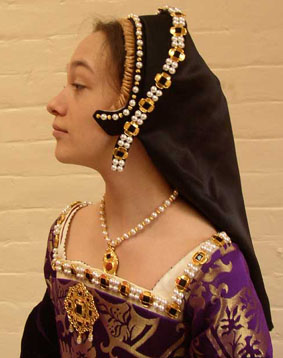
Elizabeth Walpole wrote:
The Fall/veil is shaped like a sleeve because it's attached at the top
of the shaped crescent (this is an interpretation that I support because
all the images I've seen show a band of black at the top edge of the
stiffened crescent and side views like this
http://www.bergercollection.org/artwork_detail.php?i=37 also show the
veil attached at the top of the crescent piece)
I agree that the front edge of the black hood lays just over the back
edge of the crescent, but if you look at Mary I's portrait medal, you'll
see that that edge of the hood is a band, to which is attached a bag
covering the back of the head and a separate flat tongue-shaped fall.
http://www.marileecody.com/mary1medal.jpg
You can see what is probably a similar construction in those hoods that
appear in profile in Jane Malcolm-Davies's useful online effigies
database, for example
http://www.jmdsrv1.dyndns.org/tudoreffigies/browse/view.asp?id=73
http://www.jmdsrv1.dyndns.org/tudoreffigies/browse/view.asp?id=92
and on Antoinette de Fontette, whose effigy is image 436 on page 221 of
my edition of Boucher's _20,000 Years of Fashion_.
The same shape appears in every profile image I have found so far, from
1530 on. In every case, the fall is a flat tube that emerges from the
crown of the head, not a round one whose slanted top circumference
circles the back of the head. Compare the three images linked above to
Mikhaila and Malcolm-Davies's reconstruction at
http://www.kissthefrog.co.uk/images/C16th/Elizhood2005.jpg

Melanie Schuessler


_______________________________________________
h-costume mailing list
[email protected]
http://mail.indra.com/mailman/listinfo/h-costume