On Wednesday 20 August 2003 7:18, Danilo Segan wrote:
> ATM, the best GUI for this (advanced XKB control and management on the
> user side) seems to be GSwitchIt: I believe you can find it at
>    http://gswitchit.sf.net/
>
> (though, it requires at least some parts of a working Gnome 2
> environment)
KDE has a decent one built-in as well. Thought it requires KDE. :)

> > I like the idea. While working on my proposal, I thought that a main
> > keymap per script was the way to go. Have a latin, cyrillic, greek,
> > gujarati base, and change from there (qwerty, azerty, etc.).
>
> At least cyrillic keyboards differ too much for this to work -- eg.
> there are many "phonetic" keyboards (which are similar with english
> ones based on the "sound") and there are completely different ones (a
> standard Russian I believe to be an example of this).

Well, one thing I do know is that I don't know very much about the different
keyboards. :) I have access to three different kinds, but they're all Latin.
Another reason to take these changes incrementally.

> > > The idea is then to combine keyboard type (Apple, Sun, MS, ...) and
> > > language mapping; something like "ng/keyboard(apple)+ng/sv(svorak)"
> > > for a  Swedish Dvorak mapping on an Apple keyboard.
> >
> > I really like the idea. However, I don't think we can move to fast.
> > I'd prefer to do incremental changes towards something like this.
>
> Isn't a "keycodes" directory the right place for "hardware" stuff? This
> should already be the case, unless I'm missing something.

Not really. The keycodes just maps the low-level scan code to an X keycode.
What the X keycode should do is up to the symbols. (Say, an Apple keyboard
only has one alt key, so mapping Mode_switch to Alt_R doesn't work. So map
Mode_switch to another key.)

> > > And no, keymappings are not for countries, they are for languages,
> > > though there may be some country variation, so names like en-US
> > > (which is a RFC 3066 language tag) are quite appropriate.
> >
> > People have been thinking of these mappings as per country, and in
> > some cases it makes more sense than mapping per language. Here in
> > Switzerland, the keyboard is different than the keyboard in Germany,
> > France, and Italy, and the people use it to type German, French, and
> > English. Adding a different keymap to de, fr, and it in order to make
> > the same keymap doen't make much sense (though it should just be an
> > include "de(ch)").
>
> And again, there we see why the approach of having *both* is a good
> idea, with not too much work to do ;-)

Agreed.

> > Also, with the two-letter domain-names, people think that fr is
> > France, not French, then add the flag of France to the keymaps
> > (because flags look good in the GUI). The distinction between
> > languages and countries can be very political.
>
> That's a GUI design issue, not a keymap design issue -- exactly that
> was recently discussed in relevance to GSwitchIt, and there were many
> comments on that side -- because of that, the "default" setting for
> GSwitchIt has changed from displaying flags, to *language* labels (I
> believe they're read from the Name[Group] stuff, though I'm not sure).
>
> All of this was done on Gnome HIG (Human Interface Guidelines) lists,
> where there are many experts in GUI design -- so, your premise is
> incorrect (about the tendency to use flags for the keymaps :-).

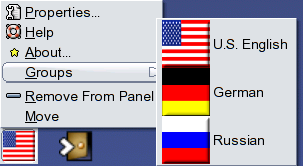
Actually, here's a screenshot from the gswitchit page that shows that they did
in fact use flags for keymaps:

http://gswitchit.sourceforge.net/gsw.applet.png

So, I stand behind by premise that developers tend to use flags for keymaps.
Perhaps with a group to control these tendencies (like the HIG did for
gswitchit) these tendencies can be changed. That's also why I want to be
specific about what these 2-letter codes represent in Xkb.

Frank

_______________________________________________
I18n mailing list
[EMAIL PROTECTED]
http://XFree86.Org/mailman/listinfo/i18n