>From the previous discussions, there seems to be Confusion between Circium
argyracanthum and C. verutum.
Let us have a closer look at its nomenclature:
*FBI from IBIS Flora*:
*Cnicus argyracanthus* (DC.) C.B.Clarke
<https://flora.indianbiodiversity.org/content/cnicus-argyracanthus-dc-cbclarke>
 (Stem cottony, leaves glabrous above cottony or glabrate beneath lobes and
teeth strongly spinescent, radical petioled pinnatifid lobes rounded,
cauline broader cordate amplexicaul, *heads 3/4-1 in. diam, sessile densely
fascicled involucrate, invol. bracts with woolly margins and long strong
erect or spreading spines, innermost linear acuminate, corolla 1/2 in.
white. **Carduus argyracanthus*, Wall. Cat. 2903.
TEMPERATE HIMALAYA, *alt. 6-9000 ft.,* from Murree to Bhutan (excl. Sikkim).
*A more slender plant than C. involucratus, with the leaves always glabrous
above and much more numerous smaller and densely fascicled heads.* Achenes
1/8 in. long ; pappus 1/2 in., nearly white.)

Description above matches with specimens of *C. argyracanthum* (POWO
<https://powo.science.kew.org/taxon/urn:lsid:ipni.org:names:195029-1>)- one
<http://apps.kew.org/herbcat/detailsQuery.do?barcode=K001118167>, two
<http://apps.kew.org/herbcat/detailsQuery.do?barcode=K000250088>

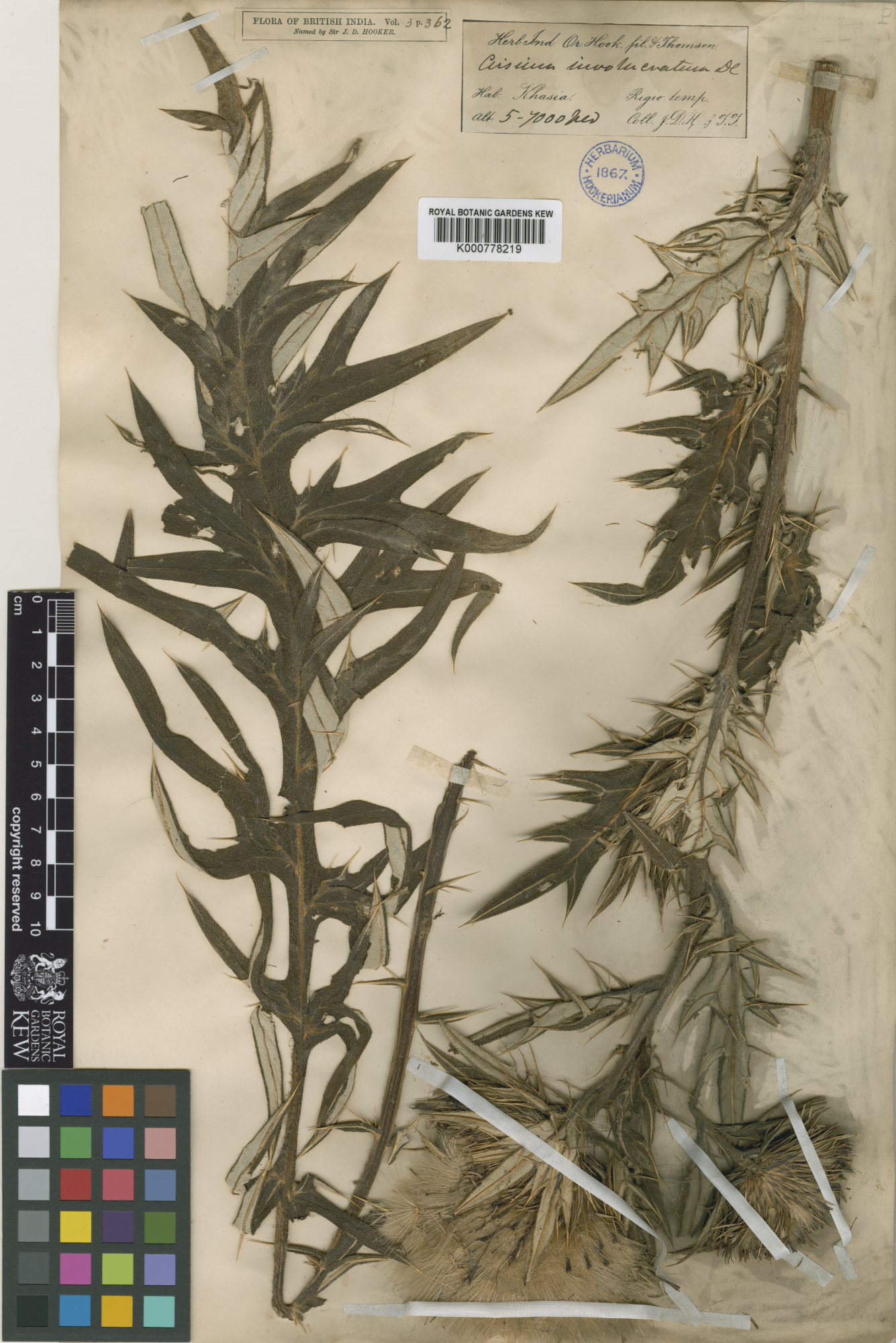
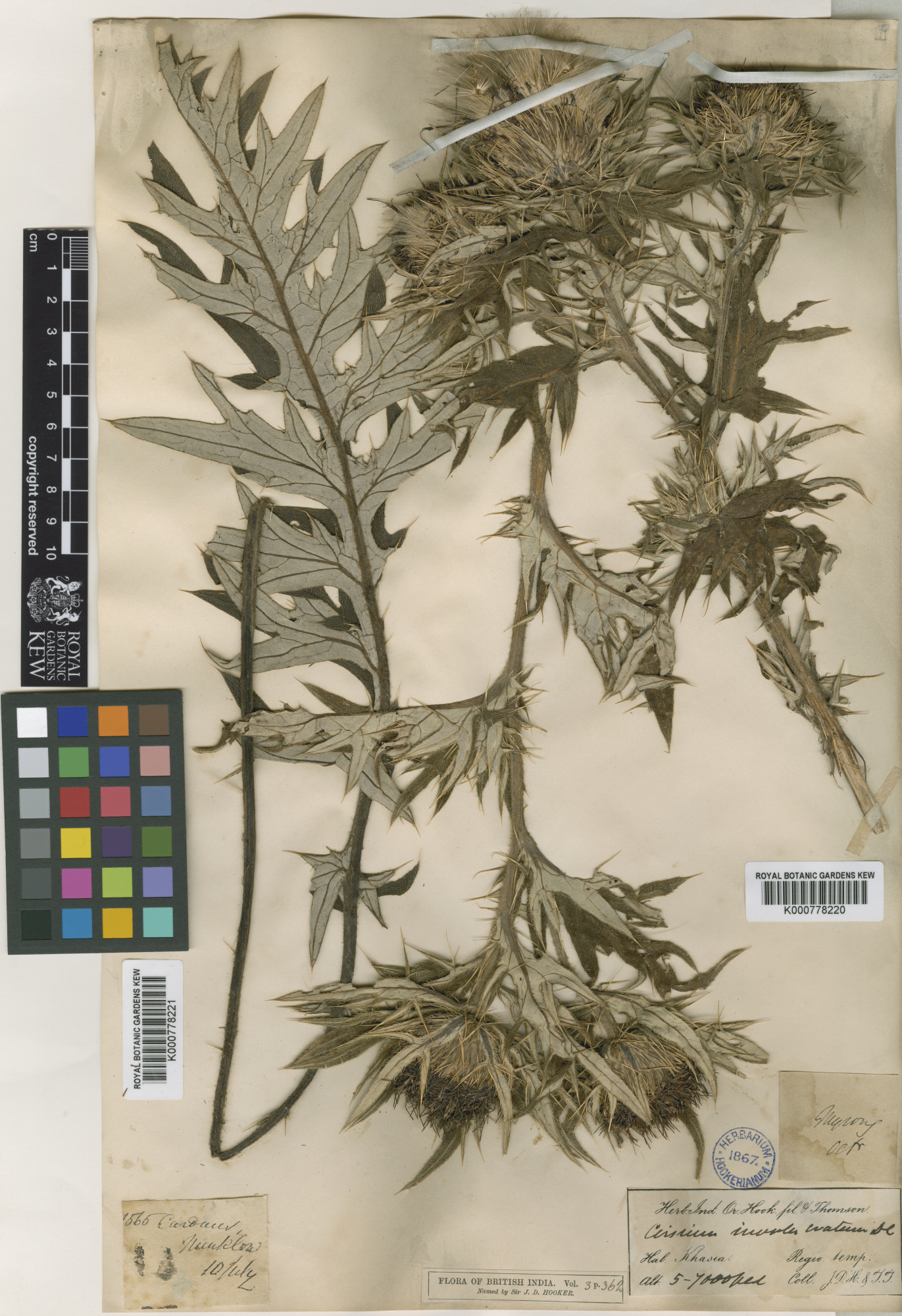
*Cnicus involucratus* Wall. ex DC.
<https://flora.indianbiodiversity.org/content/cnicus-involucratus-wall-ex-dc>
(*T**all, stout, erect,* *leaves setulose above white-tomentose beneath*
teeth and lobes spinescent, radical petioled pinnate, segments lanceolate
sinuate-lobed or toothed, cauline broader cordate-amplexicaul ovate or
lanceolate pinnatifid, *heads 1.1/2-2.1/2 in. diam, solitary or fascicled
involucrate, invol. bracts glabrate all ending in slender erect or
subrecurved spines or a few innermost linear acuminate, corolla 1 in. long.*

TEMPERATE HIMALAYA ; from Kashmir to Bhotan, alt. *8-12,000 ft.*
*Stem as thick below as the little finger, 2-6 ft. high, branched above.
Leaves, radical a foot long, pinnatifid to the middle or deeper, or to the
base with distant lobes.* *Heads inclined ;* corolla glabrous. Achenes 1/5
in. long, obovoid-oblong, margins obtuse ; pappus 2/3 in., brown.—Western
specimens of this have more rigid leaves, spinescent above, and longer
stronger invol. spines than the Sikkim ones have. *De Candolle describes
the corollas as purple, which they appear to be when dry, but they are pale
yellow-white when fresh.* I have gathered in E. Nipal withered specimens of
a plant like this, but with the leaves quite glabrous above and many rows
of inner invol. bracts with soft reflexed flat wrinkled tips. I have also
seen in Sikkim and the Khasia leaves supposed to belong to this species
that are quite glabrous above.)

Description above matches with specimens of *C. verutum* (POWO
<https://powo.science.kew.org/taxon/urn:lsid:ipni.org:names:196173-1>)- one
<http://www.kew.org/herbcatimg/358304.jpg> (C. involucratus of FBI) and two
<http://www.kew.org/herbcatimg/358305.jpg> (C. involucratus of FBI), the
following may be the real C.verutum:
Cirsium sp?? — enroute Dhel at GHNP – PKA30
<https://groups.google.com/forum/#!topic/indiantreepix/D3CMasVd7g8> (12000
ft.)

*Cnicus wallichii* (DC.) C.B.Clarke
<https://flora.indianbiodiversity.org/content/cnicus-wallichii-dc-cbclarke>
 (*DC. Prodr.* vi. 643 (Cirsium) ; stem pubescent leafy, leaves sessile
sinuate-pinnatifid lobes spinescent lobulate spines very long and strong
glabrous above and beneath or cottony or tomentose beneath, *heads
3/4-1.1/2 in. solitary and on naked peduncles or sessile fascicled and
involucrate, outer invol. bracts lanceolate ending in **appressed** erect
or recurved spines, inner with spreading or recurved more or less dilated,
lanceolate or ovate spreading or recurved scarious serrulate acute or
spinescent tips, *corolla 2/3 in. long. *C. carlinoides*, Cass. var. B,
Herb. Ind. Or. H. f. & T.

TEMPERATE HIMALAYA ; from Marri to Bhotan,* alt. 6-12,000 ft. *NILGHERRY
Mts., alt. 6000 ft.
*An extremely variable plant, 4-10 ft. high, with spreading branches, which
passes into C. argyracanthus through var. Wightiana in the Eastern
Himalayas and the Nilgherries.* The following varieties pass into one
another in the most perplexing way. *Corolla white, yellow or red
(according to Clarke)*.)

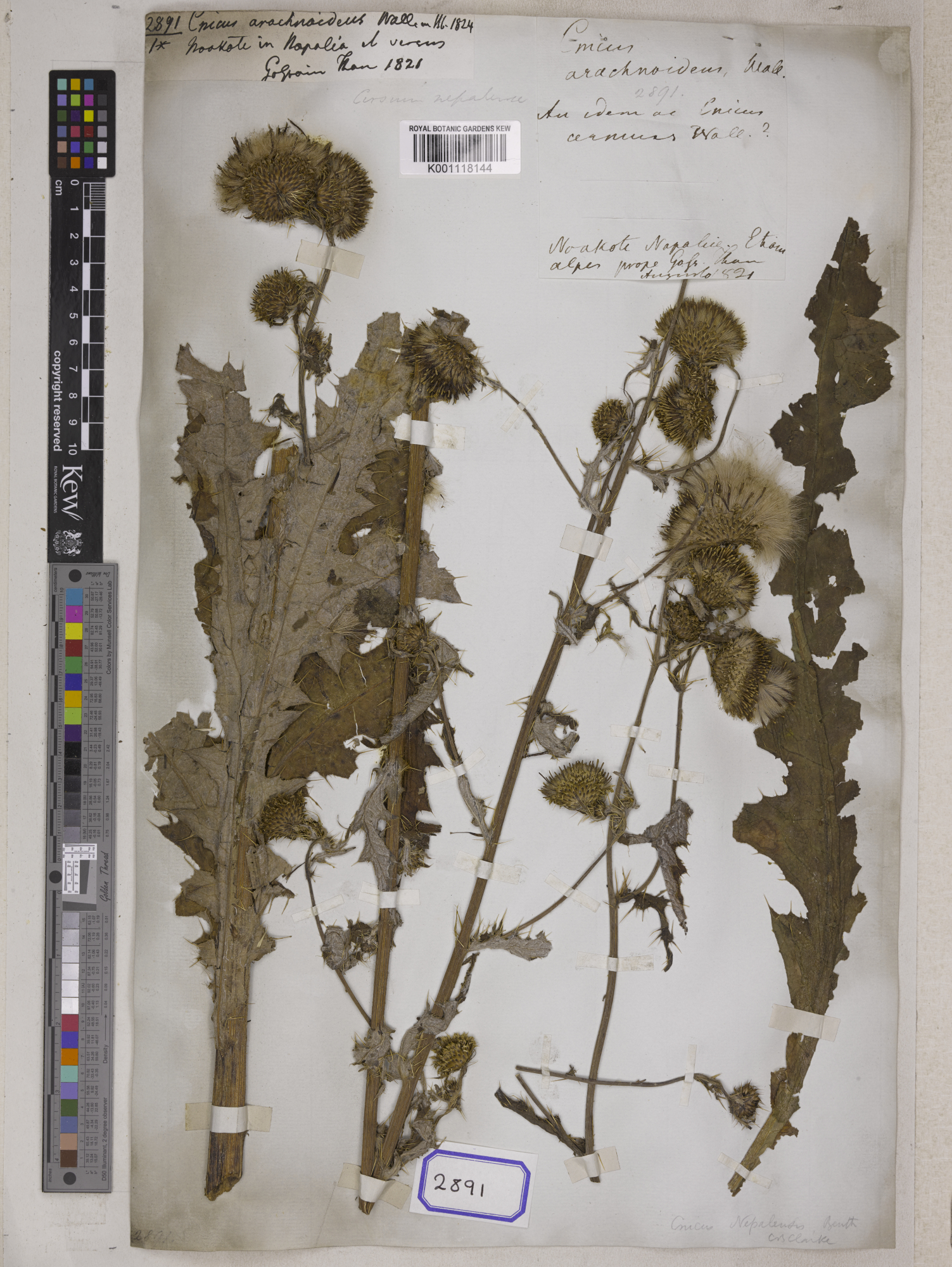
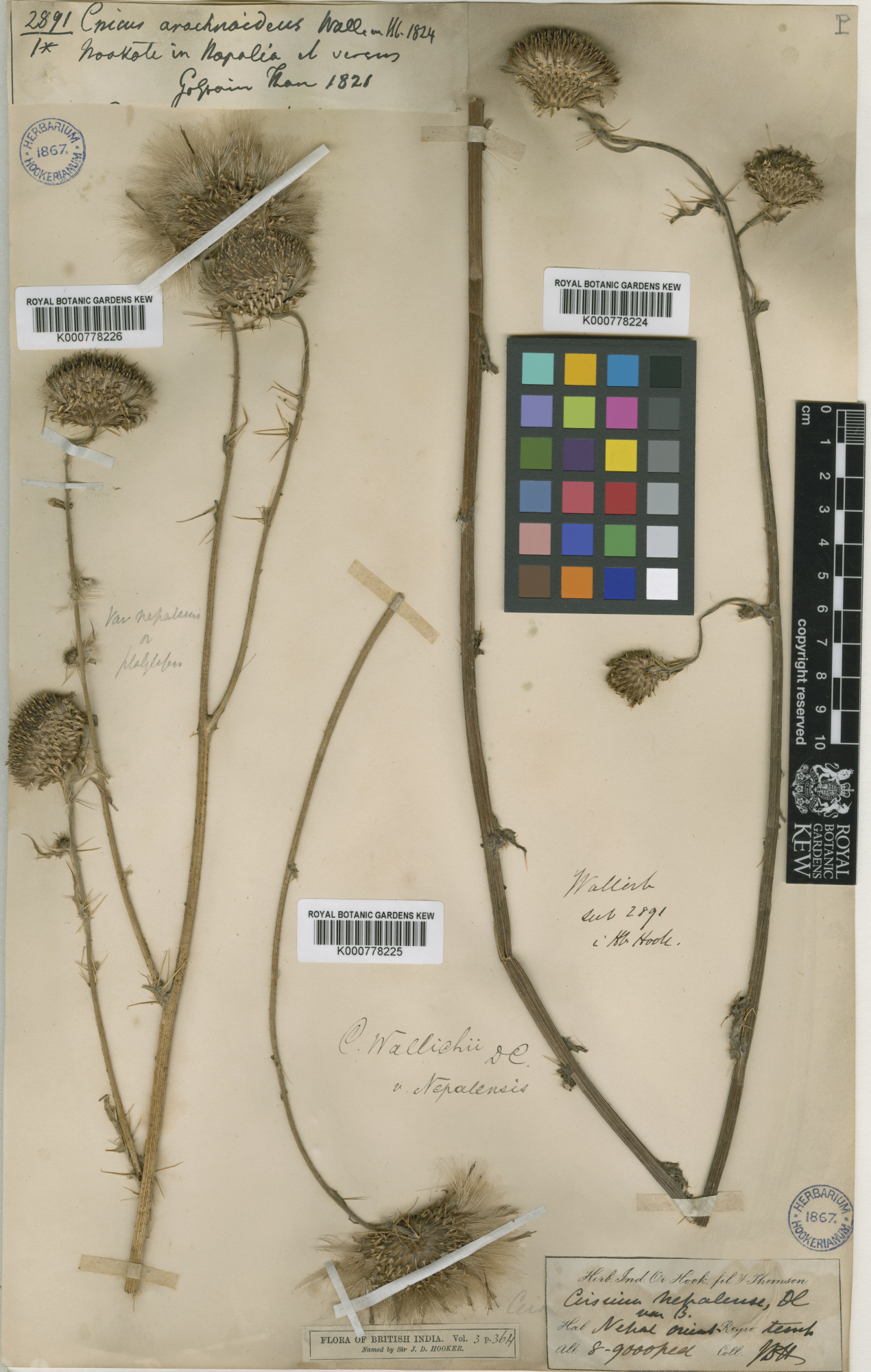
*Cnicus wallichii* var. *nepalensis* (DC.) Hook.f.
<https://flora.indianbiodiversity.org/content/cnicus-wallichii-var-nepalensis-dc-hookf>
(leaves
white-tomentose beneath,*heads peduncled, inner invol. tracts with broadly
dilated scarious reflexed tips in many series more numerous than the outer
spiniferous ones, sometimes occupying two thirds of the head.* Cnicus
arachnoides, Wall. Cat. 2891. C. Wallichii, Clarke Comp. Ind. 219. Cirsium
nepalense, DC. Prodr. vi. 642.)

GBIF <https://www.gbif.org/species/3112711> specimen- one
<https://www.gbif.org/tools/zoom/simple.html?src=//api.gbif.org/v1/image/unsafe/http%3A%2F%2Fn2t.net%2Fark%3A%2F65665%2Fm34ab4cae5-1062-421c-a2d1-c9563688e6cf>
(*Cnicus wallichii *(DC.) C.B.Clarke), POWO
<https://powo.science.kew.org/taxon/urn:lsid:ipni.org:names:196195-1>
specimen- one <http://www.kew.org/herbcatimg/684782.jpg> (Cnicus
arachnoides Wall.) and two <http://www.kew.org/herbcatimg/359206.jpg> (*Cnicus
wallichii* var. *nepalensis* (DC.) Hook.f.
<https://flora.indianbiodiversity.org/content/cnicus-wallichii-var-nepalensis-dc-hookf>
)

*Flora of China*:
*Cirsium verutum
<http://www.efloras.org/florataxon.aspx?flora_id=2&taxon_id=200023700>* (D.
Don) Sprengel
<http://www.efloras.org/florataxon.aspx?flora_id=2&taxon_id=200023700>
syn: *Cnicus
verutus* D. Don, Prodr. Fl. Nepal. 167. 1825; *Cirsium involucratum* Candolle,
nom. illeg. superfl. (2900-3900 m.)
*Cirsium argyracanthum
<http://www.efloras.org/florataxon.aspx?flora_id=2&taxon_id=242313045>*
 Candolle
<http://www.efloras.org/florataxon.aspx?flora_id=2&taxon_id=242313045>
syn: *Cirsium
tibeticum* Kitamura; *Cnicus argyracanthus* (Candolle) C. B. Clarke (2100-3700
m.)

Annotated checklist of the flowering plants of Nepal
<http://www.efloras.org/florataxon.aspx?flora_id=110&taxon_id=242313045>
(*Cirsium
verutum* (D. Don) Spreng. with *Cirsium* *argyracanthum* DC.
<http://www.efloras.org/florataxon.aspx?flora_id=110&taxon_id=242313045>,
*Cirsium* *involucratum* DC.
<http://www.efloras.org/florataxon.aspx?flora_id=110&taxon_id=242313091>,
*Cnicus* *argyracanthus* (DC.) C. B. Clarke
<http://www.efloras.org/florataxon.aspx?flora_id=110&taxon_id=242421458> as
syn.) (750-2200 m)


>From the above analysis, I feel most our specimens from lower elevation may
be of *Cnicus argyracanthus* (DC.) C.B.Clarke
<https://flora.indianbiodiversity.org/content/cnicus-argyracanthus-dc-cbclarke>

Hi, Singh ji,
If you agree with my analysis above, I will resurface old threads at Cirsium
verutum <https://efloraofindia.com/2011/02/15/cirsium-verutum/> with
correct identification.
--
With regards,
J.M.Garg

--
You received this message because you are subscribed to the Google Groups
"efloraofindia" group.
To unsubscribe from this group and stop receiving emails from it, send an email
to [email protected].
To view this discussion on the web, visit
https://groups.google.com/d/msgid/indiantreepix/CA%2BiuSFC386wNrrxLBdGa27Nbt6ZMyG7p%2BKk%2BFELRKGV%2B0p%3D%3DRg%40mail.gmail.com.