Garg ji while comparing please keep Cirsium vulgare in mind. Although not
listed in BSI Flora or FBI, the species is a weed naturalised
in many parts of the world including India and Pakistan. The heads resemble
C. verutum but leaves are narrower and not white beneath, involucre bracts
although green like V. verutum, much more narrower and sharply pointed. and
spreading.
Dr. Gurcharan Singh
Retired  Associate Professor
SGTB Khalsa College, University of Delhi, Delhi-110007
Res: 932 Anand Kunj, Vikas Puri, New Delhi-110018.
https://www.gurcharanfamily.com/


On Mon, Jan 3, 2022 at 2:02 PM J.M. Garg <[email protected]> wrote:

> From the previous discussions, there seems to be Confusion between Circium
> argyracanthum and C. verutum.
> Let us have a closer look at its nomenclature:
>
> *FBI from IBIS Flora*:
> *Cnicus argyracanthus* (DC.) C.B.Clarke
> <https://flora.indianbiodiversity.org/content/cnicus-argyracanthus-dc-cbclarke>
>  (Stem cottony, leaves glabrous above cottony or glabrate beneath lobes
> and teeth strongly spinescent, radical petioled pinnatifid lobes rounded,
> cauline broader cordate amplexicaul, *heads 3/4-1 in. diam, sessile
> densely fascicled involucrate, invol. bracts with woolly margins and long
> strong erect or spreading spines, innermost linear acuminate, corolla 1/2
> in. white. **Carduus argyracanthus*, Wall. Cat. 2903.
> TEMPERATE HIMALAYA, *alt. 6-9000 ft.,* from Murree to Bhutan (excl.
> Sikkim).
> *A more slender plant than C. involucratus, with the leaves always
> glabrous above and much more numerous smaller and densely fascicled heads.*
> Achenes 1/8 in. long ; pappus 1/2 in., nearly white.)
>
> Description above matches with specimens of *C. argyracanthum* (POWO
> <https://powo.science.kew.org/taxon/urn:lsid:ipni.org:names:195029-1>)-
> one <http://apps.kew.org/herbcat/detailsQuery.do?barcode=K001118167>, two
> <http://apps.kew.org/herbcat/detailsQuery.do?barcode=K000250088>
>
> *Cnicus involucratus* Wall. ex DC.
> <https://flora.indianbiodiversity.org/content/cnicus-involucratus-wall-ex-dc>
> (*T**all, stout, erect,* *leaves setulose above white-tomentose beneath*
> teeth and lobes spinescent, radical petioled pinnate, segments lanceolate
> sinuate-lobed or toothed, cauline broader cordate-amplexicaul ovate or
> lanceolate pinnatifid, *heads 1.1/2-2.1/2 in. diam, solitary or fascicled
> involucrate, invol. bracts glabrate all ending in slender erect or
> subrecurved spines or a few innermost linear acuminate, corolla 1 in. long.*
>
> TEMPERATE HIMALAYA ; from Kashmir to Bhotan, alt. *8-12,000 ft.*
> *Stem as thick below as the little finger, 2-6 ft. high, branched above.
> Leaves, radical a foot long, pinnatifid to the middle or deeper, or to the
> base with distant lobes.* *Heads inclined ;* corolla glabrous. Achenes
> 1/5 in. long, obovoid-oblong, margins obtuse ; pappus 2/3 in.,
> brown.—Western specimens of this have more rigid leaves, spinescent above,
> and longer stronger invol. spines than the Sikkim ones have. *De Candolle
> describes the corollas as purple, which they appear to be when dry, but
> they are pale yellow-white when fresh.* I have gathered in E. Nipal
> withered specimens of a plant like this, but with the leaves quite glabrous
> above and many rows of inner invol. bracts with soft reflexed flat wrinkled
> tips. I have also seen in Sikkim and the Khasia leaves supposed to belong
> to this species that are quite glabrous above.)
>
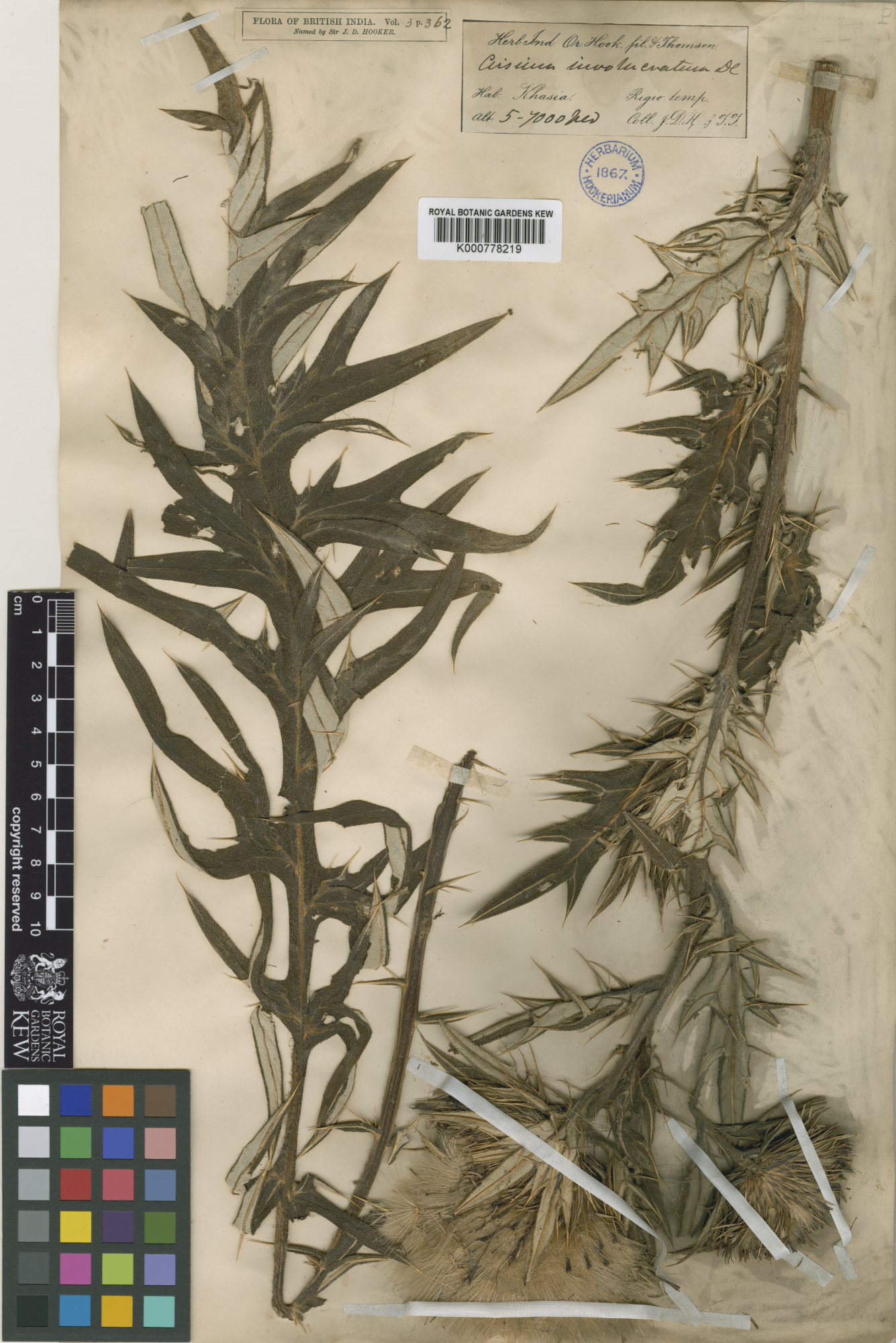
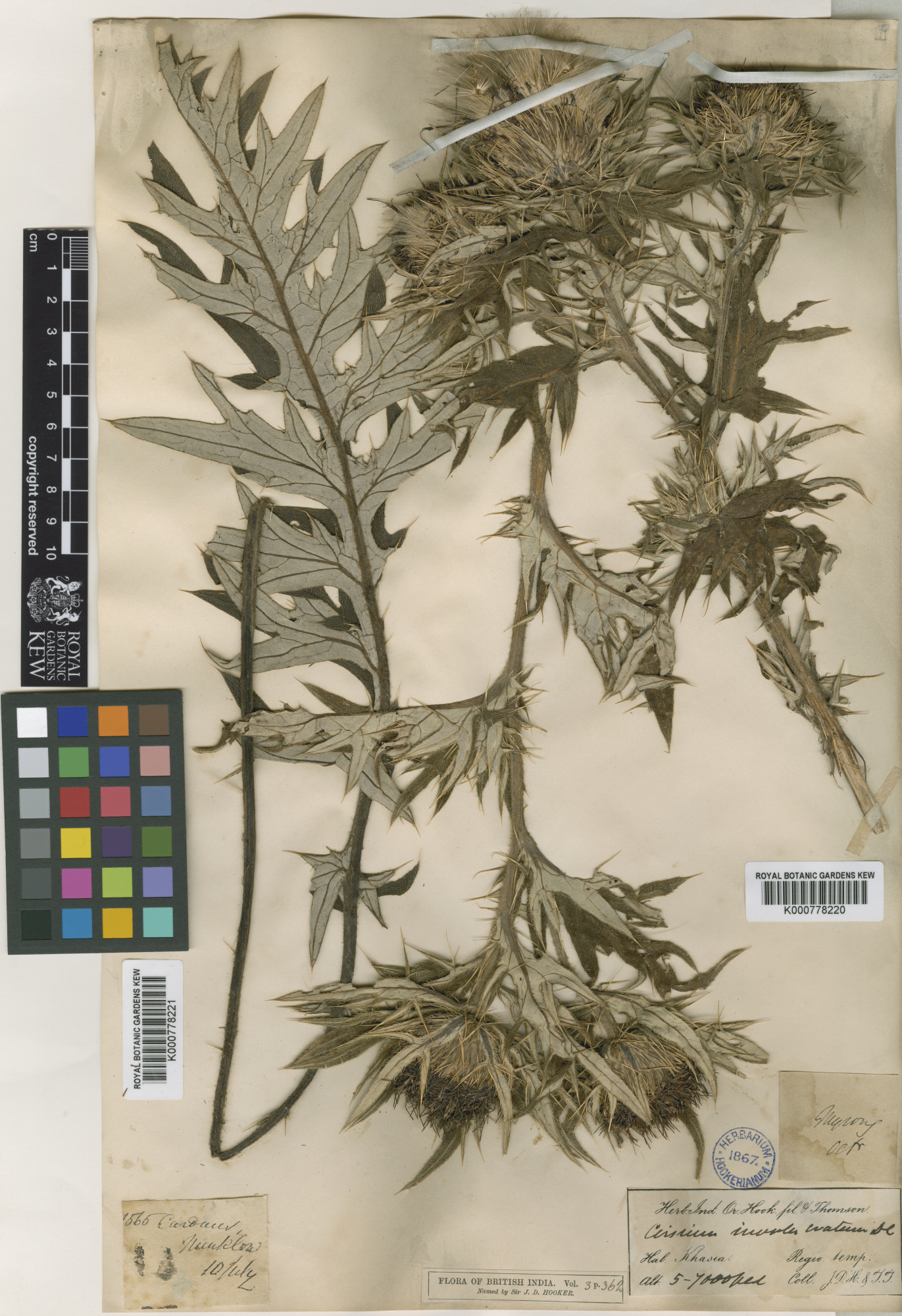
> Description above matches with specimens of *C. verutum* (POWO
> <https://powo.science.kew.org/taxon/urn:lsid:ipni.org:names:196173-1>)-
> one <http://www.kew.org/herbcatimg/358304.jpg> (C. involucratus of FBI)
> and two <http://www.kew.org/herbcatimg/358305.jpg> (C. involucratus of
> FBI), the following may be the real C.verutum:
> Cirsium sp?? — enroute Dhel at GHNP – PKA30
> <https://groups.google.com/forum/#!topic/indiantreepix/D3CMasVd7g8> (12000
> ft.)
>
> *Cnicus wallichii* (DC.) C.B.Clarke
> <https://flora.indianbiodiversity.org/content/cnicus-wallichii-dc-cbclarke>
>  (*DC. Prodr.* vi. 643 (Cirsium) ; stem pubescent leafy, leaves sessile
> sinuate-pinnatifid lobes spinescent lobulate spines very long and strong
> glabrous above and beneath or cottony or tomentose beneath, *heads
> 3/4-1.1/2 in. solitary and on naked peduncles or sessile fascicled and
> involucrate, outer invol. bracts lanceolate ending in **appressed** erect
> or recurved spines, inner with spreading or recurved more or less dilated,
> lanceolate or ovate spreading or recurved scarious serrulate acute or
> spinescent tips, *corolla 2/3 in. long. *C. carlinoides*, Cass. var. B,
> Herb. Ind. Or. H. f. & T.
>
> TEMPERATE HIMALAYA ; from Marri to Bhotan,* alt. 6-12,000 ft. *NILGHERRY
> Mts., alt. 6000 ft.
> *An extremely variable plant, 4-10 ft. high, with spreading branches,
> which passes into C. argyracanthus through var. Wightiana in the Eastern
> Himalayas and the Nilgherries.* The following varieties pass into one
> another in the most perplexing way. *Corolla white, yellow or red
> (according to Clarke)*.)
>
> *Cnicus wallichii* var. *nepalensis* (DC.) Hook.f.
> <https://flora.indianbiodiversity.org/content/cnicus-wallichii-var-nepalensis-dc-hookf>
>  (leaves
> white-tomentose beneath,*heads peduncled, inner invol. tracts with
> broadly dilated scarious reflexed tips in many series more numerous than
> the outer spiniferous ones, sometimes occupying two thirds of the head.*
> Cnicus arachnoides, Wall. Cat. 2891. C. Wallichii, Clarke Comp. Ind. 219.
> Cirsium nepalense, DC. Prodr. vi. 642.)
>
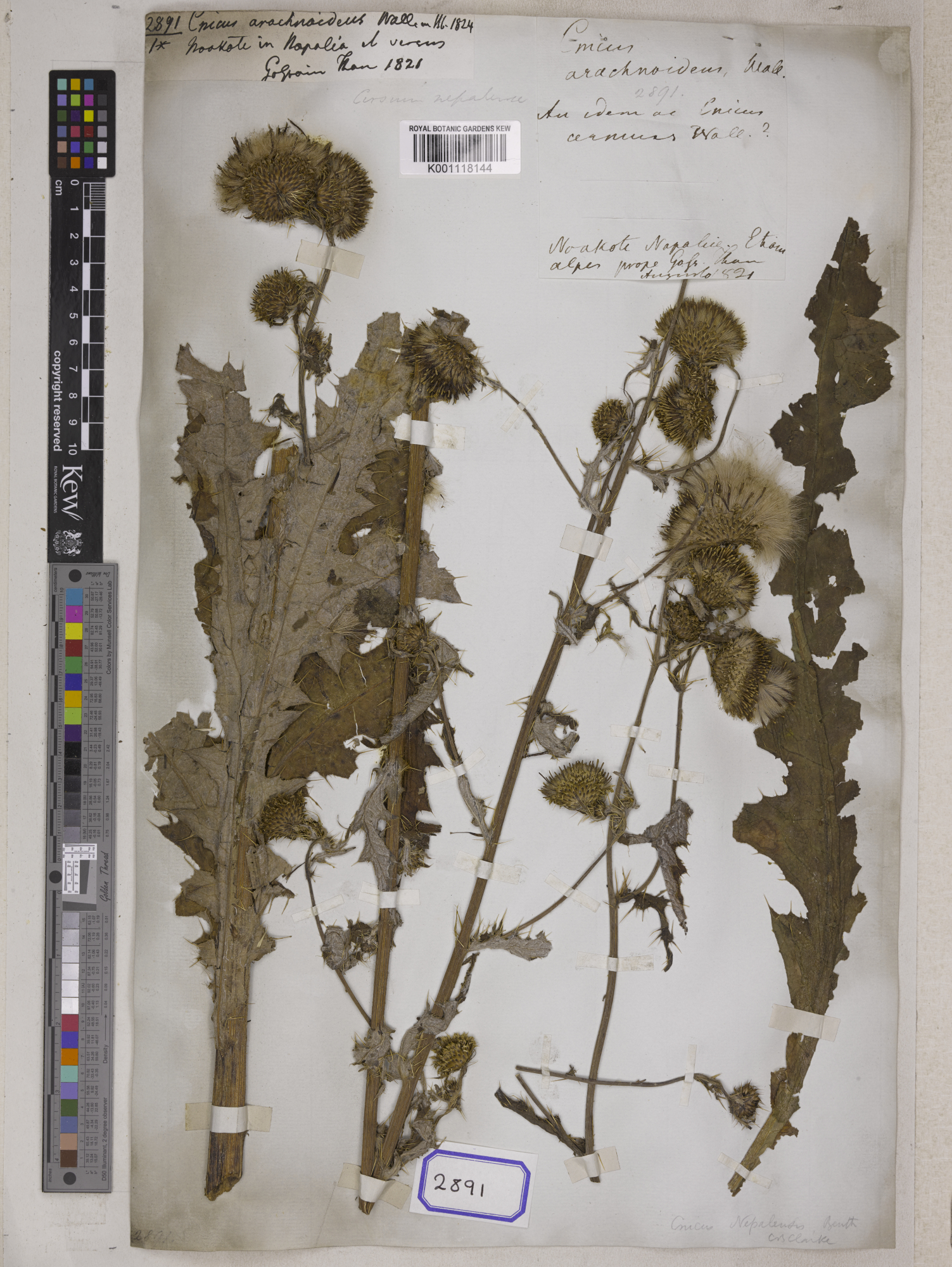
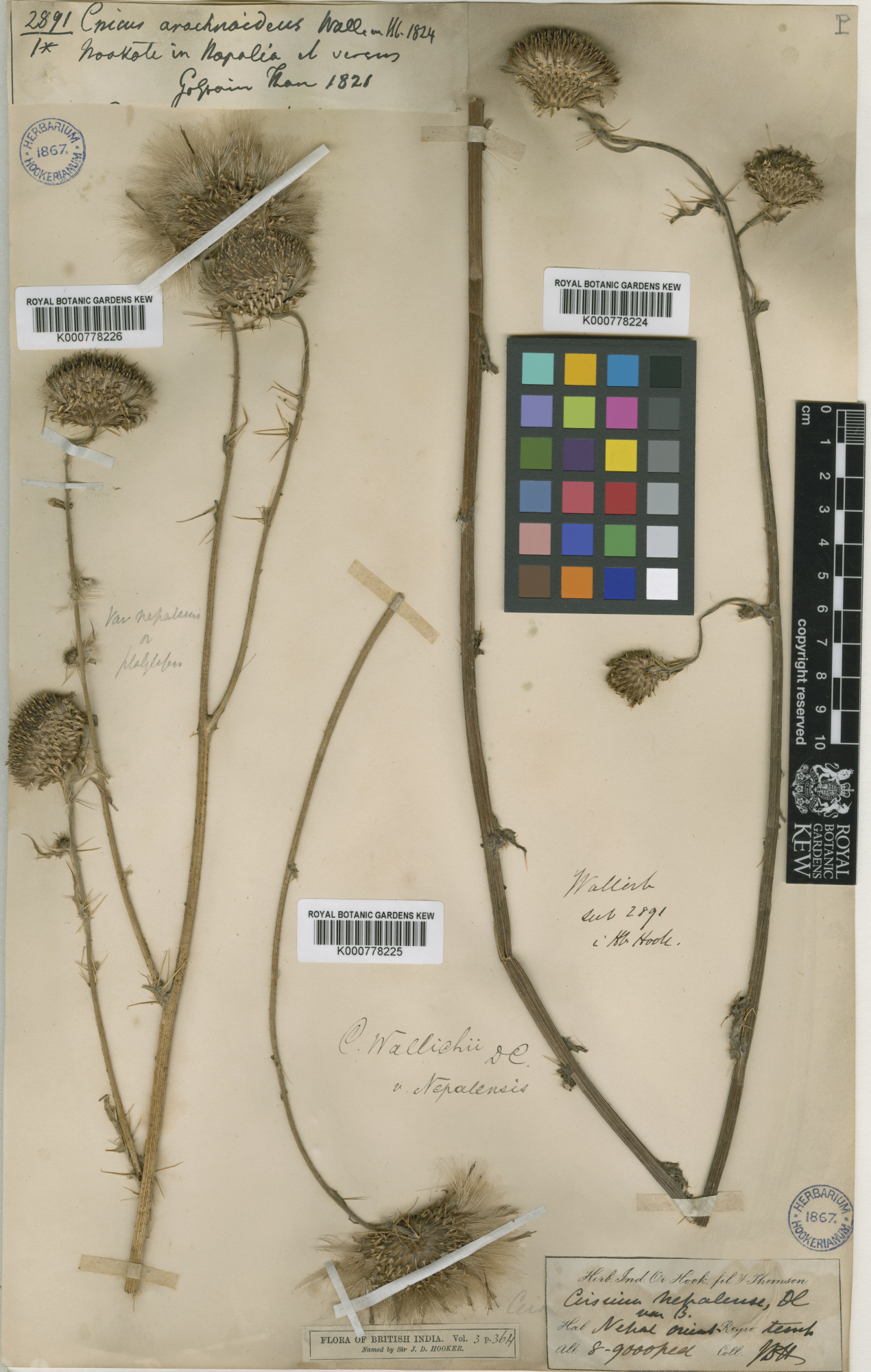
> GBIF <https://www.gbif.org/species/3112711> specimen- one
> <https://www.gbif.org/tools/zoom/simple.html?src=//api.gbif.org/v1/image/unsafe/http%3A%2F%2Fn2t.net%2Fark%3A%2F65665%2Fm34ab4cae5-1062-421c-a2d1-c9563688e6cf>
> (*Cnicus wallichii *(DC.) C.B.Clarke), POWO
> <https://powo.science.kew.org/taxon/urn:lsid:ipni.org:names:196195-1>
> specimen- one <http://www.kew.org/herbcatimg/684782.jpg> (Cnicus
> arachnoides Wall.) and two <http://www.kew.org/herbcatimg/359206.jpg> (*Cnicus
> wallichii* var. *nepalensis* (DC.) Hook.f.
> <https://flora.indianbiodiversity.org/content/cnicus-wallichii-var-nepalensis-dc-hookf>
> )
>
> *Flora of China*:
> *Cirsium verutum
> <http://www.efloras.org/florataxon.aspx?flora_id=2&taxon_id=200023700>* (D.
> Don) Sprengel
> <http://www.efloras.org/florataxon.aspx?flora_id=2&taxon_id=200023700>
> syn: *Cnicus verutus* D. Don, Prodr. Fl. Nepal. 167. 1825; *Cirsium
> involucratum* Candolle, nom. illeg. superfl. (2900-3900 m.)
> *Cirsium argyracanthum
> <http://www.efloras.org/florataxon.aspx?flora_id=2&taxon_id=242313045>*
>  Candolle
> <http://www.efloras.org/florataxon.aspx?flora_id=2&taxon_id=242313045>
> syn: *Cirsium tibeticum* Kitamura; *Cnicus argyracanthus* (Candolle) C.
> B. Clarke (2100-3700 m.)
>
> Annotated checklist of the flowering plants of Nepal
> <http://www.efloras.org/florataxon.aspx?flora_id=110&taxon_id=242313045>
> (*Cirsium
> verutum* (D. Don) Spreng. with *Cirsium* *argyracanthum* DC.
> <http://www.efloras.org/florataxon.aspx?flora_id=110&taxon_id=242313045>,
> *Cirsium* *involucratum* DC.
> <http://www.efloras.org/florataxon.aspx?flora_id=110&taxon_id=242313091>,
> *Cnicus* *argyracanthus* (DC.) C. B. Clarke
> <http://www.efloras.org/florataxon.aspx?flora_id=110&taxon_id=242421458> as
> syn.) (750-2200 m)
>
>
> From the above analysis, I feel most our specimens from lower elevation
> may be of *Cnicus argyracanthus* (DC.) C.B.Clarke
> <https://flora.indianbiodiversity.org/content/cnicus-argyracanthus-dc-cbclarke>
>
> Hi, Singh ji,
> If you agree with my analysis above, I will resurface old threads at Cirsium
> verutum <https://efloraofindia.com/2011/02/15/cirsium-verutum/> with
> correct identification.
> --
> With regards,
> J.M.Garg
>

--
You received this message because you are subscribed to the Google Groups
"efloraofindia" group.
To unsubscribe from this group and stop receiving emails from it, send an email
to [email protected].
To view this discussion on the web, visit
https://groups.google.com/d/msgid/indiantreepix/CAHiXKpX%3DP9Q3mqpeFJaLU8poJ0xiHPgaGy82y5WAT5TZEEkTwg%40mail.gmail.com.