"Glew, Andy" wrote:

> > It would be better to compare like for like.
> > Why do you compare a distributed filesystem with the local filesystem?
>
> Because that's the comparison that matters to business.
>
> E.g. I have the option of putting the source code that I compile
> on either a local disk, or a networked disk of any stripe.
> Networked diskspace has advantages, but they are not enough
> to make up for the 4-16x decrease in performance that I measure.

Andy,

Have you tried using a RAM (eg memory) cache  instead of disk cache
on your AFS client?

I have. It is way faster than a disk cache.

I used a machine with 1GB of RAM and configured a 256 MB AFS RAM cache.
With this, I first "primed" the cache to load all the code into the
RAM cache (eg: tar cf - /afs/@cell/$my_C_code_dir > /dev/null).
Then, I compiled this suite of C code. (very quickly! ;-)

I suggest to you that AFS RAM cache will beat local filespace
in terms of speed of access (once the files are in the cache).

> But AFS's lousy performance relative to NFS and local disk
> means that AFS's advantages do not outweigh the loss of performance.

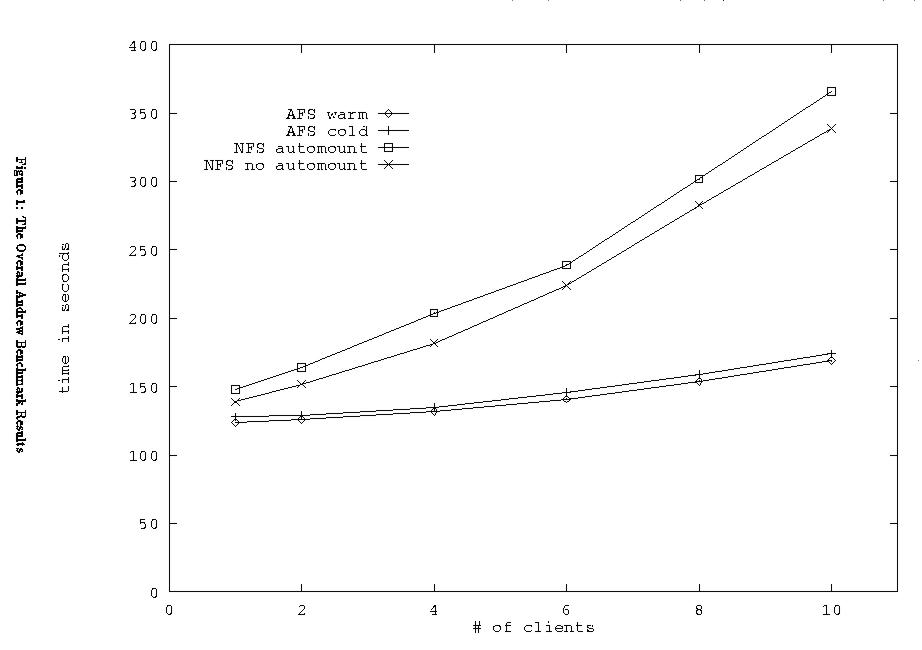
Erm...squeeze me? Have you looked at the results of the
Andrew Benchmark [1] comparison [2] between AFS and NFS?
Take a look at the performance graph [3].

AFS has the key advantages of scalability and better security than NFS.
--
cheers
paul                         http://acm.org/~mpb

References:
[1] Andrew Benchmark
     http://www.angelfire.com/hi/plutonic/afs-faq.html#sub3.18

[2] Comparison of AFS and NFS
     http://www.angelfire.com/hi/plutonic/afs-faq.html#sub1.11

[3] Andrew Benchmark results graph of AFS versus NFS
     http://www.angelfire.com/hi/plutonic/images/andrew1.jpg