Sorry, I see the message was not in simple text, so here it is again:

Dear Martyn
        I do agree that a heavy guitar strap could not be historic, and most
probably the wider Ahumada strap which is deliberately made to be seen (as well
as to give maximum support), would not be either. It would seem from the
iconography that the elegance of a lute invisibly suspended (as you say) by a
strand of gut, seems rather to have been the tendency, when they weren't simply
plonked on a table.
Both these systems appear to be depicted in this   laurent_de_la_hyre painting,
which has been shown on our list quite frequently before.

http://tinyurl.com/conmfc
The gut loop, coming from the back of the lute is clearly shown on the lute on
the table:
as tried by  yourself,
"I first tried with a gut loop fastend onto my overcoat buttin (as a rough
simulation of
    heavy 17th surcoat)  but found it horribly unstable. "  Martyn

I had hoped this historic system, would be very stable, with the lute suspended
from an ideal point on its back; indeed I was thinking of giving it a try, and
if it was compatible with my shoulder problem, I would have happily adopted it.


The solution of stabilizing the lute on a table, as frequently mentionned here,
http://www.mail-archive.com/[email protected]/msg16231.html
is also shown in this painting, but whether by this period, it was just for
tuning, or in this case, for maintaining a pose for the artist, I have no idea.
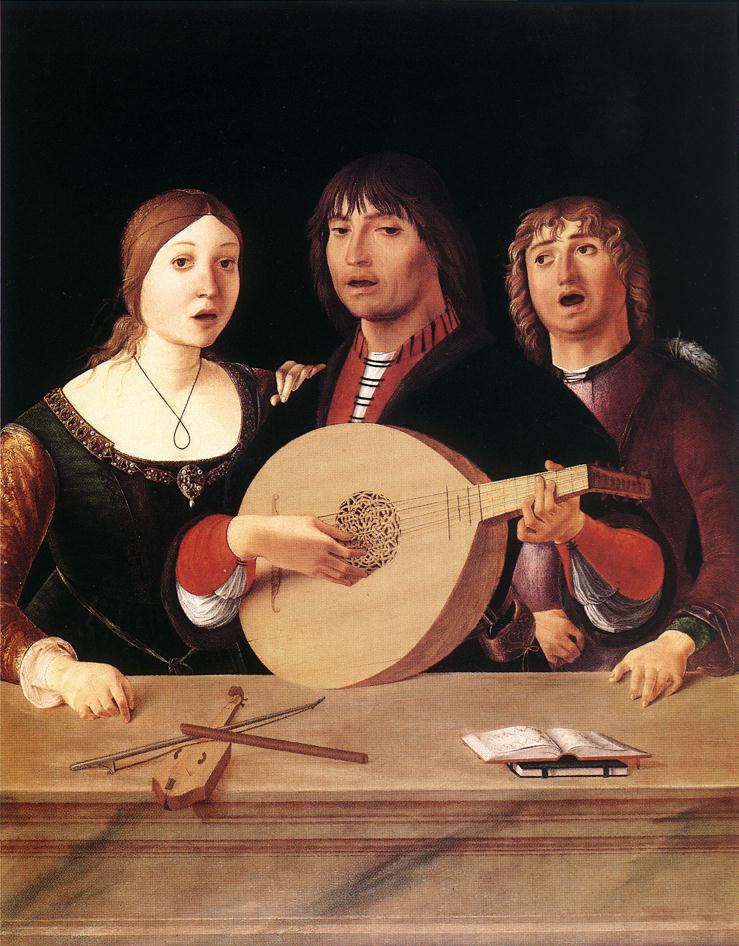
It clearly was a historic playing solution in the Renaissance period, see
Robinson, and the iconography:
http://www.wga.hu/art/c/costa/lorenzo/concert.jpg

Carlos Gonzales, lute maker, tells me he is developing such a lute table, which
both serves to stabilize as well as to "amplify" the lute, but the problem of
space and transport does not make that a practical solution for all.

I think many of us would adopt a historical solution, if it gave the desired
stability and was not too impractical. Perhaps, the solution you  suggest with
"a  long tape looped round the back and crossed at the front" could indeed give
this desired stabilty. Unfortunately. I could not see the  engraving you sent
us, which seems to have been filtered-out, but could it be similar to this
interesting system shown here, in this painting by Pietro Paolini: CONCERT DE
MUSICIENS ET DE          CHANTEURS, around 1625:
http://www.er.uqam.ca/nobel/r14310/Luth/Iconographie/Joconde/PaoliniPietro.jpg
Could this also be similar to the solution that Sean has adopted?
I tried to make a quick mock-up of this, but was not very successful.

    Nevertheless, I am wondering how far we should feel we have to go along
this

historic route. It would be "nice" to use a historic strap system, but is it
crucial to reentering the sound world of the period? Historicity, per se, might
be questioned by some.


David v O in a recent Lute News gives excellent arguments for using gut strings
as they bring us closer to the microdynamics available to earlier lute-player
composers.


In order to find similar arguments in favour of adopting historic strap
solutions, should we not have to show that the modern solution prevents us in
some way (or is at least not conducive) to reconstructing the composer's sound
world?

If this is not the case, then we may still want to adopt it, just to look or
feel the part, but it would not be crucial.

I do think that some quite invisible modern aids may effect the dynamics  of
the

lute. The rubber carpet underlay used by many to stabilize  their lutes, I
feel,

dampens the lute's sound. At least, that  is how it seems to me, so I stopped
using it.

However, I don't think that the wideness of a modern strap, would  effect the
sound; although I do think that the lute's angle (due  to the strap's set-up)
could effect the sound produced  through its effect on the RH angle of attack,
and this  therefore could be of historic concern.


I have to admit that in adopting my present  set-up, I sacrificed almost every
thing to resolving my soulder problem, which I feared could bring my  lute
playing to a hault.
I needed to be able to quickly alter the  strap length to shift the
"sweet-spot"

so as to avoid developing pain (thus the guitar strap). I  also needed to keep
my left hand as close as possible to my body, so as  to minimze the leverage
force on the shoulder capsule.

I have found  the least painful position is an almost theorbo style (rather
like

that of  Nigel North). This does not seem to be a style used by  French
lutenists  (judging by the iconography, although it IS similar to that shown on
the Pietro Paolini painting), and this unfortunately, will be effecting  my RH
position and angle of attack, and so presumably the sound.

But  my lute may also be judged to have a rather too long string length  (70cm)
for French music; and perhaps with a 67cm lute, I could manage a  more
horizontal (and historically correct) lute position.


Thus,  I am not proning these solutions for all, just trying to resolve  my own
shoulder handicap, with the lute I have at present.

Although, I did chose a red strap over the black equivalent, as it went better
with the red loaded basses, and somehow looked a little more the part than the
regular black one.

"We discussed using ribbons or tapes fastened to an end botton and a
   neck button to hold lutes fairly recently (2009 in fact). The problem
   mentioned then was that the set-up was pretty unstable  (a sort of
   rotary effect was  even mentioned) and certainly I found it so. And so
   I'm interested that you're persisting with this - how did you overcome
   the problems?" Martyn

I  would say, that a wider strap, if not historic, does seem to help  stabilize
the lute, and I wanted as rigid a lute set-up as possible.

I  found that, with this strap tied to both lute buttons, if I tilt the  table
of my lute slightly upwards, then there is less tendency for it to  roll, (or
to

rock, in spite of what the strap type might suggest ...).  The 4th and 5th ribs
from the top (of my 11 rib lute) seem to settle  into my stomach shape (but
that

could depend on one's shape). Although, I  have my strap quite long, and not
tight, I can stand and play with the  lute remaining quite stable.
Furthermore, I get better feedback from the instrument, which has been a help
to

my playing.
I am not sure this lute angle is historic, although again it is not far from
that depicted by Paolini.

Regards
Anthony


________________________________
De : Martyn Hodgson <[email protected]>
À : Anthony Hind <[email protected]>
Cc : [email protected]
Envoyé le : Ven 11 mars 2011, 15h 15min 11s
Objet : [LUTE] Ribbons to hold (baroque) lutes WAS Re: Strap slips off left
shoulder.


    Dear Anthony,

   We discussed using ribbons or tapes fastened to an end botton and a
   neck button to hold lutes fairly  recently (2009 in fact). The problem
   mentioned then was that the set-up was pretty unstable  (a sort of
   rotary effect was  even mentioned) and certainly I found it so. And so
   I'm interested that you're persisting with this - how did you overcome
   the problems?

   I think I know how the early players did since there is one rather good
   illustration of tapes/ribbons coming from waistcoat buttons (or perhaps
   round the players back and coming from the button holes) fastened to
   the two buttons. This greatly increases the stability of the
   arrangement since these are pretty firmly fixed.There is an engraving
   which seems to show this and I'm attaching it again.  It is, to my
   knowledge, the ONLY representation showing such an attachment to a
   button on the top block and thus a unique examplar of what must, if the
   number of lutes with such buttons are an indication, have been common
   practice from (mid?) 17thC on. Certainly few paintings show a strap  (as
   used with theorbos and the like) being used for lute and some (eg
   Mouton) seem to have them suspended in mid air almost (tho' perhaps
   they might have suggested straps not  being shown....)

   I've tried it and the system with a long tape looped round the back and
   crossed at the front provides the required stabilty. I first tried with
   a gut loop fastend onto my overcoat buttin (as a rough simulation of
   heavy 17th surcoat)  but found it horribly unstable. Any other ideas?

   rgds

   Martyn

   PS  I think the heavy wide rock guitar straps are a diversion from
   historical practice - surely if such massive straps were ever used
   they'd be seen on almost all the representations of people playing
   lutes? Ribbons/tapes are much more discrete and, not being over the
   shoulder, do not really  show at all - hence, presumably, why not seen
   in iconography

   --- On Fri, 11/3/11, Anthony Hind <[email protected]> wrote:

     From: Anthony Hind <[email protected]>
     Subject: [LUTE] Re: Strap slips off left shoulder.
     To: "Sean Smith" <[email protected]>, "Herbert Ward"
     <[email protected]>
     Cc: [email protected]
     Date: Friday, 11 March, 2011, 10:36

      On my Baroque  lute, I attach both ends to the lute bowl, although
   the
      button at the front end occasionally pops out!
      I am using a red suede leather terminated guitar strap, but as the
      strap tends to slip off the shoulder, I have sown rubber undercarpet
      material  to the underside of the strap (the same material as many
      people use on their lap).
      I have turned the strap over to show this, here:
      [1][1]http://tinyurl.com/67qfg6x
      It may seem inelegant, but it doesn't show when playing.
      The only problem is that this material , with prolonged contact, can
      take the varnish off the lute (or mark it, as did happen to me), so
      another  solution could  be to use a thick velvet, similar to that
   used
      on this lute strap, by Jose Antonio Ahumada:
      [2][2]http://tinyurl.com/4g27r7d
      Indeed, I would use this strap type, as it grips on to the shoulder
      very well, except that you can't control the strap length quite so
      well.
      The grip is even better if you can have the strap tight, but that
   means
      holding your lute high on the chest. As Benjamin Narvey is doing
   here:
      [3][3]http://tinyurl.com/4wbw8d8
      I used to do this, as I could then either stand or sit, but having
   had
      a frozen shoulder  (adhesive capsulitisis), I now have to  hold my
   lute
      as low as possible, so as to put minimum strain on the shoulder
   area.
      Regards
      Anthony
        __________________________________________________________________
      De : Sean Smith <[4][email protected]>
      A : [5][email protected]
      Envoye le : Jeu 10 mars 2011, 19h 20min 18s
      Objet : [LUTE] Re: Strap slips off left shoulder.
      Thanks, Roman, but this shouldn't be taken as an illustration of
   what I
      meant. I'm sorry that I don't have the means to throw it up on  the
   web
      at the  moment.
      Think stabilizing triangle from strap-end to pegbox.
      s
      On Mar 10, 2011, at 9:58 AM, Roman Turovsky
   <[4][6][email protected]>
      wrote:
      > I've made a little chart of how to tie the strap to prevent
      rolling/slipping:
      > [5][7]http://torban.org/images/strap.jpg
      > RT'
      >
      >
      >
      >
      >
      > ----- Original Message ----- From: "Sean Smith"
      <[6][8][email protected]>
      > To: <[7][9][email protected]>
      > Sent: Thursday, March 10, 2011 12:43 PM
      > Subject: [LUTE] Re: Strap slips off left shoulder.
      >
      >
      >> Tie the strap off at the butt end of lute in the usual way. Where
      the strap ends over the left shoulder attach a long loop of string
   (I
      like  a dark shoelace). Let one end run over the peg at the nut end
   of
      the  pegbox and the other at the tip (or wherever you like
   considering
      all  those  pegs to choose from). Make a few loops around varius pegs
   on
       the  far side to finetune the length and to keep it from traveling.
      >>
      >> I've done this for years. I can stand or sit and expect zero lute
      rotation. It also keeps my shoulders 'square' and non slumpy which
   may
      help your slippage problem.
      >>
      >>
      >> Sean
      >>
      >> On Mar 9, 2011, at 7:20 PM, Herbert Ward
      <[8][10][email protected]> wrote:
      >>
      >>>
      >>> In playing my 13-course, the strap is constantly on the verge
       >>> of slipping  backwards off my left shoulder.  To a lesser extent
      >>> this happens with my Renaissance lute also.  Any suggeestions
      >>> besides safety-pinning the strap to my shirt?
      >>>
      >>>
      >>>
      >>> To get on or off this list see list information at
      >>> [9][11]http://www.cs.dartmouth.edu/~wbc/lute-admin/index.html
      >>
      >>
      >
      >
      --
   References
      1. [12]http://tinyurl.com/67qfg6x
       2. [13]http://tinyurl.com/4g27r7d
      3. [14]http://tinyurl.com/4wbw8d8
      4. mailto:[15][email protected]
      5. [16]http://torban.org/images/strap.jpg
      6. mailto:[17][email protected]
      7. mailto:[18][email protected]
      8. mailto:[19][email protected]
      9. [20]http://www.cs.dartmouth.edu/%7Ewbc/lute-admin/index.html

   --

References

   1. http://tinyurl.com/67qfg6x
   2. http://tinyurl.com/4g27r7d
   3. http://tinyurl.com/4wbw8d8
   4. http://uk.mc263.mail.yahoo.com/mc/[email protected]
   5. http://uk.mc263.mail.yahoo.com/mc/[email protected]
   6. http://uk.mc263.mail.yahoo.com/mc/[email protected]
   7. http://torban.org/images/strap.jpg
   8. http://uk.mc263.mail.yahoo.com/mc/[email protected]
   9. http://uk.mc263.mail.yahoo.com/mc/[email protected]
  10. http://uk.mc263.mail.yahoo.com/mc/[email protected]
  11. http://www.cs.dartmouth.edu/~wbc/lute-admin/index.html
  12. http://tinyurl.com/67qfg6x
  13. http://tinyurl.com/4g27r7d
  14. http://tinyurl.com/4wbw8d8
  15. http://uk.mc263.mail.yahoo.com/mc/[email protected]
  16. http://torban.org/images/strap.jpg
  17. http://uk.mc263.mail.yahoo.com/mc/[email protected]
  18. http://uk.mc263.mail.yahoo.com/mc/[email protected]
  19. http://uk.mc263.mail.yahoo.com/mc/[email protected]
  20. http://www.cs.dartmouth.edu/~wbc/lute-admin/index.html