As I continue to study this stuff, I have more questions...Thanks to all
for your patience and generosity in answering them...
In terms of the capacitors, is there a type you recommend if I am going to
go the capacitive reactance route to step down the AC?  Besides using a
non-polarized one, is there any material that is preferable to others?  If
so, any particular recommendations from online sources?

I also wanted to revisit the use of the MAX628 to get AC from DC for the
filaments that was offered as a suggestion earlier in this thread.  I know
I originally asked for a non microcontroller based approach, but I am open
to that or the use of a 555 or a PIC/ATMega.

I looked over the Kosbo circuit diagram and the datasheet.  I gather I feed
a square wave into pins 2&4 of the MAX628 and connect 5&7 to the filament?
 This is all still pretty new to me, and although I know what a square wave
is, especially after playing around with CMOS and 555 based noisemakers,
could someone spell out in detail how I would use the MAX628 with let's say
a 5V DC input and either a PIC/Arduino or 555 to get AC out?

Best,
Dylan

>
> > I am also pretty unfamiliar with capacitive reactance but did some
> googling after your reply.  I will do some continued follow up, but if you
> have a second to look at this attachment, is the idea here the same concept
> as the section related to the capacitive transformerless PS?
> http://www.electro-tech-online.com/custompdfs/2004/09/00954A.pdf   I
> realize I am using a transformer, but I figured the step down concept was
> the same.
>
> Yeah, it's essentially the same idea.  Luckily, for VFD filament supply,
> you have a constant load and don't need regulator circuitry, just a fixed
> drop.
>
> Let's assume we have a 24V transformer, and a VFD that has a filament that
> takes 1.5 volts at 150mA.  What size capacitor would we need?  The first
> step is to figure out what value to use if it was a resistance.  It would
> need to drop 22.5 volts (24 - 1.5) at 150mA.  Ohm's law says R=E/I.  Note
> that I do all my calculations in basic units (volts, amps, ohms, farads)
> and apply milli- and kilo- and so forth later.  So 150mA is 0.15A.  Back to
> R=E/I, that's 22.5 volts divided by 0.15 amperes, for 150 ohms.  Now to
> calculate a capacitor that would have 150 ohms of reactance.  The formula
> for capacitive reactance is X = 1/(2 pi f C).  Rearranging to solve for C,
> I get C = 1 ( 2 pi f X).  As I live in the United States, f is 60.  So I
> need 1 / (2 x 3.14 x 60 x 150) or 0.000 017 7 farads, which is 17.7
> microfarads.
>
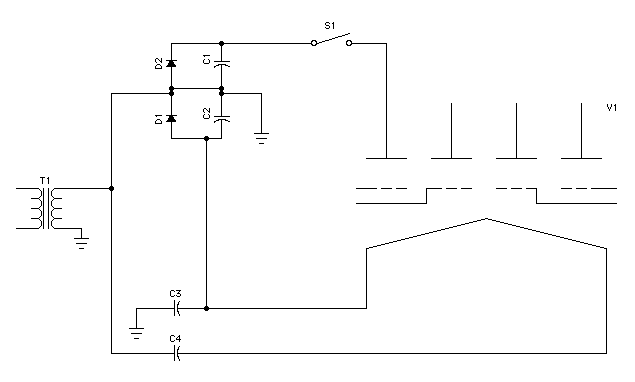
> My original idea was to make a symmetrical circuit, with the filament
> completely DC isolated from the transformer:
>
> http://www.vitriol.com/images/tech/vfdps1.gif
>
> I've deliberately ignored most of the details of the VFD drive, as this is
> just a power supply illustration.
>
> Note that in this case, two capacitors are used, effectively in series, so
> they would each need to be half the reactance, which is twice the
> capacitance, or about 35 microfarads apiece.  Then I realized I didn't
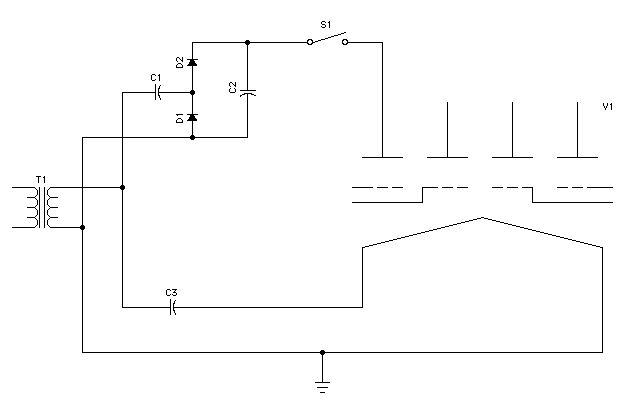
> really need to isolate the filament, I could just decide that one side of
> the transformer winding is "ground", and reference my grid/anode supply to
> that:
>
> http://www.vitriol.com/images/tech/vfdps2.gif
>
> This uses one 18 microfarad capacitor instead of two 35 microfarad ones,
> which is nice.  I used a different version of the voltage doubler for the
> anode/grid supply too, but this seems like it ought to work.
>
> Note that you'd probably want a third supply to power the logic, there are
> a few different ways to address that (more if your transformer offers a
> center tap).
>
> - John
>
> --
> You received this message because you are subscribed to the Google Groups
> "neonixie-l" group.
> To post to this group, send an email to [email protected].
> To unsubscribe from this group, send email to
> [email protected].
> For more options, visit this group at
> http://groups.google.com/group/neonixie-l?hl=en-GB.
>
>

--
You received this message because you are subscribed to the Google Groups
"neonixie-l" group.
To post to this group, send an email to [email protected].
To unsubscribe from this group, send email to
[email protected].
For more options, visit this group at
http://groups.google.com/group/neonixie-l?hl=en-GB.