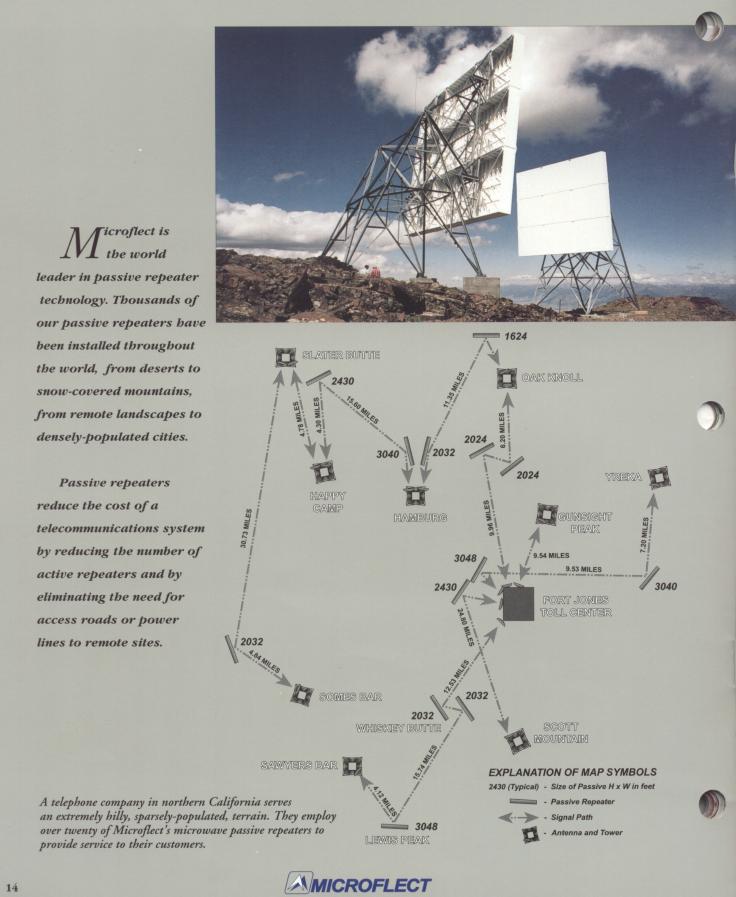
Well... it depends. (Depends on what, you ask...)

It depends on the distance - the total distance from one radio
to the passive repeater and then to the other radio.
Briefly put:
a) The good news - A passive repeater can help you fill in or extend
coverage
to an area that has a blocked line-of-sight path. This could be helpful
say, in
NYC where you need coverage around a corner, for example.
b) The bad news - The signal loss with a passive repeater is very high.
With low power license-free 802.11b equipment (unlike licensed microwave
equipment) we can't just increase the power to make up for the passive
repeater
losses. Unless the total end-to-end distance is very short, the passive
repeater losses
mean that not enough signal will reach the far end.
In conclusion, if you do decide to experiment with a passive repeater, I'd
suggest
using not a single flat plane (like in your embedded link) but a pair of
high-gain 2.4 GHz
antennas connected back-to-back with a short length of low-loss coax.

If you need more help calculating the actual amount of signal that will
make it
to the far end (the link budget), get hold of me off-line.

jack


evilbunny wrote:

> Hello ptp,
>
>   passive repeaters anyone?
>
>   http://www.qsl.net/n9zia/pics/passive_repeater.jpg
>
> --
> Best regards,
>  evilbunny                          mailto:[EMAIL PROTECTED]
>
> http://www.NodeDB.com/NodeDB/sslinfo.php - Free Security Certificates

--
Jack Unger ([EMAIL PROTECTED])
President - Wireless InfoNet, Inc. (818) 227-4220
The first and only vendor-neutral Wireless ISP workshop.
http://www.ask-wi.com/2002workshops.html


--
NYCwireless - http://www.nycwireless.net/
Un/Subscribe: http://lists.nycwireless.net/mailman/listinfo/nycwireless/
Archives: http://lists.nycwireless.net/pipermail/nycwireless/