Hello evilbunny,

Passive repeaters do get the creative juices going. If we had more 802.11b power
to work with we could have more fun with them.
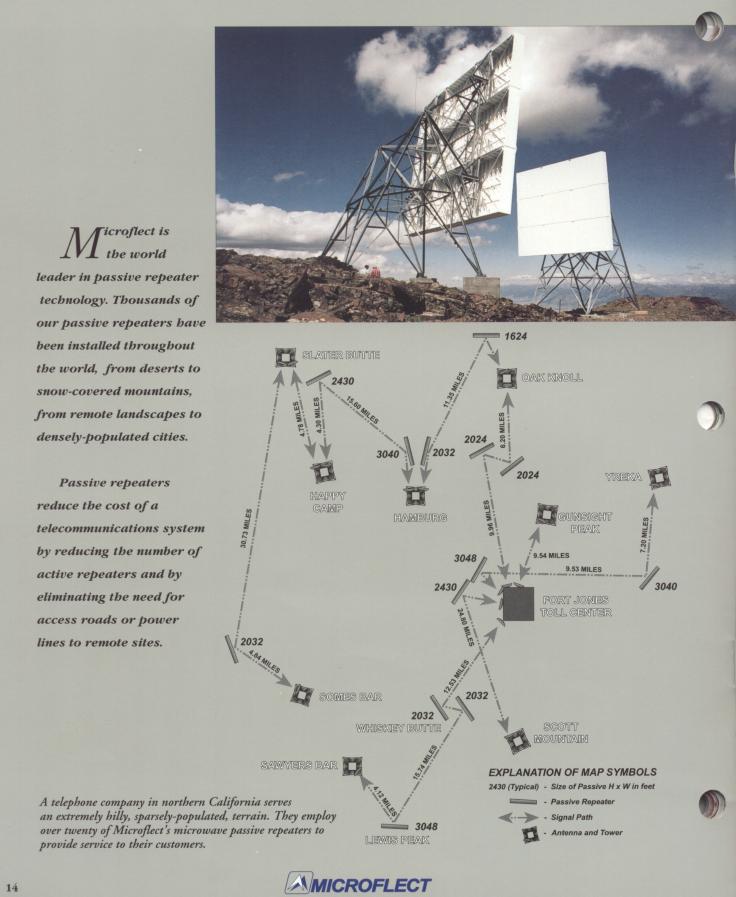
For those who might wish to put an image with the "periscope antenna" name, here's
a link to a periscope antenna drawing.
http://exadios.d2.net.au/Wireless/Antennas/periscope.html

We can see these in the U.S. along some railroad lines. They're the towers with a
flat reflector at the top that is
angled at 45 degrees.

BTW, I looked at your www.sidneywireless.com website. All I can say is "very, very
nice".

jack


evilbunny wrote:

> Hello Jack,
>
> Passive repeaters have been done to death on other lists I'm on, some
> of the guys even giving very in depth reasons into why they won't work
> and what cringly said was a load... in any case I just thought it was
> interesting...
>
> The only time it might work, and for those of you worried about
> lightning etc, I saw a passive repeater (flat surface too) used in a
> periscope design, it served to increase height while decreasing cable
> runs...
>
> and there was one other design, the top was basically a cone and
> turned a directional signal into omni...
>
> --
> Best regards,
>  evilbunny                            mailto:[EMAIL PROTECTED]
>
> http://www.SydneyWireless.com - Exercise your communications
> freedom to make it do what you never thought possible...
>
> Saturday, September 21, 2002, 4:45:03 AM, you wrote:
>
> JU> Well... it depends. (Depends on what, you ask...)
>
> JU> It depends on the distance - the total distance from one radio
> JU> to the passive repeater and then to the other radio.
> JU> Briefly put:
> JU> a) The good news - A passive repeater can help you fill in or extend
> JU> coverage
> JU> to an area that has a blocked line-of-sight path. This could be helpful
> JU> say, in
> JU> NYC where you need coverage around a corner, for example.
> JU> b) The bad news - The signal loss with a passive repeater is very high.
> JU> With low power license-free 802.11b equipment (unlike licensed microwave
> JU> equipment) we can't just increase the power to make up for the passive
> JU> repeater
> JU> losses. Unless the total end-to-end distance is very short, the passive
> JU> repeater losses
> JU> mean that not enough signal will reach the far end.
>
> JU> In conclusion, if you do decide to experiment with a passive repeater, I'd
> JU> suggest
> JU> using not a single flat plane (like in your embedded link) but a pair of
> JU> high-gain 2.4 GHz
> JU> antennas connected back-to-back with a short length of low-loss coax.
>
> JU> If you need more help calculating the actual amount of signal that will
> JU> make it
> JU> to the far end (the link budget), get hold of me off-line.
>
> JU> jack
>
> JU> evilbunny wrote:
>
> >> Hello ptp,
> >>
> >>   passive repeaters anyone?
> >>
> >>   http://www.qsl.net/n9zia/pics/passive_repeater.jpg
> >>
> >> --
> >> Best regards,
> >>  evilbunny                          mailto:[EMAIL PROTECTED]
> >>
> >> http://www.NodeDB.com/NodeDB/sslinfo.php - Free Security Certificates

--
Jack Unger ([EMAIL PROTECTED])
President - Wireless InfoNet, Inc. (818) 227-4220
The first and only vendor-neutral Wireless ISP workshop.
http://www.ask-wi.com/2002workshops.html


--
NYCwireless - http://www.nycwireless.net/
Un/Subscribe: http://lists.nycwireless.net/mailman/listinfo/nycwireless/
Archives: http://lists.nycwireless.net/pipermail/nycwireless/