Den 09/12/12 12.18, Nick Robinson skrev:
For some years I’ve been using a symbol for “repeat behind” which has been
pointed out to me is non-standard! It’s a fold behind arrow with a dash through
it (and optionally, as shown right) which steps to
repeat).
First thing: I have no trouble understanding your symbol.
The "repeat" symbol seems in general to be one of the least standardized
symbols. Probably because Harbin's version has been so much criticized,
leaving us with no natural standard here; I don't like it either. Many
diagrammers then use som kind of call-out (an often dotted line from the
point of interest to some symbol or textbox) indicating which steps to
repeat and how many times, but often leaves the problem of what to do if
you just want to indicate "repeat this flap" or "repeat behind" in the
same drawing as the step to be repeated. Montroll solves this by writing
it in the caption, but what if you would like the drawings to be
selfcontained?
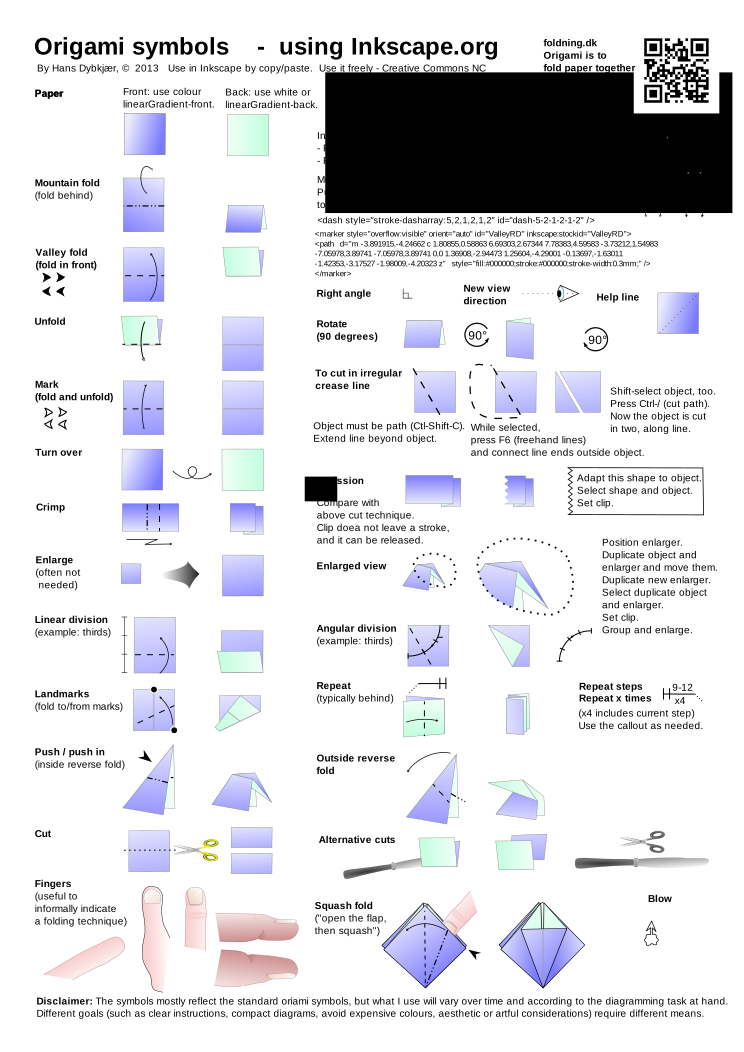
My take on this has been to make an equally non-standard repeat-like
call-out that may be decorated with the steps to be repeated (such as
5-7) and/or the number of times to repeat (such as x2, the number
includes the original step, i.e. it is the total number of times to
perform this manipulation).
You may see it here, about 2/3 down:
http://papirfoldning.dk/temp/symbols_origami.svg
For "reapeat behind" I would just use that symbol, pointing to the point
of interest, and no decoration. For diagrams with text, I would include
"repeat behind" in the text as well.
I believe that though standards are a good thing that in general helps
communication. However, "standards" should never have priority over a
clear presentation, some of the clearest diagrams I have seen, are in a
book from 1944, many years before Yoshizawa became known.
I’m also torn on the fold/unfold. For years I used a line going to the
location then returning. more recently, I’ve adopted the single line
with solid/hollow arrowheads.

This then leaves the issue of where you fold/unfold and it doesn’t
matter which way, such as an initial diagonal. Here, both arrowheads are
conventionally solid. Is this wasting a symbol and possibly adding an
extra level of confusion? Should I always use “one end hollow”?
I prefer your newer practice with solid/hollow arrow heads and a single
line, as it provides a less cluttered drawing. I use that myself.
Using two solid heads seems wrong, it sort of declares that you should
fold both corners rather than declaring that it doesn't matter which
corner to fold.
Is there any case where fold/unfold must be done from one particular
side? Of course, one or the other may be more practical, e.g. if most of
the paper is situated on one side of the crease line.
Best regards,
    Hans