Cheers or all the replies guys

Firstly the foam I have selected is structural in the 16lb density
range, looking at the literature supplied in the kit (which is
identical to the website) quote "Applications
BETAFOAM polyurethane foams can be used wherever cavity sealing or
stiffening is required, including body-side joints, sills, pillars,
underbody cross-car structure, frame rails, longitudinal structure,
door panels, engine cradles, lateral rails and hydroformed
replacements."
I chose this foam because we use an almost identical type at work, in
fact the only difference is the size of the container and colour, I
cant say exactly what its used for but its intention is to absorb mine
blast damage yet also seal a large void that will be exposed to very
rough terrain and most importantly water,

in use his is 100 miles away in terms of comparison to the aerosol can
stuff from B&Q, the can stuff just doesn’t flow enough but just bulges
out once injected into a cavity (just ask my wife after I tried to
fill the void in our outside cupboard wall partition, she is still
moaning now 3 years on.....)
the Dow foam, which is mixed 1:1 via mixing nozzles, literally pours
into the cavities yet is quite tolerant to not over filling, no where
near as sensitive as the canned aerosol stuff,

im 100% confident that the sill structures are dry since the car has
not been wet since October last year, hence why ive been so reluctant
to go out in the car if the weather looked a bit dodgy, certainly
looking down the cavity there is no evidence of water or even
condensation, the garage has been heated all winter (hope my wife
isn’t reading this....)

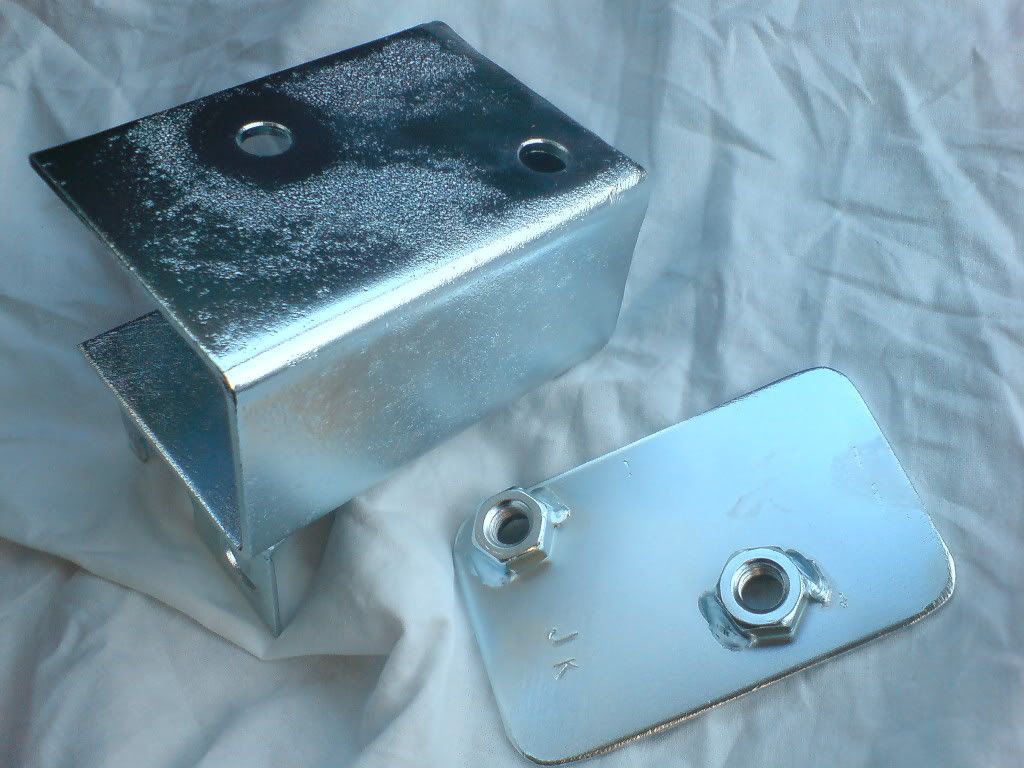
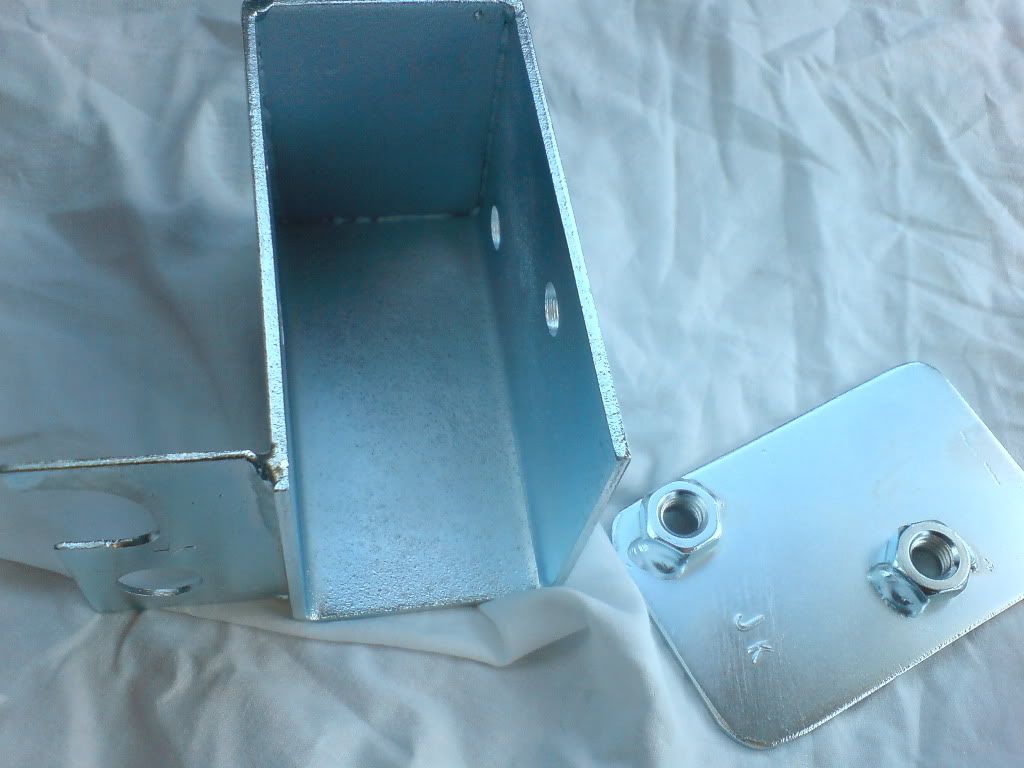
Regarding the trailing arm nuts, I made some steel plates for those a
couple of years back and bonded them into the sills back then


http://i120.photobucket.com/albums/o192/jindal/DSC00716.jpg
http://i120.photobucket.com/albums/o192/jindal/DSC00717.jpg

all along I knew id be doing this so I thought I may as well make
captive plates at the start, I had them zinc plated too so they should
last indefinitely

ive run a few crude experiments and even on cut / sanded foam they
show no absorption, in fact they are almost hydrophobic in they don’t
even hold water to the surface, ive weighed pieces before and after
immersion with no weight gain, incidentally no air bubbles were
expelled during immersion and the test pieces emerged totally dry,
however as mentioned I will be fiberglassing the open face of the foam
anyway for good measure, ive sanded most of it to shape (great to work
with, sands really easily - bit messy though) and I should get the
areas glassed over at the weekend, my main aim at the end of this is
to
A. block off all entries to the sill cavity with fibreglass / foam so
water can not penetrate
B. remove all air from the structure so there is no chance that
moisture can cause effect,

I too had r4ad tales regarding minis and such like with foam in the
sills going rotten, but the general consensus among those that fill
sills with foam often (mainly an American / Jap thing) is technology
has moved on allot since those days - to be fair minis used to leave
the factory with rust, as mentioned before if this foam absorbed water
or was non structural it would not be selected for what we do at work,

Ill keep you posted on the finishing touches

On Jul 9, 9:50 am, "[email protected]"
<[email protected]> wrote:
> Funny story about rigid foam.
>
> We once made some targets for planes,
>
> we filled 200 litre steel drums with rigid foam, almost structural foam,
> then painted the outside bright orange.
>
> they were fixed using steel chains into the wash target area.
>
> planes continually shot through them and they still floated even with loads
> of bullet holes through them.  this went on for about
> 6 weeks, but then some bullets shot through the chains, and the drums
> flaoted around the coast and washed up near grate yarmouth beach.
>
> Suffice to say they were not happy that "chemical drums had been washed up
> onto there prize beach!"
> so the whole project was stopped.
>
> so now they still tow old boats in there and sink them instead.
> shame as there must be tonnes of steel there now rusting away.
>
> Steve
>
>
>
> ----- Original Message -----
> From: "Jim Hearne" <[email protected]>
> To: <[email protected]>
> Sent: Monday, July 09, 2012 9:30 AM
> Subject: Re: [Quantum Owners] Re: foam filling the sills 2+2 waterproofing
>
> Can it absorb water ?, i know when i scraped a load of it off some s/h
> double glazed window frames it had a lot of water in it.
> But maybe that was just from the cut surface.
>
> Jim
>
> -----Original Message-----
> From: [email protected]
> Sent: Monday, July 09, 2012 9:26 AM
> To: [email protected]
> Subject: Re: [Quantum Owners] Re: foam filling the sills 2+2 waterproofing
>
> Jim,
>
> yes it contains water, but it is used up in the foaming proccess to make the
> carbon dioxide bubbles, and so no water is left once the
> reactions have taken place.
>
> The problem with this regarding rusting is, that the cavity needs to be
> fully dry before the foam enters, so that no water is trapped
> against any metal at the interface with the foam, so I would suggest trying
> to do this in the winter or damp conditions will result in
> accelerated rusting.  so its very important to make it a warm and dry day
> when doing this, and maybe even use a hair dryer or fan heater to
> blow air through the cavity to ensure no moisture is present before foaming.
>
> Steve
>
> ----- Original Message -----
> From: "Jim Hearne" <[email protected]>
> To: <[email protected]>
> Sent: Monday, July 09, 2012 9:21 AM
> Subject: Re: [Quantum Owners] Re: foam filling the sills 2+2 waterproofing
>
> >(in most cases
> >water is used to make carbon dioxide to make the bubbles and the foam
> >rise).
>
> Do you mean the foam actually contains water ?
> Isn't this the exact opposite to what Jin wants to achive.
> I know you can spray water on the foam to make it set more.
>
> Jim
>
> -----Original Message-----
> From: [email protected]
> Sent: Monday, July 09, 2012 9:09 AM
> To: [email protected]
> Subject: Re: [Quantum Owners] Re: foam filling the sills 2+2 waterproofing
>
> Hi everyone,
>
> Well the foaming sills issue:-
>
> just by chance I happen to be a Polymer chemist.  My special skills in
> polyurethanes,
>
> so some observations.
>
> 2 pack Polyurethanes would be a very good solution for this type of work,
> and structural foam very ideal.
>
> Actually the low density foam in fridges and even in the B7Q cans is
> actually the same material but with more blowing agant (in most cases
> water is used to make crabon dioxide to make the bubbles and the foam rise).
>
> Normally  the mix ratio is about 100 resin (Polyol - the flexible component)
> mixed with  110 - 150 parts crosslinker  (MDI - the hardener ish)
> which gives a very strong rigid structure. the density/ strength is then
> purely controlled by how much the material is blown by adding more water
> more carbon dioxide is produced.
>
> The biggest problem is as you mentioned the fast reaction time of the
> materials, which presents potential problems in that it has to flow, blow
> and completely fill the cavity.
>
> Usually to slow these materials down if over catalysed we put in a small
> amount of inhibitors, (basically they attack some fo the catalyst so
> just reducing catalyst level) and an easy one to get hold of is,  gring up
> an aspirin, the acid component of this when mixed in does slow the foam
> down.
>
> I am not sure how you are getting the liquid into the sills?
>
> On the Dow website the mention NVH, basically sound absorbing, which is the
> same base chemicals, but at very different ratios,
> and very flexible in comparison.
>
> Normally mix ratio  about 100 resin (Polyol)  mixed with 40-60 parts
> crosslinker (MDI)
>
> At work we actually make NVH parts, and rigid parts, but the biggest
> difficulty is getting the materials into where you want them,
> or the other alternative is to make a mould and premake the shape, which
> isn't so bad for NVH, but obviously not very practical to foam the sills.
> (The extra strength only comes from the fact that the structural foam
> actually bonds to all the faces inside the sill).
>
> ok chemistry lesson over. lol
>
> Steve
>
> ----- Original Message -----
> From: "jin" <[email protected]>
> To: "Quantum Owners Group" <[email protected]>
> Sent: Monday, July 09, 2012 7:46 AM
> Subject: [Quantum Owners] Re: foam filling the sills 2+2 waterproofing
>
> oh yeah your right
>
> lets try again
>
> So as many of you may know already I have a severe worry regarding
> the
> sills my car filling up with water, this is not without reason
> especially going by recent posts on here, however my concerns started
> a long time ago just after I bought the car and discovered it had
> steel laminated in the sills as part of the structure and read
> stories
> about owners drilling small holes in the sill fiberglass to fit
> screws
> for later fixings only to find rusty water pouring out!, not why I
> bought the car. but I suppose it s my fault not checking first,
> having
> said this id still rather have the quantum with steel in its sills
> and
> know it s extremely strong (anyone who has read the newspaper article
> regarding the 2+2 hit by a lorry and several cars will know what I
> mean) than say a GTM rossa that is prone to flexing even when jacking
> up to change a wheel,!!!
> So seeing as this is my best option I have been slowly improving the
> situation by removing all pop rivets that enter into the sill / front
> rear bulkhead sections and either removing them full stop or
> replacing
> them with bonded in stainless steel studs instead
> Additionally to this id made up a list of areas where water can enter
> in, namely the seatbelt reel holes and the fuel filler neck if not
> properly sealed, also the area where the filler spout fits through he
> sill to the tank, on mine it was just sealed with a split / perished
> badly fitting rubber disk - now totally sealed with proper bonded in
> disks. add to this the cable for the sender was loosely placed
> through
> an oversize hole in the opposite side sill there are many potential
> entry points, possibly more I ve not yet thought of, so I decided my
> best option was to totally seal off the steel sills with foam so no
> water or even condensation can get anywhere near them, especially
> since once water gets in it can t easily get out.
> So after some research I decided the best option was to use this from
> Dow engineering
>
> http://www.dowautomotive.com/capabilities/product_family/betafoam.htm
>
> It will essentially seal out the sills and stiffen the structure,
> it s
> the same stuff used in the Mazda RX8 front end for crash protection
> and also the new BMW M5 uses it in the rear sub frame mounts to
> prevent stress cracks in the structure, without the foam it cracks.
> Some other articles I ve read on this type of structural foam (as it
> is called, not to be confused with the stuff from B&Q) are solely for
> the purposes of chassis stiffness
> The best reference I have read is here
>
> http://www.sr20-forum.com/suspension/11917-foam-filling-chassis.html
>
> The foam I m using is the same density, if it stiffens the chassis it
> will be a bonus however my sole reason is to seal out moisture, this
> is high density closed cell foam
> Trial runs
> it has been in my mind that there could be an issue of over filling
> the sills and damaging the fiberglass / cracking the gel coat, the
> foam selected is quick rising literally seconds to full expansion,
> so by the time it travels down a 4 ft. long probe it will have done
> most of its expanding so I ll just be pouring in to fill the sills
> under the pressure of the tanks and not excess pressure via
> expansion,
> but for this to work ill need to see the foam as it expands, this
> will
> be impossible inside the void between the steel sill and the outer
> body sill (my main area of concern) without cutting a hole in one
> end,
> so after much head scratching I decide on the rear edge as its
> flatter
> compared to the front and easier to seal off afterwards.
> To mimic the sill I made a mock up using cardboard, the theory being
> if I can control the process enough to not damage the cardboard I ll
> be fine on the car, I made up a 50mm x 150mm box section to roughly
> mimic the void
>
> http://i120.photobucket.com/albums/o192/jindal/2012%20quantum/
> 13062012365.jpg
>
> http://i120.photobucket.com/albums/o192/jindal/2012%20quantum/
> 13062012369.jpg
>
> Nozzles assembled and gun purged
>
> http://i120.photobucket.com/albums/o192/jindal/2012%20quantum/
> 13062012367.jpg
>
> PVC hose bonded to the end of the mixing nozzle
>
> http://i120.photobucket.com/albums/o192/jindal/2012%20quantum/
> 13062012366.jpg
>
> First fill
>
> http://i120.photobucket.com/albums/o192/jindal/2012%20quantum/
> 13062012370.jpg
>
> No distortion
>
> http://i120.photobucket.com/albums/o192/jindal/2012%20quantum/
> 13062012373.jpg
>
> http://i120.photobucket.com/albums/o192/jindal/2012%20quantum/
> 13062012372.jpg
>
> Thin card box
>
> http://i120.photobucket.com/albums/o192/jindal/2012%20quantum/
> 13062012374.jpg
>
> Again no distortion and total fill
>
> The sum total of the trial runs
>
> http://i120.photobucket.com/albums/o192/jindal/2012%20quantum/
>
> ...
>
> read more »- Hide quoted text -
>
> - Show quoted text -

--
You received this message because you are subscribed to the Google Groups
"Quantum Owners Group" group.
To post to this group, send email to [email protected]
To unsubscribe from this group, send email to
[email protected]
For more options, visit this group at
http://groups.google.com/group/quantumowners?hl=en

IMPORTANT NOTE: All information presented herewith is provided on an "As Is"
basis, without warranty or the implication thereof. Neither the Quantum Owners
Club nor the individuals associated with the Quantum Owners Club or in the
preparation of the above information shall have any liability to any person or
entity with respect to liability, loss, or damage caused or alleged to be
caused directly or indirectly by the instructions contained within this or
related message(s).