In einer eMail vom 11.07.2008 06:19:20 Westeuropäische Normalzeit schreibt
[EMAIL PROTECTED]:
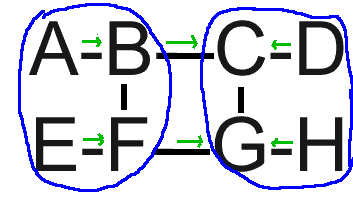
Based  on: http://bill.herrin.us/network/geoag.gif

The path I claim your  algorithm picks for packets from D to E is
wrong. It subjects an  unaffiliated third-party to an unbounded and
unrecoverable expense. The  only valid path from D to E is D-C-G-F-E.
If your algorithm might pick some  other path, your algorithm is
broken. Period.

This is your "put up  or shut up" moment. If you think your algorithm
picks D-C-G-F-E to get from  D to E -AND- picks H-G-C-B-A to get from H
to A (the only valid paths for  those two communications), show us how
nodes C and G over in "right area"  make those polar-opposite path
selections based on the aggregated knowledge  that destinations A and E
both reside in "left  area."


Sorry Bill, but your proof is broken.You may consider your black lines as
one or eventually two directed arrows (2 if opposite) and compute a path being
a
 sequence of arrows all bound to the same endpoint.

Heiner