On Thu, Jul 10, 2008 at 9:04 AM,  <[EMAIL PROTECTED]> wrote:
> But geographical labelling does, and, it does NOT need any distribution
> mechanism.
Heiner,

As I'm pretty sure most everyone else on the list has figured out,
routing based on geographic aggregation results in routing policy
violations in any sufficiently complex internetwork.

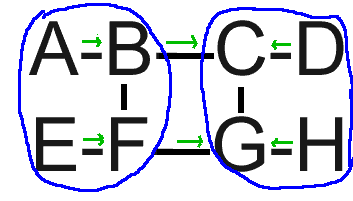
Consider the configuration of 8 nodes at:
http://bill.herrin.us/network/geoag.gif

The black lines are network links. The two blue circles represent
geographically proximate areas, that is every node in the same circle
has the same geographic label. The green arrows indicate who pays who
for transit service. Note the absence of an arrow between C and G, and
between B and F: those are unpaid reciprocal peering.

With both BGP and geographical routing, this network is fully
connected. There are announced routing paths leading from each node to
every other node.

With BGP, packets from D to F would travel:

D-C(d pays)-G(e pays)-F(e pays)-E

With geographic routing, they travel:

D-C(d pays)-B(oops!)-F(e pays)-E.

This breaks a critically important part of routing policy! At every
router and on every link, the source, the destination or both must pay
for that packet to be there.

When are you gonna figure this out and move on from geographic
routing? There are a couple  topological aggregation variants which
still hold some possibility but geographic isn't one of them.

Regards,
Bill Herrin


--
William D. Herrin ................ [EMAIL PROTECTED] [EMAIL PROTECTED]
3005 Crane Dr. ...................... Web: <http://bill.herrin.us/>
Falls Church, VA 22042-3004

--
to unsubscribe send a message to [EMAIL PROTECTED] with the
word 'unsubscribe' in a single line as the message text body.
archive: <http://psg.com/lists/rrg/> & ftp://psg.com/pub/lists/rrg