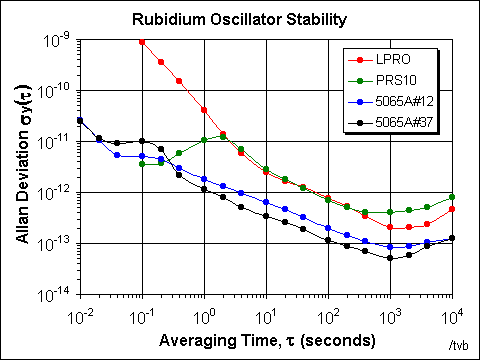
The hump is the DAC update frequency measure: fast update -> hump towards
the left, slow update -> towards the right.  Better update fast or slow:
recently it was pointed out that fast should be better and this will shift
the hump in the 1 to 10 seconds range.
On Mon, Oct 22, 2012 at 1:32 PM, Tom Van Baak <[email protected]> wrote:

> Hi Bert,
>
> Not sure about the range/resolution. That would depend on how the standard
> is used and what its frequency drift rate is. The stability doesn't have to
> be too much better than the standard itself.
> The Austron 2055 resolution is 1e-14, IIRC. The Symmetricom AOG is 1e-19
> (overkill).
>
> What I've found in some GPSDO and passive atomic standards (e.g., Rb or
> Cs) is that as soon as you turn on the DAC and enable the loop, you get
> more short-term noise, say in the range of 1 to 100 seconds. That's why for
> best stability you always switch off the loop during a sensitive
> measurement. Many older Cs had a "Cs off" switch for this. Not only did it
> conserve cesium but it also means you're running straight off the
> high-quality OCXO. This is also true for GPSDO, like the TBolt which allows
> you to turn off disciplining with a s/w command.
>
> In general, when you discipline a OCXO you get that characteristic ADEV
> "hump". This is expected, a natural byproduct of combining two unknowns,
> one that's assumed to be better at short tau and worse at long tau (e.g.,
> OCXO) and one that's assumed to be better at long tau and worse at short
> tau (e.g., Rb cell, or Cs beam, or GPS receiver). At some point there is a
> cross-over and you know/assume that at that point each must be contributing
> 1/sqrt(2) of the noise.
>
> To see the humps in living color, refer to:
> http://www.leapsecond.com/pages/gpsdo/
>
> To answer your question about short/medium/long, I guess in this case
> short is tau left of the hump; medium is the hump, and long is tau to the
> right of the hump.
>
> /tvb
>
> ----- Original Message -----
> From: <[email protected]>
> To: <[email protected]>
> Sent: Monday, October 22, 2012 4:04 AM
> Subject: Re: [time-nuts] Adjusting HP 5065A frequency
>
>
> Tom
> I have two questions what should the range, resolution and stability   of
> the delay generator be and how much do you think a digital loop driven by a
> Tbolt would degrade short and medium precision. What is your definition of
> short  and medium?
> Bert Kehren
>
>
> In a message dated 10/22/2012 12:25:08 A.M. Eastern Daylight Time,
> [email protected] writes:
>
> Three  companies come to mind for phase microsteppers. A popular one
> decades ago was  made by Austron (model 2055A). I got mine on eBay but
> they are
> not as common  now as ten years ago.
>
> The current models by Symmetricom and Spectra  Dynamics are extremely
> high-end (expensive) and overqualified for use with a  vintage rubidium
> oscillator. If you visit NIST or USNO you will see these  impressive units.
>
> It would be a very fun project to make your own. I  suspect other group
> members could either help you or would eagerly employ your  design for
> their
> own use.
>
> But -- before you decide on a hardware  solution see if you can do it in
> software.
>
> An analogy is what we do  with GPS 1PPS sawtooth errors. There are two ways
> to deal with this. One is to  capture the correction message over RS232,
> measure the DUT vs. GPS 1PPS with a  TIC, and then numerically apply the
> sawtooth correction with one line of code.  Several of the popular GPS
> monitor
> programs do this automatically for you  (TBoltmon and TAC32, for example).
> The
> software solution is perfect to the  granularity of the sawtooth message,
> typically 1 ns.
>
> The hardware  implementation usually involves a PIC and a programmable
> delay generator. The  PIC listens for the correction message over RS232
> and then
> has plenty of time  (up to one second) to program the delay chip. When the
> hardware 1PPS arrives  it is delayed to compensate for the aforementioned
> sawtooth error. The result  is a hardware 1PPS that's quite close to the
> ideal
> 1PPS, limited again by the  granularity of the message, as well as offset
> or linearity errors in the delay  chip.
>
> So that's the analogy. To apply this to your rubidium, ask  yourself which
> instruments or measurements or users are downstream of your  5065A 10 MHz
> output. Can they deal with daily software corrections to a stable  but
> slightly imprecise frequency, or do they really need the frequency to be
>  as
> accurate as possible at all times.
>
> There's a third alternative as  well. You might consider using your 5065A
> as the LO in a GPSDO. This will  sacrifice some short- and mid-term
> precision
> due to additive noise, but it  will guarantee the best possible long-term
> accuracy.
>
> /tvb
>
> ----- Original Message -----
> From: Edgardo Molina
> To:  Tom Van Baak ; Discussion of precise time and frequency measurement
> Sent: Sunday, October 21, 2012 8:49 PM
> Subject: Re: [time-nuts]  Adjusting HP 5065A frequency
>
>
> Dear Tom,
>
>
> Good evening. In relation to your last comments on this and other subjects,
> I  am sharing some thoughts and experience about it. I took the liberty to
> separate the topics as to ease the interested parties to follow up
> accordingly. TNX.
>
>
>
>
> a. Information you kindly provided  and the index for newbies:
>
>
> Thank you! You just provided me  with lots of new ideas and information on
> the subject. You have very valuable  information in your web site. As Hal
> was saying, an index should be done  anywhere so it could be easier for the
> rest of us to locate the information. I  am planning soon to build a web
> page
> for my lab. In english of course for  everybody to share my experiences. I
> could work on an index to point out to  the various sources of information
> and topics that are difficult to find. That  I think could expedite things
> a
> little bit.
>
>
> b. Phase Micro  steppers:
>
>
> I saw the phase micro steppers working at CENAM  time scale. I was
> wondering that the technique could be translated to my  5065As and not
> trying to
> touch them so often. If I am assuming correctly and  the technique could be
> used with the HP Rb standards. Are those phase micro  steppers easy to
> find? I
> mean, affordable in the second market? If there is  one of course. I saw
> the
> ones used at CENAM are produced by SpectraDynamics in  Colorado. According
> to Mike Lombardi it is a small highly specialized company  with a small
> market to serve. I could translate it as "expensive and  exotic"  : ) Am I
> correct?
>
>
> c. Thunderbolt and my will  to share initial experiences:
>
>
> I am gathering a lot of  information on the Thunderbolts as I am using them
> in my thesis work. I bought  a couple of them. If my information or novice
> experience with these receivers  is good for anybody, I would be more than
> glad to share it.
>
>
> Thank you.
>
>
> Kind regards,
>
>
>
>
>
>
> Edgardo Molina
> Dirección IPTEL
>
>
> www.iptel.net.mx
>
>
> T : 55 55 55202444
> M : 04455  20501854
>
>
> Piensa en Bits SA de  CV
>
>
>
>
>
>
> Información  anexa:
>
>
>
>
>
>
>
>
> CONFIDENCIALIDAD DE  INFORMACION
>
> Este mensaje tiene carácter confidencial. Si usted  no es el destinarario
> de este mensaje, le suplicamos se lo notifique al  remitente mediante un
> correo electrónico y que borre el presente mensaje y sus  anexos de su
> computadora sin retener una copia de los mismos. Queda  estrictamente
> prohibido
> copiar este mensaje o hacer usode el para cualquier  propósito o divulgar
> su en
> forma parcial o total su contenido.  Gracias.
>
>
>
>
> NON-DISCLOSURE OF INFORMATION
>
> This email is strictly confidential and may also be privileged. If you are
> not  the intended recipient please immediately advise the sender by
> replying
> to  this e-mail and then deleting the message and its attachments from your
>  computer without keeping a copy. It is strictly forbidden to copy it or
> use it  for any purpose or disclose its contents to any third party. Thank
> you.
>
>
>
>
>
>
>
>
>
> On Oct 21, 2012, at 7:29  PM, "Tom Van Baak" <[email protected]> wrote:
>
>
> Hi Edgardo,
>
> What you'll find is that many labs do not  periodically adjust the C-field
> of their 5061A or 5065A at all.
>
> Instead, any phase or frequency adjustment is done with phase
> microsteppers or simply done in software with time and rate adjustments to
> the  raw
> data. These methods avoid all possible physical side-effects of changing
> voltages, currents, and fields. It also makes it possible to gather
> long-term
> data to show how the standard is operating (if you make mechanical rate
> adjustments it complicates data that you have already  collected).
>
> The other point is that when making stability  measurements, there is no
> requirement that the reference (e.g., 5065A) be  perfectly on-frequency. So
> this removes motivation for physically touching and  possibly perturbing
> the
> operation of the reference.
>
> Please also take the time to read these pages.
>
> "HP 5065A  Rubidium C-Field Resolution"
> http://leapsecond.com/pages/hp-5065a-cfield/
>
> "Rubidium  Oscillator Stability"
> http://leapsecond.com/images/4rb.gif
>
> "Stability and Noise  Performance of Various Rubidium Standards"
> http://www.ke5fx.com/rb.htm
>
> "Performance of Low-Cost  Rubidium Standards"
> http://febo.com/pages/oscillators/rubes/
>
> "A close look at  a drifting HP 5065A Rubidium Frequency Standard"
> http://leapsecond.com/pages/doug-rb/
>
> /tvb
>
>
> _______________________________________________
> time-nuts  mailing list -- [email protected]
> To unsubscribe, go to
> https://www.febo.com/cgi-bin/mailman/listinfo/time-nuts
> and  follow the instructions  there.
>
>
> _______________________________________________
> time-nuts  mailing list -- [email protected]
> To unsubscribe, go to
> https://www.febo.com/cgi-bin/mailman/listinfo/time-nuts
> and follow the  instructions there.
> _______________________________________________
> time-nuts mailing list -- [email protected]
> To unsubscribe, go to
> https://www.febo.com/cgi-bin/mailman/listinfo/time-nuts
> and follow the instructions there.
>
>
>
> _______________________________________________
> time-nuts mailing list -- [email protected]
> To unsubscribe, go to
> https://www.febo.com/cgi-bin/mailman/listinfo/time-nuts
> and follow the instructions there.
>
_______________________________________________
time-nuts mailing list -- [email protected]
To unsubscribe, go to https://www.febo.com/cgi-bin/mailman/listinfo/time-nuts
and follow the instructions there.