Hi Edgardo,

What you'll find is that many labs do not periodically adjust the C-field of
their 5061A or 5065A at all.
Instead, any phase or frequency adjustment is done with phase microsteppers or
simply done in software with time and rate adjustments to the raw data. These
methods avoid all possible physical side-effects of changing voltages,
currents, and fields. It also makes it possible to gather long-term data to
show how the standard is operating (if you make mechanical rate adjustments it
complicates data that you have already collected).

The other point is that when making stability measurements, there is no
requirement that the reference (e.g., 5065A) be perfectly on-frequency. So this
removes motivation for physically touching and possibly perturbing the
operation of the reference.

Please also take the time to read these pages.

"HP 5065A Rubidium C-Field Resolution"
http://leapsecond.com/pages/hp-5065a-cfield/

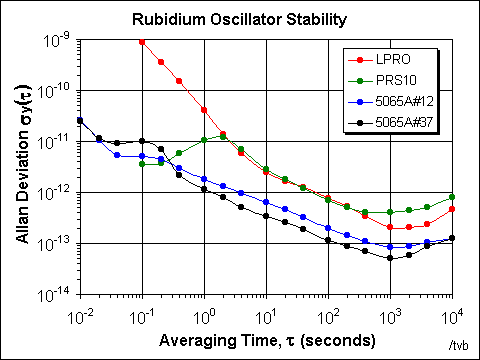
"Rubidium Oscillator Stability"
http://leapsecond.com/images/4rb.gif

"Stability and Noise Performance of Various Rubidium Standards"
http://www.ke5fx.com/rb.htm

"Performance of Low-Cost Rubidium Standards"
http://febo.com/pages/oscillators/rubes/

"A close look at a drifting HP 5065A Rubidium Frequency Standard"
http://leapsecond.com/pages/doug-rb/

/tvb


_______________________________________________
time-nuts mailing list -- [email protected]
To unsubscribe, go to https://www.febo.com/cgi-bin/mailman/listinfo/time-nuts
and follow the instructions there.