Three companies come to mind for phase microsteppers. A popular one decades ago
was made by Austron (model 2055A). I got mine on eBay but they are not as
common now as ten years ago.
The current models by Symmetricom and Spectra Dynamics are extremely high-end
(expensive) and overqualified for use with a vintage rubidium oscillator. If
you visit NIST or USNO you will see these impressive units.

It would be a very fun project to make your own. I suspect other group members
could either help you or would eagerly employ your design for their own use.

But -- before you decide on a hardware solution see if you can do it in
software.

An analogy is what we do with GPS 1PPS sawtooth errors. There are two ways to
deal with this. One is to capture the correction message over RS232, measure
the DUT vs. GPS 1PPS with a TIC, and then numerically apply the sawtooth
correction with one line of code. Several of the popular GPS monitor programs
do this automatically for you (TBoltmon and TAC32, for example). The software
solution is perfect to the granularity of the sawtooth message, typically 1 ns.

The hardware implementation usually involves a PIC and a programmable delay
generator. The PIC listens for the correction message over RS232 and then has
plenty of time (up to one second) to program the delay chip. When the hardware
1PPS arrives it is delayed to compensate for the aforementioned sawtooth error.
The result is a hardware 1PPS that's quite close to the ideal 1PPS, limited
again by the granularity of the message, as well as offset or linearity errors
in the delay chip.

So that's the analogy. To apply this to your rubidium, ask yourself which
instruments or measurements or users are downstream of your 5065A 10 MHz
output. Can they deal with daily software corrections to a stable but slightly
imprecise frequency, or do they really need the frequency to be as accurate as
possible at all times.

There's a third alternative as well. You might consider using your 5065A as the
LO in a GPSDO. This will sacrifice some short- and mid-term precision due to
additive noise, but it will guarantee the best possible long-term accuracy.

/tvb

  ----- Original Message -----
  From: Edgardo Molina
  To: Tom Van Baak ; Discussion of precise time and frequency measurement
  Sent: Sunday, October 21, 2012 8:49 PM
  Subject: Re: [time-nuts] Adjusting HP 5065A frequency


  Dear Tom,


  Good evening. In relation to your last comments on this and other subjects, I
am sharing some thoughts and experience about it. I took the liberty to
separate the topics as to ease the interested parties to follow up accordingly.
TNX.


  a. Information you kindly provided and the index for newbies:


  Thank you! You just provided me with lots of new ideas and information on the
subject. You have very valuable information in your web site. As Hal was
saying, an index should be done anywhere so it could be easier for the rest of
us to locate the information. I am planning soon to build a web page for my
lab. In english of course for everybody to share my experiences. I could work
on an index to point out to the various sources of information and topics that
are difficult to find. That I think could expedite things a little bit.


  b. Phase Micro steppers:


  I saw the phase micro steppers working at CENAM time scale. I was wondering
that the technique could be translated to my 5065As and not trying to touch
them so often. If I am assuming correctly and the technique could be used with
the HP Rb standards. Are those phase micro steppers easy to find? I mean,
affordable in the second market? If there is one of course. I saw the ones used
at CENAM are produced by SpectraDynamics in Colorado. According to Mike
Lombardi it is a small highly specialized company with a small market to serve.
I could translate it as "expensive and exotic"  : ) Am I correct?


  c. Thunderbolt and my will to share initial experiences:


  I am gathering a lot of information on the Thunderbolts as I am using them in
my thesis work. I bought a couple of them. If my information or novice
experience with these receivers is good for anybody, I would be more than glad
to share it.


  Thank you.


  Kind regards,


  Edgardo Molina
  Dirección IPTEL


  www.iptel.net.mx


  T : 55 55 55202444
  M : 04455 20501854


  Piensa en Bits SA de CV


  Información anexa:


  CONFIDENCIALIDAD DE INFORMACION

  Este mensaje tiene carácter confidencial. Si usted no es el destinarario de
este mensaje, le suplicamos se lo notifique al remitente mediante un correo
electrónico y que borre el presente mensaje y sus anexos de su computadora sin
retener una copia de los mismos. Queda estrictamente prohibido copiar este
mensaje o hacer usode el para cualquier propósito o divulgar su en forma
parcial o total su contenido. Gracias.


  NON-DISCLOSURE OF INFORMATION

  This email is strictly confidential and may also be privileged. If you are
not the intended recipient please immediately advise the sender by replying to
this e-mail and then deleting the message and its attachments from your
computer without keeping a copy. It is strictly forbidden to copy it or use it
for any purpose or disclose its contents to any third party. Thank you.


  On Oct 21, 2012, at 7:29 PM, "Tom Van Baak" <[email protected]> wrote:


    Hi Edgardo,

    What you'll find is that many labs do not periodically adjust the C-field
of their 5061A or 5065A at all.

    Instead, any phase or frequency adjustment is done with phase microsteppers
or simply done in software with time and rate adjustments to the raw data.
These methods avoid all possible physical side-effects of changing voltages,
currents, and fields. It also makes it possible to gather long-term data to
show how the standard is operating (if you make mechanical rate adjustments it
complicates data that you have already collected).

    The other point is that when making stability measurements, there is no
requirement that the reference (e.g., 5065A) be perfectly on-frequency. So this
removes motivation for physically touching and possibly perturbing the
operation of the reference.

    Please also take the time to read these pages.

    "HP 5065A Rubidium C-Field Resolution"
    http://leapsecond.com/pages/hp-5065a-cfield/

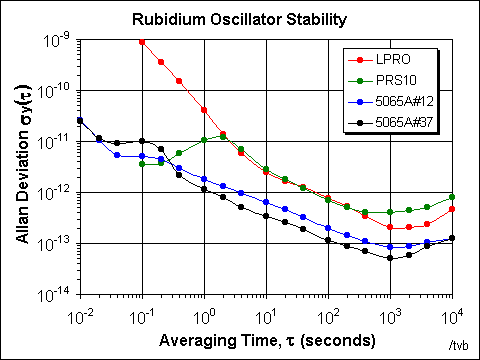
    "Rubidium Oscillator Stability"
    http://leapsecond.com/images/4rb.gif

    "Stability and Noise Performance of Various Rubidium Standards"
    http://www.ke5fx.com/rb.htm

    "Performance of Low-Cost Rubidium Standards"
    http://febo.com/pages/oscillators/rubes/

    "A close look at a drifting HP 5065A Rubidium Frequency Standard"
    http://leapsecond.com/pages/doug-rb/

    /tvb


    _______________________________________________
    time-nuts mailing list -- [email protected]
    To unsubscribe, go to
https://www.febo.com/cgi-bin/mailman/listinfo/time-nuts
    and follow the instructions there.


_______________________________________________
time-nuts mailing list -- [email protected]
To unsubscribe, go to https://www.febo.com/cgi-bin/mailman/listinfo/time-nuts
and follow the instructions there.