Anders,

I used an AD9858 years ago in our FireFox synthesizer product clocked at 1GHz
locked to the on-board 10MHz GPSDO.
I used an ADF4002 or 4000 (can't remember) pll with integer division driving a
UMC (now Sirenza) VCO. It worked very well and there where no 10MHz spurs
measurable. Its very easy to get rid of reference feedthrough by using a good
low pass filter on the EFC input and proper layout technique. I used a 5KHz
bandwidth or so. The Analog Devices PLL simulator tool makes it a breeze to
design the loop filter and predict output performance. Choosing a VCO with
limited modulation BW also helps keep the reference away from the output. You
can even select VCOs from a list of programmed parts in the AD software.

Today I would not use a simple (cheap) 1GHz VCO anymore because of the
relatively high phase noise, and some if them require up to 20V drive voltage.
I would use a Crystal based product such as our ULN-1G 1GHz crystal oscillator.
That part may be overkill since it has DC-DC regulators, filters, mil-temp
range, and a +22dBm temp-stabilized output amplifier, but its a drop-in
replacement for a VCO. With that part, the loop filter bandwidth can be reduced
to a couple 100Hz to take advantage of the very low PN of the oscillator.

If price is an issue, and you just need a one-off then you can build your own
1GHz crystal VCXO:

Use a third harmonic crystal to run a single transistor oscillator at 125MHz
(or buy a 125MHz low-noise oscillator). A third harmonic crystal will allow a
wider frequency control range than a fifth harmonic, which may be needed to
compensate aging and temp effects on the crystal.Then multiply by four using a
simple RC resonant circuit in a common emitter driver. Follow this by another
driver to get +10dBm or so. Then use a diode doubler (Mini Circuits etc) to get
1GHz output, and buffer that output with an RF transistor, or an LVDS driver
chip etc. you may want to follow that with a mini circuits 1200MHz low pass
filter to get rid of any residual 1500MHz f3 spurs.

But depending on your needs a passive, five or six component LP filter driven
by an ADF400x and a standard 1GHz VCO may just do the trick. You should be able
to get an ADF400x eval board cheaply and swap out the VCO to a 1GHz unit from
Ebay and program the board using a PC or micro-controller. Caveat Emptor: I
tried other PLL vendors, and they were not as good as Analog. Also stay away
from fractional-n PLLs for phase noise and spurs.

Voila.
Bye,
Said


Sent From iPhone

On Dec 30, 2013, at 9:56, Anders Wallin <[email protected]> wrote:

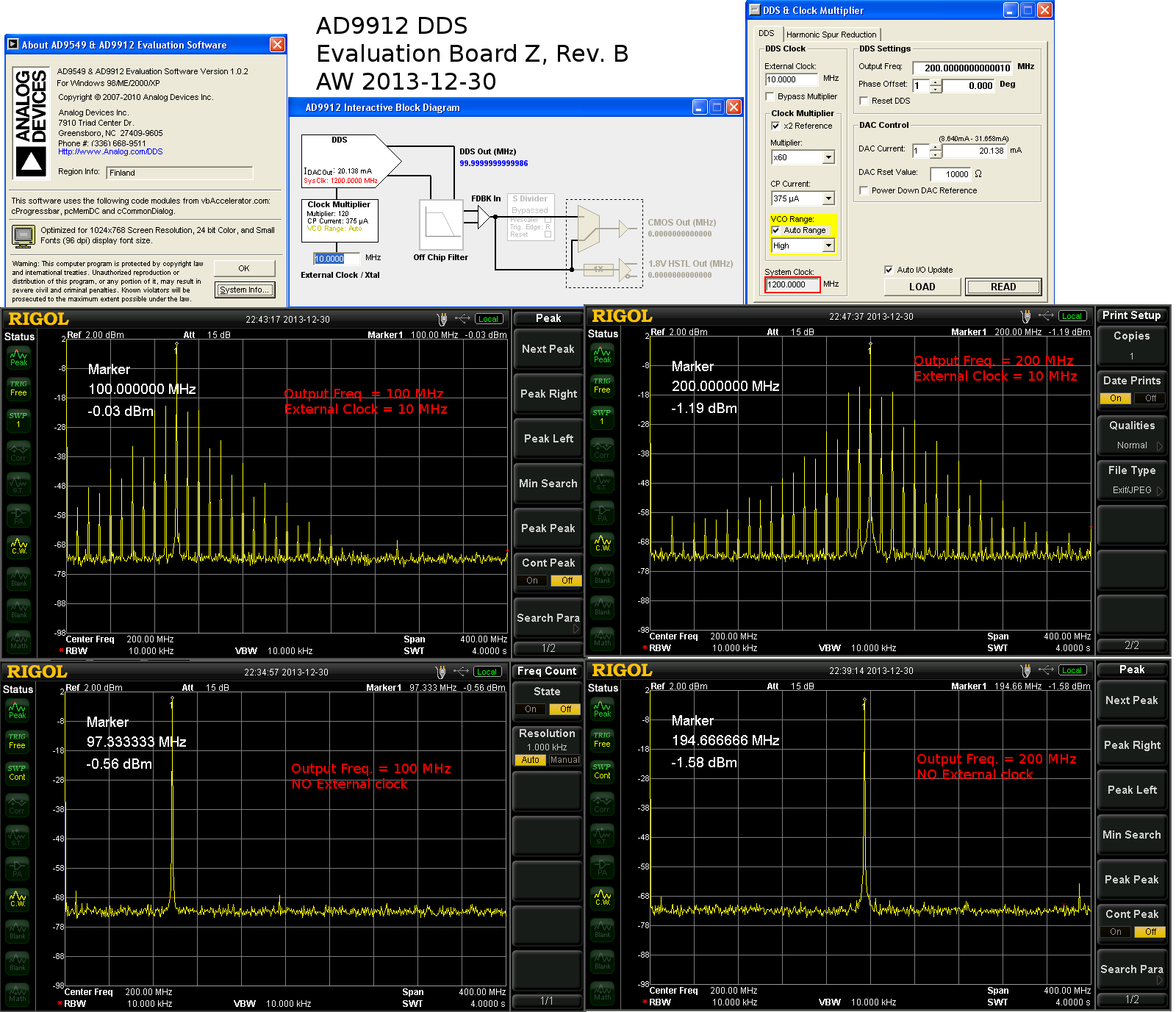
> I've tested the AD9912 evaluation board:
> http://www.anderswallin.net/wp-content/uploads/2013/12/dds_test_2013-12-30.png
>
> I want to use it with a 10MHz external input clock, but it looks like the
> on-board PLL that generates a 1200MHz sample clock from my input isn't that
> great, since I get strong side-bands on the output that are only 18-20 dB
> down from the fundamental.
>
> So it looks like I need to supply a clean 800-1000MHz clock to the DDS to
> get a clean output. Any ideas/suggestions for generating this from a 10 MHz
> sine?
> Driving the DDS system clock from an expensive RF generator (e.g. HP 8648A)
> would be possible but I'd prefer a PLL from 10MHz if it's doable
> simply/cheaply.
>
> Anders
> _______________________________________________
> time-nuts mailing list -- [email protected]
> To unsubscribe, go to https://www.febo.com/cgi-bin/mailman/listinfo/time-nuts
> and follow the instructions there.
_______________________________________________
time-nuts mailing list -- [email protected]
To unsubscribe, go to https://www.febo.com/cgi-bin/mailman/listinfo/time-nuts
and follow the instructions there.