> They say that the system clock is 12.504 MHz and that they use both the
> rising and falling edges.   That is about 40 nS between quantization time
> slots.   The PPS can only appear on a 40 nS edge.   I should be seeing
> 40 nS jumps in the waveforms.   I do see ~40 nS jumps but they are less
> common.
"The PPS can only appear on a 40 ns edge" -- of the imprecise, unstable,
uncompensated, unshielded, crystal oscillator on the Resolution-T board. It may
be 12.504 MHz, but it certainly isn't (and not intended to be) 12.504000000
MHz. There's also instability in your 'scope or counter. Thus you will see
significant jitter, drift, and wander in the observed 40 ns edges. All this is
normal and expected any time you "beat" two oscillators against each other.

The net result is that the jumps are very evenly (and not Gaussian) distributed
anywhere from 0 ns to 40 ns. Again, look at the raw data, plots, and histograms
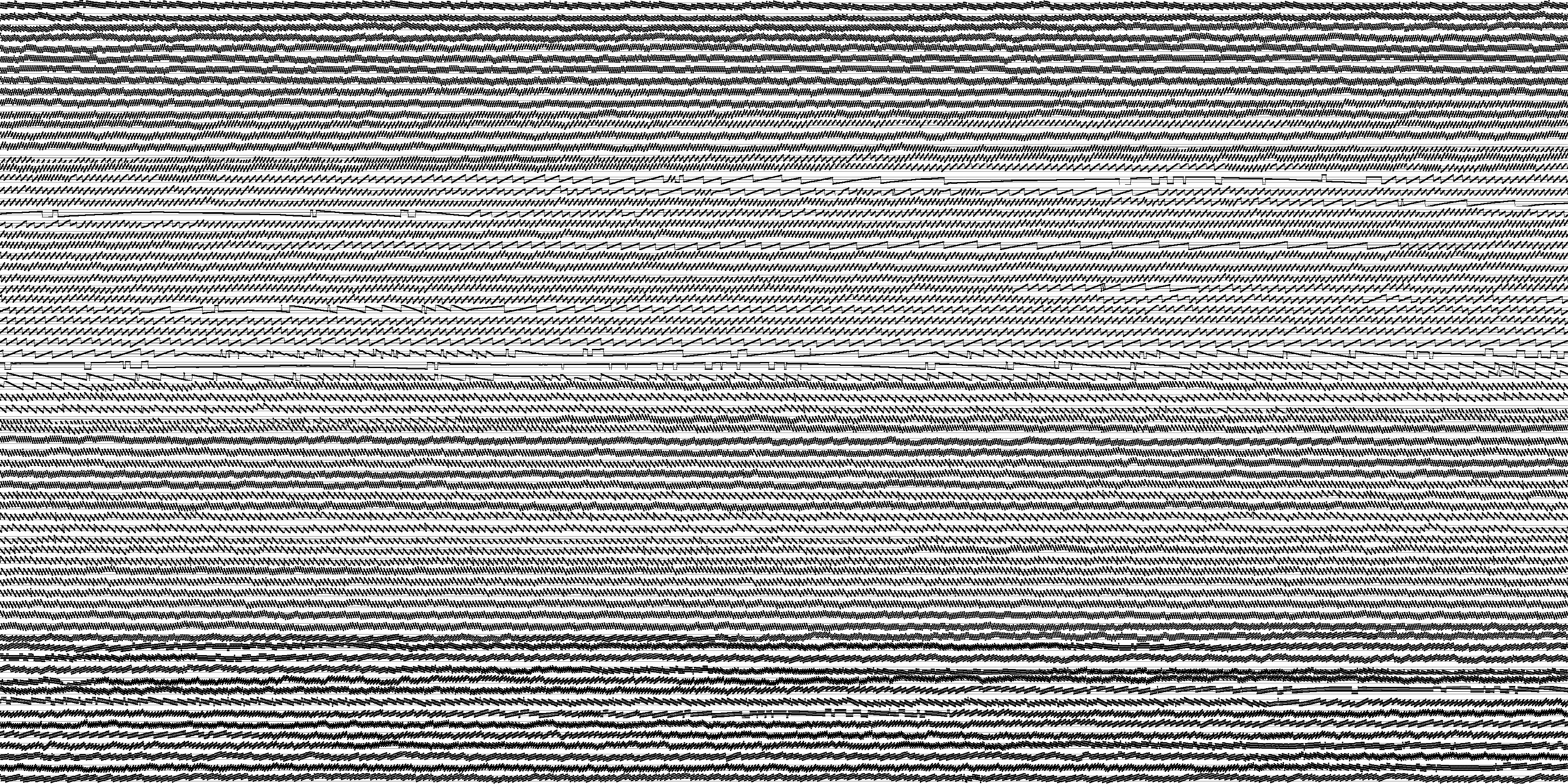
that I provided. Especially the "zebra" plots which show just how varied the
sawtooth error is over the span of minutes, hours, and days:

http://leapsecond.com/pages/MG1613S/tic-72-hour.gif (3600x1800 pixels!)

> The waveform timing is clearly quantized but I am seeing ~2 nS jumps.
> My scope is a Rigol DS2202 which samples at 1 GSP in 2 channel mode.
> Could this 2 nS quantization be a result of the scope?   Perhaps I should
> get my 400 MHz analog scope out (Tek 2465B) and repeat the measurements?

Off-list you mentioned you don't have a ns or sub-ns time interval counter, so
yes, I guess you should try the analog 'scope. I'm wondering now if your GPS
receiver more stable than your scope's timebase.

/tvb

_______________________________________________
time-nuts mailing list -- [email protected]
To unsubscribe, go to https://www.febo.com/cgi-bin/mailman/listinfo/time-nuts
and follow the instructions there.