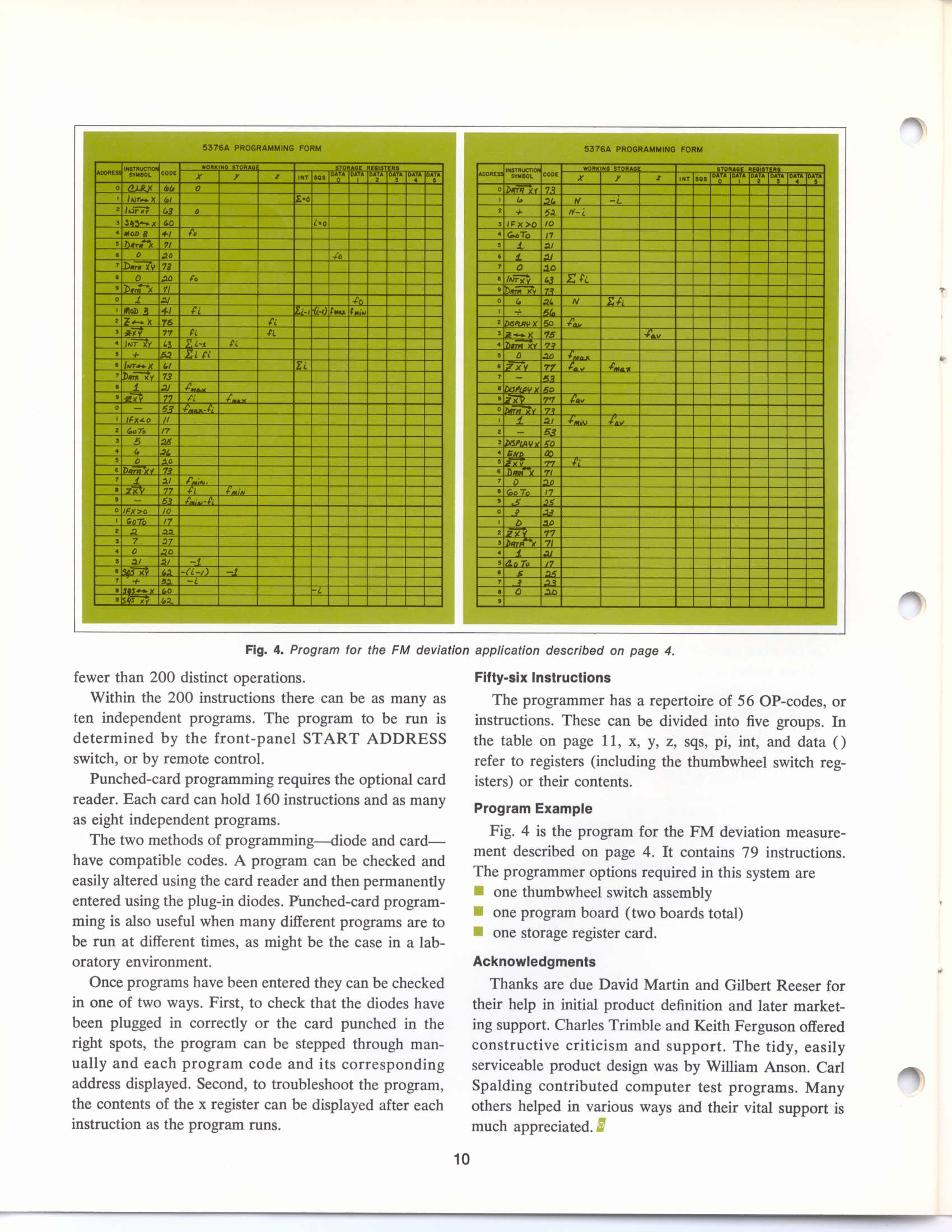
Yes you could use diodes to program the unit. In fact as it came the center
module held a program
I will be quite honest in that I never spent the time to figure that out
because by the time I picked up 5360s a real computer could be adapted into
the unit to do things.
But never had a real need to go the extra mile.
Indeed the panalplex displays were a later replacement for the nixies. I
have seen thos counters and they look good. The LED replacement I built
matched the nixie color so the filter could be retained.
Fun stuff lots O little wires and yes today everything can be done on your
favorite chip for $2.
Not really but thats eviloution.
On Wed, Apr 13, 2016 at 4:44 PM, John Ackermann N8UR <[email protected]> wrote:

> Thanks, Tom (and others)!  That's fascinating.
>
> I was interested in the mention of diode programming systems.  It's a
> little off topic, but I encountered a few of those in the 1970s amateur
> radio world.  A couple of the early synthesized (as opposed to
> fixed-frequency-crystal) controlled ham radios had memory channels that
> were "programmed" in BCD digits by installing or removing 1N914 diodes,
> often in a row of DIP sockets.
>
> Another early design was in the first synthesized "police radio" scanner
> by Regency.  It used aluminum combs that looked like, well, combs.  You
> broke off the tines as instructed for a particular frequency and then
> inserted the comb into a socket.  The presence or absence of the tine
> signified 1 or 0.
>
> ----
>
> On 4/13/2016 3:57 PM, Tom Van Baak wrote:
>
>> John,
>>
>> I agree with Paul, an absolutely amazing instrument. The early models
>> have nixie display, later ones plasma. 11 digits! In 1969! It was the first
>> hp instrument that was capable enough to compute stability statistics. In
>> real-time! Like Paul I have a couple, along with various the accessories.
>> Built like a tank, even the keyboard.
>>
>> You'll find mention of the counter in old technical articles, sometimes
>> including the programs people would write for automated statistics. I've
>> always thought the 5360 was uniquely at the cross-roads between hp as an
>> instrument company and hp as a computer company (not to mention hp as a
>> printer ink company). You can see the DNA of each of these in the 5360 &
>> its accessories.
>>
>> You were probably reading this major 5360A Computing Counter issue:
>>
>> http://www.hpl.hp.com/hpjournal/pdfs/IssuePDFs/1969-05.pdf
>>
>> Here's all about the 5375A keyboard:
>>
>> http://www.hpl.hp.com/hpjournal/pdfs/IssuePDFs/1970-03.pdf
>>
>> And this is where the diode and punch card interface is shown, as well as
>> ADEV from 1 us to 1 s (see page 4, fig 4).
>>
>> http://www.hpl.hp.com/hpjournal/pdfs/IssuePDFs/1970-12.pdf
>>
>> More on ADEV on the 5360:
>>
>> http://www.hpl.hp.com/hpjournal/pdfs/IssuePDFs/1971-11.pdf
>>
>> Select high-res page scans from my own hardcopy HPJ collection are here:
>>
>> http://www.leapsecond.com/hpj/
>>
>> For example, the 79-step ADEV program is here:
>>
>> http://www.leapsecond.com/hpj/v22n4/v22n4p10.jpg
>>
>> Finally, do not miss HP AN116 "Precision Frequency Measurements":
>>
>> http://www.hpmemoryproject.org/an/pdf/an_116.pdf
>>
>> /tvb
>>
>> ----- Original Message -----
>> From: "John Ackermann N8UR" <[email protected]>
>> To: <[email protected]>
>> Sent: Wednesday, April 13, 2016 9:38 AM
>> Subject: [time-nuts] HP 5360A History?
>>
>>
>> I was browsing through the HP Journal archives and came across the May,
>>> 1969 issue, dedicated to the new 5360A Computing Counter -- "An
>>> Electronic Counter for the 1970s!"
>>>
>>> I don't recall hearing much about these in time-nuts lore.  I can guess
>>> from the Journal articles that it was a beast to keep running and was
>>> very expensive (500 ICs and a 10A 5V power supply).
>>>
>>> Is anyone here familiar with the story of this product?
>>>
>>> John
>>>
>>
>> _______________________________________________
>> time-nuts mailing list -- [email protected]
>> To unsubscribe, go to
>> https://www.febo.com/cgi-bin/mailman/listinfo/time-nuts
>> and follow the instructions there.
>>
>> _______________________________________________
> time-nuts mailing list -- [email protected]
> To unsubscribe, go to
> https://www.febo.com/cgi-bin/mailman/listinfo/time-nuts
> and follow the instructions there.
>
_______________________________________________
time-nuts mailing list -- [email protected]
To unsubscribe, go to https://www.febo.com/cgi-bin/mailman/listinfo/time-nuts
and follow the instructions there.