Hi

I had a 5360 on my bench in the 1970’s. Back then it was a pretty impressive
piece of gear. The most amazing thing I remember doing with it was converting
the output to PPM. Yes, that’s not really all that exciting these days …..
Bob

> On Apr 13, 2016, at 5:32 PM, Jeremy Nichols <[email protected]> wrote:
>
> The insider name for the 5360A was "computing pig" because of its size
> (weight) and complexity. It combined most of the counting ability of a 5345
> with much of the computing ability of the 9100 programmable calculator.
> Jamming so much into a standard (for the era) -hp- cabinet was quite a
> challenge. One of my 5360s uses Nixie tubes while the newer one is plasma.
>
> Since there is no way to store a program entered with the keyboard, you have
> to leave the machine 'on' or re-key your program. Given the limited 32-step
> memory, this is not a terrible limitation. The 5376 Systems Programmer could
> be expanded to 200 (!) steps but I've not had the privilege of using one with
> my 5360.
>
> If any one has a copy of Application Sheet No. 27, "Fractional Frequency
> Deviation Measurements on Ultra-Stable Sources" or Application Note AN 120-2,
> "Measuring Phase with the 5360A," I'd like to buy copies.
>
> Jeremy
>
> On 4/13/2016 1:44 PM, John Ackermann N8UR wrote:
>> Thanks, Tom (and others)!  That's fascinating.
>>
>> I was interested in the mention of diode programming systems. It's a little
>> off topic, but I encountered a few of those in the 1970s amateur radio
>> world.  A couple of the early synthesized (as opposed to
>> fixed-frequency-crystal) controlled ham radios had memory channels that were
>> "programmed" in BCD digits by installing or removing 1N914 diodes, often in
>> a row of DIP sockets.
>>
>> Another early design was in the first synthesized "police radio" scanner by
>> Regency.  It used aluminum combs that looked like, well, combs.  You broke
>> off the tines as instructed for a particular frequency and then inserted the
>> comb into a socket. The presence or absence of the tine signified 1 or 0.
>>
>> ----
>> On 4/13/2016 3:57 PM, Tom Van Baak wrote:
>>> John,
>>>
>>> I agree with Paul, an absolutely amazing instrument. The early models have
>>> nixie display, later ones plasma. 11 digits! In 1969! It was the first hp
>>> instrument that was capable enough to compute stability statistics. In
>>> real-time! Like Paul I have a couple, along with various the accessories.
>>> Built like a tank, even the keyboard.
>>>
>>> You'll find mention of the counter in old technical articles, sometimes
>>> including the programs people would write for automated statistics. I've
>>> always thought the 5360 was uniquely at the cross-roads between hp as an
>>> instrument company and hp as a computer company (not to mention hp as a
>>> printer ink company). You can see the DNA of each of these in the 5360 &
>>> its accessories.
>>>
>>> You were probably reading this major 5360A Computing Counter issue:
>>>
>>> http://www.hpl.hp.com/hpjournal/pdfs/IssuePDFs/1969-05.pdf
>>>
>>> Here's all about the 5375A keyboard:
>>>
>>> http://www.hpl.hp.com/hpjournal/pdfs/IssuePDFs/1970-03.pdf
>>>
>>> And this is where the diode and punch card interface is shown, as well as
>>> ADEV from 1 us to 1 s (see page 4, fig 4).
>>>
>>> http://www.hpl.hp.com/hpjournal/pdfs/IssuePDFs/1970-12.pdf
>>>
>>> More on ADEV on the 5360:
>>>
>>> http://www.hpl.hp.com/hpjournal/pdfs/IssuePDFs/1971-11.pdf
>>>
>>> Select high-res page scans from my own hardcopy HPJ collection are here:
>>>
>>> http://www.leapsecond.com/hpj/
>>>
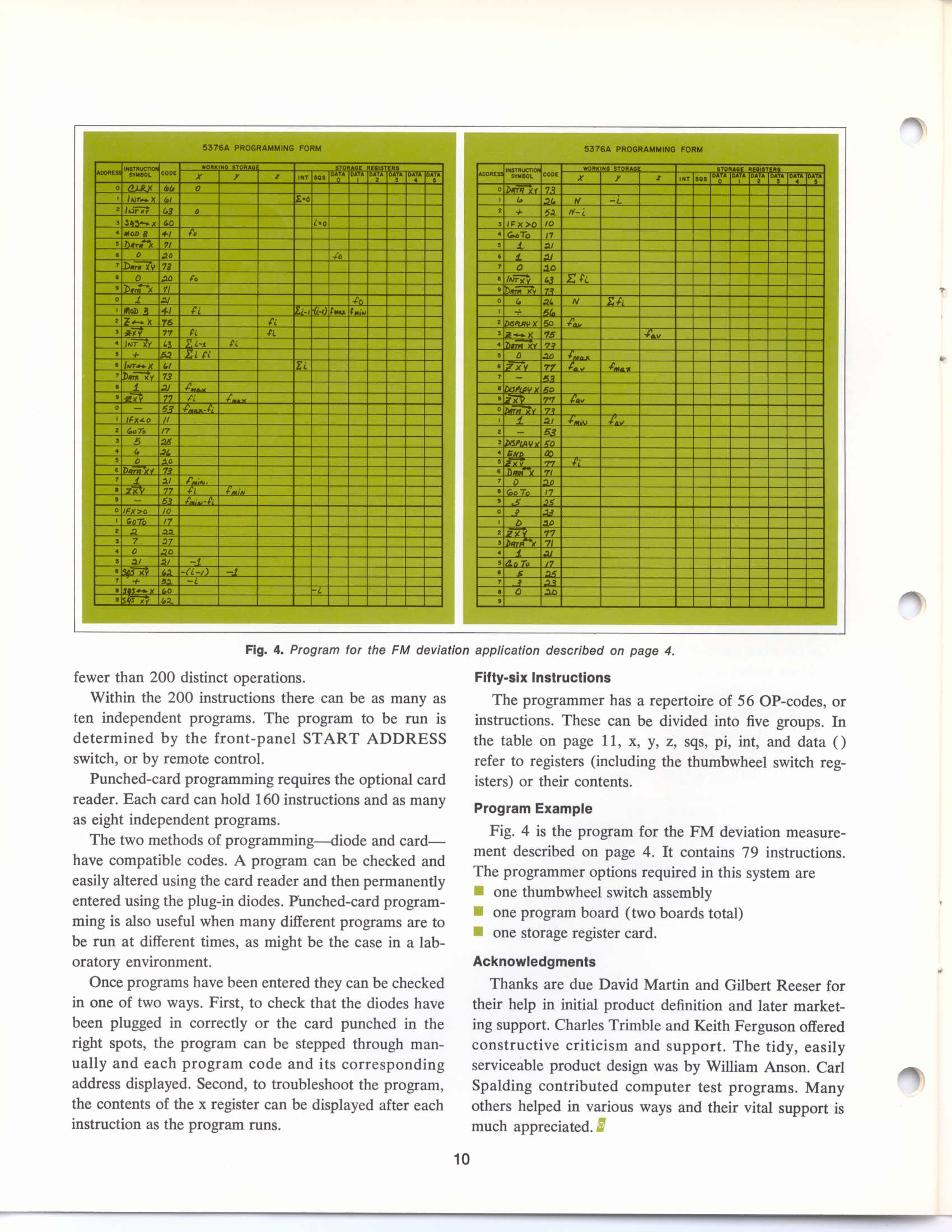
>>> For example, the 79-step ADEV program is here:
>>>
>>> http://www.leapsecond.com/hpj/v22n4/v22n4p10.jpg
>>>
>>> Finally, do not miss HP AN116 "Precision Frequency Measurements":
>>>
>>> http://www.hpmemoryproject.org/an/pdf/an_116.pdf
>>>
>>> /tvb
>>>
>>> ----- Original Message -----
>>> From: "John Ackermann N8UR" <[email protected]>
>>> To: <[email protected]>
>>> Sent: Wednesday, April 13, 2016 9:38 AM
>>> Subject: [time-nuts] HP 5360A History?
>>>
>>>
>>>> I was browsing through the HP Journal archives and came across the May,
>>>> 1969 issue, dedicated to the new 5360A Computing Counter -- "An
>>>> Electronic Counter for the 1970s!"
>>>>
>>>> I don't recall hearing much about these in time-nuts lore.  I can guess
>>>> from the Journal articles that it was a beast to keep running and was
>>>> very expensive (500 ICs and a 10A 5V power supply).
>>>>
>>>> Is anyone here familiar with the story of this product?
>>>>
>>>> John
>>>
>>> _______________________________________________
>>> time-nuts mailing list -- [email protected]
>>> To unsubscribe, go to
>>> https://www.febo.com/cgi-bin/mailman/listinfo/time-nuts
>>> and follow the instructions there.
>>>
>> _______________________________________________
>> time-nuts mailing list -- [email protected]
>> To unsubscribe, go to https://www.febo.com/cgi-bin/mailman/listinfo/time-nuts
>> and follow the instructions there.
>
> _______________________________________________
> time-nuts mailing list -- [email protected]
> To unsubscribe, go to https://www.febo.com/cgi-bin/mailman/listinfo/time-nuts
> and follow the instructions there.

_______________________________________________
time-nuts mailing list -- [email protected]
To unsubscribe, go to https://www.febo.com/cgi-bin/mailman/listinfo/time-nuts
and follow the instructions there.