Here's a good example of diode programming - the answerback unit from a G E
Terminet printer. The plastic cover over the diode array was removed for the
photo. The 'tool' for shifting diodes is also shown.
http://homepages.ihug.co.nz/~tractorb/AB%20unit%20GE%20Terminet.jpg
John- you are possibly thinking of the Icom IC- 22S.(among others!)
DaveB, NZ
----- Original Message -----
From: "John Ackermann N8UR" <[email protected]>
To: "Tom Van Baak" <[email protected]>; "Discussion of precise time and
frequency measurement" <[email protected]>
Sent: Thursday, April 14, 2016 8:44 AM
Subject: Re: [time-nuts] HP 5360A History?
Thanks, Tom (and others)! That's fascinating.
I was interested in the mention of diode programming systems. It's a
little off topic, but I encountered a few of those in the 1970s amateur
radio world. A couple of the early synthesized (as opposed to
fixed-frequency-crystal) controlled ham radios had memory channels that
were "programmed" in BCD digits by installing or removing 1N914 diodes,
often in a row of DIP sockets.
Another early design was in the first synthesized "police radio" scanner
by Regency. It used aluminum combs that looked like, well, combs. You
broke off the tines as instructed for a particular frequency and then
inserted the comb into a socket. The presence or absence of the tine
signified 1 or 0.
----
On 4/13/2016 3:57 PM, Tom Van Baak wrote:
John,
I agree with Paul, an absolutely amazing instrument. The early models
have nixie display, later ones plasma. 11 digits! In 1969! It was the
first hp instrument that was capable enough to compute stability
statistics. In real-time! Like Paul I have a couple, along with various
the accessories. Built like a tank, even the keyboard.
You'll find mention of the counter in old technical articles, sometimes
including the programs people would write for automated statistics. I've
always thought the 5360 was uniquely at the cross-roads between hp as an
instrument company and hp as a computer company (not to mention hp as a
printer ink company). You can see the DNA of each of these in the 5360 &
its accessories.
You were probably reading this major 5360A Computing Counter issue:

http://www.hpl.hp.com/hpjournal/pdfs/IssuePDFs/1969-05.pdf

Here's all about the 5375A keyboard:

http://www.hpl.hp.com/hpjournal/pdfs/IssuePDFs/1970-03.pdf
And this is where the diode and punch card interface is shown, as well as
ADEV from 1 us to 1 s (see page 4, fig 4).
http://www.hpl.hp.com/hpjournal/pdfs/IssuePDFs/1970-12.pdf

More on ADEV on the 5360:

http://www.hpl.hp.com/hpjournal/pdfs/IssuePDFs/1971-11.pdf

Select high-res page scans from my own hardcopy HPJ collection are here:

http://www.leapsecond.com/hpj/

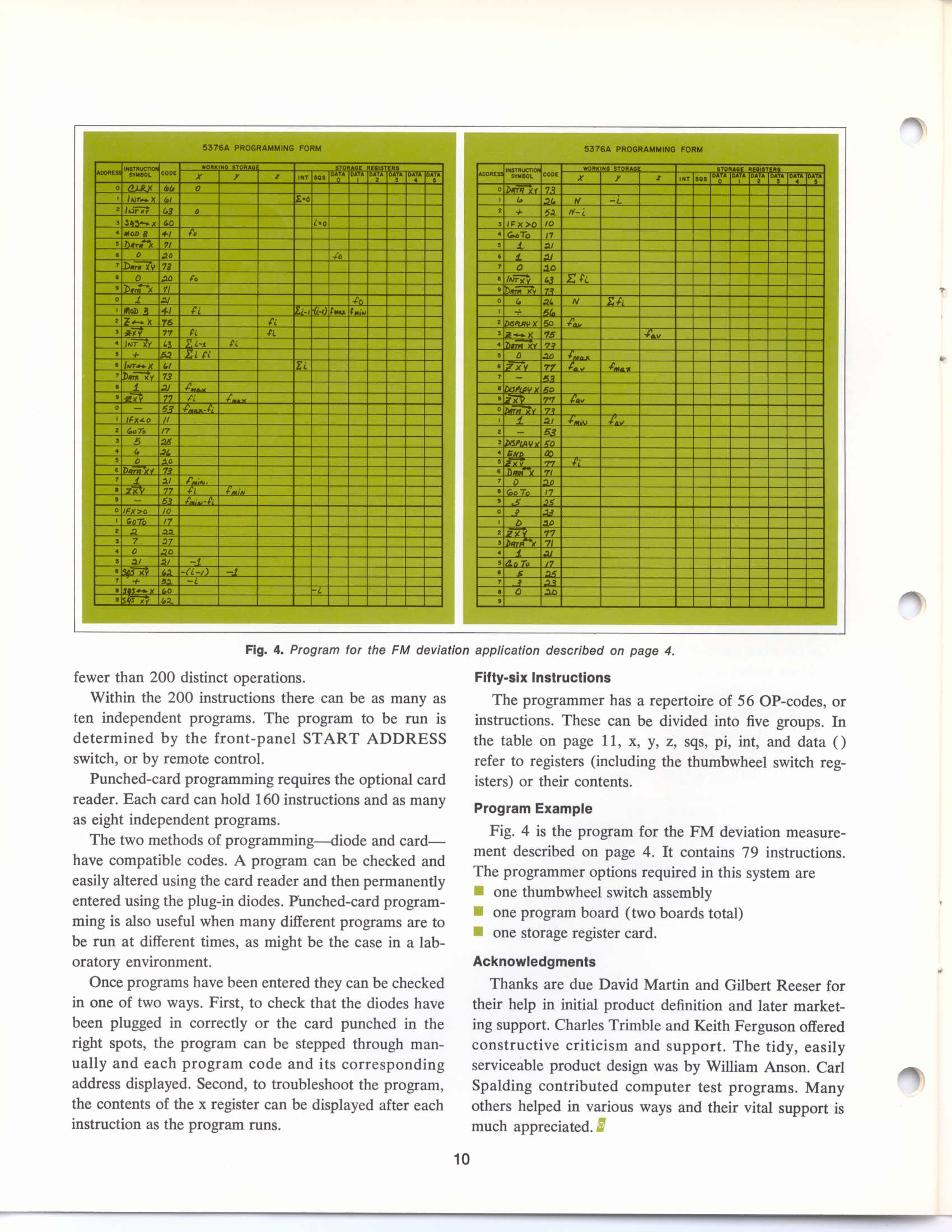
For example, the 79-step ADEV program is here:

http://www.leapsecond.com/hpj/v22n4/v22n4p10.jpg

Finally, do not miss HP AN116 "Precision Frequency Measurements":

http://www.hpmemoryproject.org/an/pdf/an_116.pdf

/tvb

----- Original Message -----
From: "John Ackermann N8UR" <[email protected]>
To: <[email protected]>
Sent: Wednesday, April 13, 2016 9:38 AM
Subject: [time-nuts] HP 5360A History?
I was browsing through the HP Journal archives and came across the May,
1969 issue, dedicated to the new 5360A Computing Counter -- "An
Electronic Counter for the 1970s!"

I don't recall hearing much about these in time-nuts lore.  I can guess
from the Journal articles that it was a beast to keep running and was
very expensive (500 ICs and a 10A 5V power supply).

Is anyone here familiar with the story of this product?

John
_______________________________________________
time-nuts mailing list -- [email protected]
To unsubscribe, go to
https://www.febo.com/cgi-bin/mailman/listinfo/time-nuts
and follow the instructions there.
_______________________________________________
time-nuts mailing list -- [email protected]
To unsubscribe, go to
https://www.febo.com/cgi-bin/mailman/listinfo/time-nuts
and follow the instructions there.
_______________________________________________
time-nuts mailing list -- [email protected]
To unsubscribe, go to https://www.febo.com/cgi-bin/mailman/listinfo/time-nuts
and follow the instructions there.