So, are you measuring OCXO stability or EFC stability?
Bob
 -----------------------------------------------------------------
AE6RV.com
GFS GPSDO list:
groups.yahoo.com/neo/groups/GFS-GPSDOs/info

      From: Tom Van Baak <[email protected]>
 To: Discussion of precise time and frequency measurement <[email protected]>
 Sent: Saturday, November 12, 2016 3:54 PM
 Subject: [time-nuts] quartz drift rates, linear or log

There were postings recently about OCXO ageing, or drift rates.

I've been testing a batch of TBolts for a couple of months and it provides an
interesting set of data from which to make visual answers to recent questions.
Here are three plots.


1) attached plot: TBolt-10day-fit0-e09.gif (
http://leapsecond.com/pages/tbolt/TBolt-10day-fit0-e09.gif )

A bunch of oscillators are measured with a 20-channel system. Each frequency
plot is a free-running TBolt (no GPS, no disciplining). The X-scale is 10 days
and the Y-scale is 1 ppb, or 1e-9 per Y-division. What you see at this scale is
that all the OCXO are quite stable. Also, some of them show drift.

For example, the OCXO frequency in channel 14 changes by 2e-9 in 10 days for a
drift rate of 2e-10/day. It looks large in this plot but its well under the
typical spec, such as 5e-10/day for a 10811A. We see a variety of drift rates,
including some that appear to be zero: flat line. At this scale, CH13, for
example, seems to have no drift.

But the drift, when present, appears quite linear. So there are two things to
do. Zoom in and zoom out.


2) attached plot: TBolt-10day-fit0-e10.gif (
http://leapsecond.com/pages/tbolt/TBolt-10day-fit0-e10.gif )

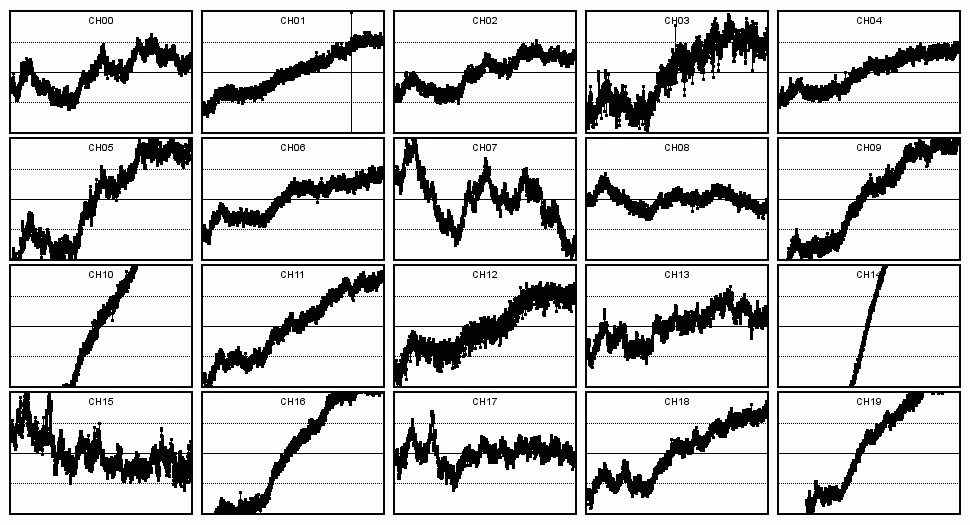
Here we zoom in by changing the Y-scale to 1e-10 per division. The X-scale is
still 10 days. Now we can see the drift much better. Also at this level we can
see instability of each OCXO (or the lab environment). At this scale, channels
CH10 and CH14 are "off the chart". An OCXO like the one in CH01 climbs by 2e-10
over 10 days for a drift rate of 2e-11/day. This is 25x better than the 10811A
spec. CH13, mentioned above, is not zero drift after all, but its drift rate is
even lower, close to 1e-11/day.

For some oscillators the wiggles in the data (frequency instability) are large
enough that the drift rate is not clearly measurable.

The 10-day plots suggests you would not want to try to measure drift rate based
on just one day of data.

The plots also suggest that drift rate is not a hard constant. Look at any of
the 20 10-day plots. Your eye will tell you that the daily drift rate can
change significantly from day to day to day.

The plots show that an OCXO doesn't necessarily follow strict rules. In a sense
they each have their own personality. So one needs to be very careful about
algorithms that assume any sort of constant or consistent behavior.


3) attached plot: TBolt-100day-fit0-e08.gif (
http://leapsecond.com/pages/tbolt/TBolt-100day-fit0-e08.gif )

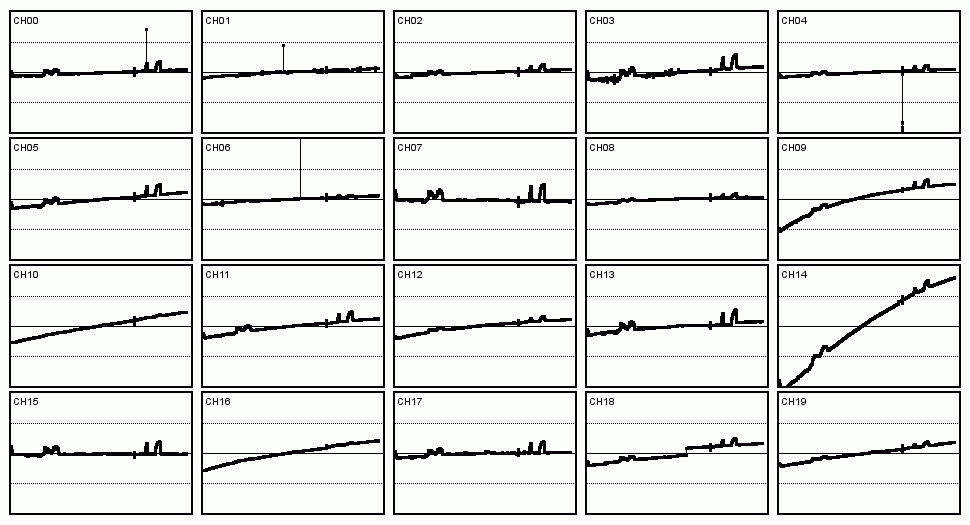
Here we look at 100 days of data instead of just 10 days. To fit, the Y-scale
is now 1e-8 per division. Once a month I created a temporary thermal event in
the lab (the little "speed bumps") which we will ignore for now.

At this long-term scale, OCXO in CH09 has textbook logarithmic drift. Also CH14
and CH16. In fact over 100 days most of them are logarithmic but the
coefficients vary considerably so it's hard to see this at a common scale. Note
also the logarithmic curve is vastly more apparent in the first few days or
weeks of operation, but I don't have that data.

In general, any exponential or log or parabolic or circular curve looks linear
if you're looking close enough. A straight highway may look linear but the
equator is circular. So most OCXO drift (age) with a logarithmic curve and this
is visible over long enough measurements. But for shorter time spans it will
appear linear. Or, more likely, internal and external stability issues will
dominate and this spoils any linear vs. log discussion.

So is it linear or log? The answer is it depends. Now I sound like Bob ;-)

/tvb
_______________________________________________
time-nuts mailing list -- [email protected]
To unsubscribe, go to https://www.febo.com/cgi-bin/mailman/listinfo/time-nuts
and follow the instructions there.


_______________________________________________
time-nuts mailing list -- [email protected]
To unsubscribe, go to https://www.febo.com/cgi-bin/mailman/listinfo/time-nuts
and follow the instructions there.