Those are wonderful plots :)

I vaguely recall that a 1ppm frequency shift is approximately equivalent to
the mass transfer of one molecular layer of a crystal. So at some point
your counting atoms if there was no noise, thermal disturbance, mechanical
disturbance...
On Sat, Nov 12, 2016 at 5:00 PM Tom Van Baak <[email protected]> wrote:

> There were postings recently about OCXO ageing, or drift rates.
>
> I've been testing a batch of TBolts for a couple of months and it provides
> an interesting set of data from which to make visual answers to recent
> questions. Here are three plots.
>
>
> 1) attached plot: TBolt-10day-fit0-e09.gif (
> http://leapsecond.com/pages/tbolt/TBolt-10day-fit0-e09.gif )
>
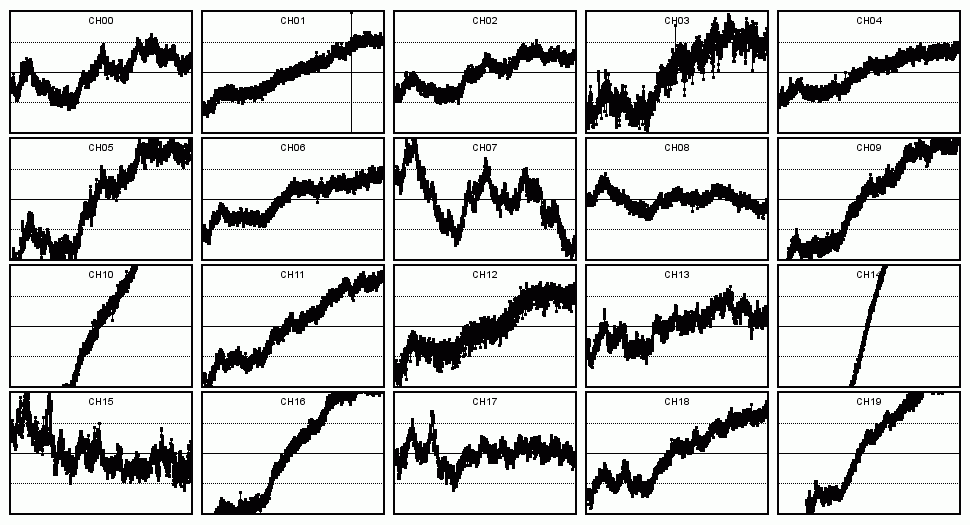
> A bunch of oscillators are measured with a 20-channel system. Each
> frequency plot is a free-running TBolt (no GPS, no disciplining). The
> X-scale is 10 days and the Y-scale is 1 ppb, or 1e-9 per Y-division. What
> you see at this scale is that all the OCXO are quite stable. Also, some of
> them show drift.
>
> For example, the OCXO frequency in channel 14 changes by 2e-9 in 10 days
> for a drift rate of 2e-10/day. It looks large in this plot but its well
> under the typical spec, such as 5e-10/day for a 10811A. We see a variety of
> drift rates, including some that appear to be zero: flat line. At this
> scale, CH13, for example, seems to have no drift.
>
> But the drift, when present, appears quite linear. So there are two things
> to do. Zoom in and zoom out.
>
>
> 2) attached plot: TBolt-10day-fit0-e10.gif (
> http://leapsecond.com/pages/tbolt/TBolt-10day-fit0-e10.gif )
>
> Here we zoom in by changing the Y-scale to 1e-10 per division. The X-scale
> is still 10 days. Now we can see the drift much better. Also at this level
> we can see instability of each OCXO (or the lab environment). At this
> scale, channels CH10 and CH14 are "off the chart". An OCXO like the one in
> CH01 climbs by 2e-10 over 10 days for a drift rate of 2e-11/day. This is
> 25x better than the 10811A spec. CH13, mentioned above, is not zero drift
> after all, but its drift rate is even lower, close to 1e-11/day.
>
> For some oscillators the wiggles in the data (frequency instability) are
> large enough that the drift rate is not clearly measurable.
>
> The 10-day plots suggests you would not want to try to measure drift rate
> based on just one day of data.
>
> The plots also suggest that drift rate is not a hard constant. Look at any
> of the 20 10-day plots. Your eye will tell you that the daily drift rate
> can change significantly from day to day to day.
>
> The plots show that an OCXO doesn't necessarily follow strict rules. In a
> sense they each have their own personality. So one needs to be very careful
> about algorithms that assume any sort of constant or consistent behavior.
>
>
> 3) attached plot: TBolt-100day-fit0-e08.gif (
> http://leapsecond.com/pages/tbolt/TBolt-100day-fit0-e08.gif )
>
> Here we look at 100 days of data instead of just 10 days. To fit, the
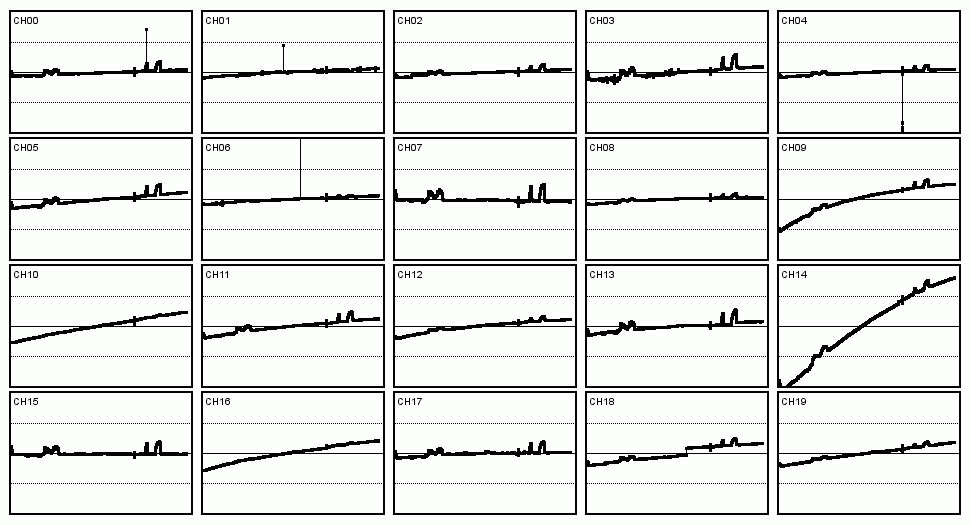
> Y-scale is now 1e-8 per division. Once a month I created a temporary
> thermal event in the lab (the little "speed bumps") which we will ignore
> for now.
>
> At this long-term scale, OCXO in CH09 has textbook logarithmic drift. Also
> CH14 and CH16. In fact over 100 days most of them are logarithmic but the
> coefficients vary considerably so it's hard to see this at a common scale.
> Note also the logarithmic curve is vastly more apparent in the first few
> days or weeks of operation, but I don't have that data.
>
> In general, any exponential or log or parabolic or circular curve looks
> linear if you're looking close enough. A straight highway may look linear
> but the equator is circular. So most OCXO drift (age) with a logarithmic
> curve and this is visible over long enough measurements. But for shorter
> time spans it will appear linear. Or, more likely, internal and external
> stability issues will dominate and this spoils any linear vs. log
> discussion.
>
> So is it linear or log? The answer is it depends. Now I sound like Bob ;-)
>
> /tvb
> _______________________________________________
> time-nuts mailing list -- [email protected]
> To unsubscribe, go to
> https://www.febo.com/cgi-bin/mailman/listinfo/time-nuts
> and follow the instructions there.
_______________________________________________
time-nuts mailing list -- [email protected]
To unsubscribe, go to https://www.febo.com/cgi-bin/mailman/listinfo/time-nuts
and follow the instructions there.