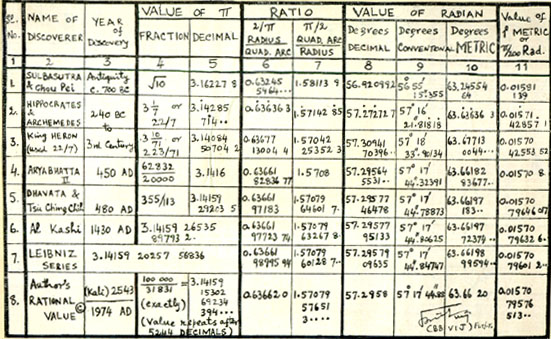
There are times today when one has to use very small microcontrollers -- that
is computers which do not support floating point arithmetic -- and the
programmer has to deal with so-called real numbers. These can best be dealt
with using rational number arithmetic to acheive the fastest and best
approximations to real numbers.
marion moon

------ Original Message ------
Received: Sat, 15 Oct 2005 08:16:36 PM PDT
From: "Daniel" <[EMAIL PROTECTED]>
To: <[EMAIL PROTECTED]>,        "U.S. Metric Association" <[email protected]>
Subject: Re: [USMA:34887] Re: common fractions fail for some numbers

I don't know why we need to care about a fractional representation of π.
There was a time in the past when such was needed, and that was in the days of
doing math with complex logarithms on a slide rule.  This is the 21-st
century, we use calculators.  If I want to know the value of π, I press the
π key on my calculator and get a number more accurate then any fractional
representation can ever hope to give me.

If you run Windows, you can run a program called calc.exe, I can with the
click of a mouse have it display the value of π as:
3.1415926535897932384626433832795.  Can any fraction display this much
accuracy?  Fractions are obsolete, we really need to forget about them.

Dan

----- Original Message -----
From: "m.f.moon" <[EMAIL PROTECTED]>
To: "U.S. Metric Association" <[email protected]>
Sent: Saturday, 2005-10-15 14:56
Subject: [USMA:34887] Re: common fractions fail for some numbers


> For another data point, the next regular convergent of the rational
fraction
> expansion of pi is 102573/32650 which has an error of 2.2x10^-8. There are
> many other ratios between 355/113 and the above one which will yield small
> ratios and better accuracy if you want the take the time to find them.
>
> marion moon
>
> ------ Original Message ------
> Received: Wed, 12 Oct 2005 06:24:25 AM PDT
> From: Pierre Abbat <[EMAIL PROTECTED]>
> To: "U.S. Metric Association" <[email protected]>
> Subject: [USMA:34819] Re: common fractions fail for some numbers
>
> On Wednesday 12 October 2005 03:09, Brij Bhushan Vij wrote:
>> Pierre Abbat & list:
>> The Pi question has been discussed several times over. If Pi is the ratio
>> between circumference to the diametre of a circle, the BEST and only
>> fractional value for Pi in the form *a/b ratio* happen to be simple:
>> 100000/31831, which also defines the angle radian at 57.2958 degree. Also,
>> visit: http://www.the-light.com/cal/bbv_pi-radian.jpg
>
> 100000/31831 is off by 1.1e-6. 355/113 is off by only 0.3e-6.
>
> phma
>
>
>
>
>
>
> --
> No virus found in this incoming message.
> Checked by AVG Anti-Virus.
> Version: 7.0.344 / Virus Database: 267.12.0/134 - Release Date: 2005-10-14
>
>