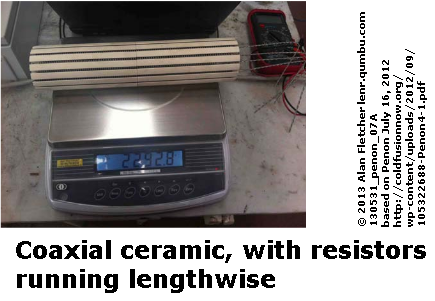
Jones,  I believe you are mistaken.  The bottom picture shows the thick
alumina (probably not high purity, but rather an AlSiMag blend) with the
slots for the resistor wires in the middle.  Inside this is only the
stainless tube - blackened by the refractory sealant they put over that
whole end in that vintage of HotCat (the ends are different on the new
design of the "Independent Test".  Then there is the outer tube about 4-5mm
thick which we are told is SiN (plausible).  I don't think there is
anything between the alumina resistor assembly and the stainless tube.
On Thu, Jul 4, 2013 at 5:10 PM, Jones Beene <[email protected]> wrote:

>
>
>                 From: Jed Rothwell
>
>                 If Rossi was using corundum, then carborundum would seem
> like an improvement, but it is important to track down the actual
> composition of what was used in the December test.
>
>                 I asked about this while correcting typos in the paper. One
> of the authors told me it was "corundum, corindone in Italian."
>
>
> Thanks - it is a bit of a surprise. It is true that the fluted cylinder
> with
> the slots - which holds the resistance wire could easily be corundum which
> is light-colored. Carborundum is blacker than black.
>
> This picture on Alan's site shows the proper coloration of corundum
>
> http://lenr.qumbu.com/web_hotcat_pics/130531_penon_07A.png
>
> But this picture, below it - shows a black cylinder inside the HotCat where
> another separate cylinder should be, and it is not light colored and not
> stainless.
>
> http://lenr.qumbu.com/web_hotcat_pics/130531_penon_08A.png
>
> Therefore I am still of the opinion - but without any real evidence other
> than this picture, that the ceramic which holds the stainless steel capsule
> is carborundum or SiC.
>
> Jones
>