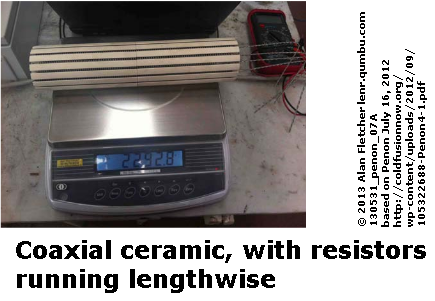
The photo links you supplied appear to be from Fabio Penon's report of
8/7/2012.  In this report, he states that this inner tube is stainless
steel painted with a "black coating, heat resistant to 1200C".  He also
says that in this early HotCat, the outer cylinder is painted stainless.
 Also, it appears that the inner stainless tube is open to the air (thru)
and it is not stated where the ingredients are contained.  The paint
appears to be to maximize the emissivity.
In this older HotCat I surmise that the inner SS tube may actually be
comprised of 2 coaxial tubes with the ingredients between them in a thin
layer.  Then the ends are welded closed (hot or cold welded) and it looks
like a single, thick monolithic stainless tube.  The Penon report states
that the inner tube is painted on the inside and the outside.

On Thu, Jul 4, 2013 at 6:12 PM, Jones Beene <[email protected]> wrote:

>  Bob,****
>
> ** **
>
> Did you blow the image up?  (thanks to Alan for having all of this info
> handy)****
>
> ** **
>
> I could be wrong, but the tube in question still looks to be far too thick
> to be blackened stainless - and there is no sign of metal at all – it looks
> black all the way in. Plus there is no sign of the markings of a
> hammered-in fitting which would cause metal damage. I think its thickness
> and color is consistent with SiC and the stainless capsule has been
> removed. ****
>
> ** **
>
> The lack of an end cap (or evidence that one was ever there) also makes me
> think that this tube is not steel.****
>
> ** **
>
> ** **
>
> *From:* Bob Higgins ****
>
> ** **
>
> Jones,  I believe you are mistaken.  The bottom picture shows the thick
> alumina (probably not high purity, but rather an AlSiMag blend) with the
> slots for the resistor wires in the middle.  Inside this is only the
> stainless tube - blackened by the refractory sealant they put over that
> whole end in that vintage of HotCat (the ends are different on the new
> design of the "Independent Test".  Then there is the outer tube about 4-5mm
> thick which we are told is SiN (plausible).  I don't think there is
> anything between the alumina resistor assembly and the stainless tube.****
>
> ** **
>
> On Thu, Jul 4, 2013 at 5:10 PM, Jones Beene <[email protected]> wrote:**
> **
>
>
>
>                 From: Jed Rothwell
>
>                 If Rossi was using corundum, then carborundum would seem
> like an improvement, but it is important to track down the actual
> composition of what was used in the December test.
>
>                 I asked about this while correcting typos in the paper. One
> of the authors told me it was "corundum, corindone in Italian."
>
>
> Thanks - it is a bit of a surprise. It is true that the fluted cylinder
> with
> the slots - which holds the resistance wire could easily be corundum which
> is light-colored. Carborundum is blacker than black.
>
> This picture on Alan's site shows the proper coloration of corundum
>
> http://lenr.qumbu.com/web_hotcat_pics/130531_penon_07A.png
>
> But this picture, below it - shows a black cylinder inside the HotCat where
> another separate cylinder should be, and it is not light colored and not
> stainless.
>
> http://lenr.qumbu.com/web_hotcat_pics/130531_penon_08A.png
>
> Therefore I am still of the opinion - but without any real evidence other
> than this picture, that the ceramic which holds the stainless steel capsule
> is carborundum or SiC.
>
> Jones****
>