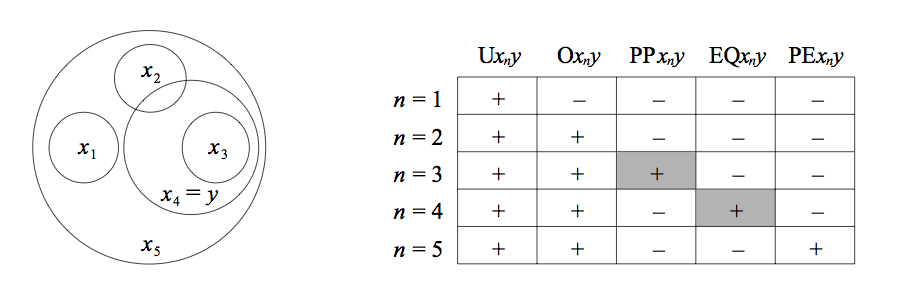
I think we should drop "part of" and start using a better mereological
system
https://en.wikipedia.org/wiki/Mereology#Various_systems
http://plato.stanford.edu/entries/mereology/image1.png
Cheers,
Micru


On Tue, Jun 10, 2014 at 8:05 PM, Joe Filceolaire <[email protected]>
wrote:

> Even where there is complete agreement that a human settlement is a 'city'
> there is still usually a question over the population of that city. The
> question is down to what to include.
>
> A city in many cases is understood to include the contiguous built up area
> but this will often extend far beyond the original administrative region
> that bears the name. So we have the "City of London" (the central business
> district, corresponding to the medieval and Roman city), "Greater London"
> (The collection of contiguous urban boroughs that area part of the Greater
> London administrative entity - ironically this does not include the "City
> of London" but does include the "City of Westminster"), all the built up
> areas out to the "Metropolitan green belt" (includes bits of every county
> adjacent to Greater London), or all areas within commuting distance of
> Central London (with the train services this includes a lot of area and it
> is getting bigger as faster trains are deployed).
>
> When do two cities become one? London and Westminster? Buda and Pest?
> Minneapolis and St Paul? Dallas and Fort Worth? Kansas MI and Kansas KA?
> Dusseldorf, Essen and Dortmund? Detroit and Windsor?
>
> Joe
>
>
> On Tue, Jun 10, 2014 at 12:50 PM, Andrew Gray <[email protected]>
> wrote:
>
>> On 10 June 2014 09:20, Markus Krötzsch <[email protected]>
>> wrote:
>>
>> > The class "city" is used for "relatively large and permanent human
>> > settlement[s]" [1], which does not say much (because the vagueness of
>> > "relatively"). Maybe we should even wonder if "city" is a good class to
>> use
>> > in Wikidata. Saying that something has been awarded city status in the
>> UK
>> > (Q1867820) has a clear meaning. Saying that something is a "human
>> > settlement" is also rather clear. But drawing the line between
>> "village",
>> > "city" and "town" is quite tricky, and will probably never be done
>> uniformly
>> > across the data.
>> >
>> > Conclusion: if you are looking for, say, human settlements with more
>> than
>> > 100k inhabitants, then you should be searching for just that (which I
>> think
>> > is basically what you also are saying below :-).
>>
>> OSM has had a lot of problems with this as well, I think - labelling
>> something as a "city" is one of those very slippery terms that
>> everyone thinks is obvious but never quite agrees on what the obvious
>> bit is :-)
>>
>> I wonder if we should think about how best to make sure people know
>> this. Perhaps there is a role for the "human-readable" pages to have
>> disambiguation-type notes on them? "If you are aiming to do a search
>> based on "instances of 'city'", we recommend you try "instances of
>> 'human settlement'" instead..."
>>
>> --
>> - Andrew Gray
>>   [email protected]
>>
>> _______________________________________________
>> Wikidata-l mailing list
>> [email protected]
>> https://lists.wikimedia.org/mailman/listinfo/wikidata-l
>>
>
>
> _______________________________________________
> Wikidata-l mailing list
> [email protected]
> https://lists.wikimedia.org/mailman/listinfo/wikidata-l
>
>


--
Etiamsi omnes, ego non
_______________________________________________
Wikidata-l mailing list
[email protected]
https://lists.wikimedia.org/mailman/listinfo/wikidata-l