Hoi,

I fear that when words like mereology are expected to be understood, we
will fall into the trap where our communities fear what we have been
sniffing. It will just alienate them.
Part of is something that is understood. There may be academic reasons that
make sense to the people who care about them. The question I think we
should take serious is if that is really where we want to go.
Thanks,
     GerardM


On 10 June 2014 20:21, David Cuenca <[email protected]> wrote:

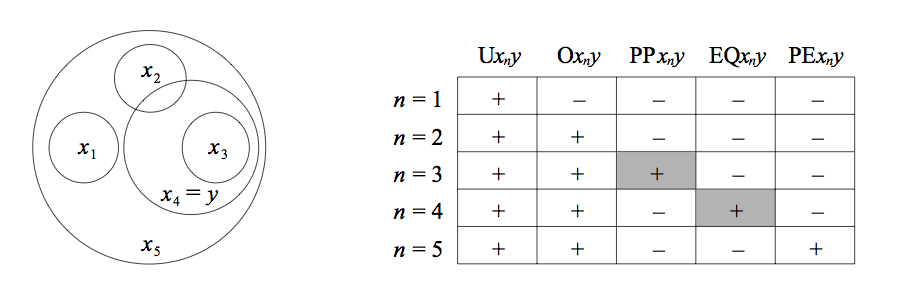
> I think we should drop "part of" and start using a better mereological
> system
> https://en.wikipedia.org/wiki/Mereology#Various_systems
> http://plato.stanford.edu/entries/mereology/image1.png
>
> Cheers,
> Micru
>
>
> On Tue, Jun 10, 2014 at 8:05 PM, Joe Filceolaire <[email protected]>
> wrote:
>
>> Even where there is complete agreement that a human settlement is a
>> 'city' there is still usually a question over the population of that city.
>> The question is down to what to include.
>>
>> A city in many cases is understood to include the contiguous built up
>> area but this will often extend far beyond the original administrative
>> region that bears the name. So we have the "City of London" (the central
>> business district, corresponding to the medieval and Roman city), "Greater
>> London" (The collection of contiguous urban boroughs that area part of the
>> Greater London administrative entity - ironically this does not include the
>> "City of London" but does include the "City of Westminster"), all the built
>> up areas out to the "Metropolitan green belt" (includes bits of every
>> county adjacent to Greater London), or all areas within commuting distance
>> of Central London (with the train services this includes a lot of area and
>> it is getting bigger as faster trains are deployed).
>>
>> When do two cities become one? London and Westminster? Buda and Pest?
>> Minneapolis and St Paul? Dallas and Fort Worth? Kansas MI and Kansas KA?
>> Dusseldorf, Essen and Dortmund? Detroit and Windsor?
>>
>> Joe
>>
>>
>> On Tue, Jun 10, 2014 at 12:50 PM, Andrew Gray <[email protected]>
>> wrote:
>>
>>> On 10 June 2014 09:20, Markus Krötzsch <[email protected]>
>>> wrote:
>>>
>>> > The class "city" is used for "relatively large and permanent human
>>> > settlement[s]" [1], which does not say much (because the vagueness of
>>> > "relatively"). Maybe we should even wonder if "city" is a good class
>>> to use
>>> > in Wikidata. Saying that something has been awarded city status in the
>>> UK
>>> > (Q1867820) has a clear meaning. Saying that something is a "human
>>> > settlement" is also rather clear. But drawing the line between
>>> "village",
>>> > "city" and "town" is quite tricky, and will probably never be done
>>> uniformly
>>> > across the data.
>>> >
>>> > Conclusion: if you are looking for, say, human settlements with more
>>> than
>>> > 100k inhabitants, then you should be searching for just that (which I
>>> think
>>> > is basically what you also are saying below :-).
>>>
>>> OSM has had a lot of problems with this as well, I think - labelling
>>> something as a "city" is one of those very slippery terms that
>>> everyone thinks is obvious but never quite agrees on what the obvious
>>> bit is :-)
>>>
>>> I wonder if we should think about how best to make sure people know
>>> this. Perhaps there is a role for the "human-readable" pages to have
>>> disambiguation-type notes on them? "If you are aiming to do a search
>>> based on "instances of 'city'", we recommend you try "instances of
>>> 'human settlement'" instead..."
>>>
>>> --
>>> - Andrew Gray
>>>   [email protected]
>>>
>>> _______________________________________________
>>> Wikidata-l mailing list
>>> [email protected]
>>> https://lists.wikimedia.org/mailman/listinfo/wikidata-l
>>>
>>
>>
>> _______________________________________________
>> Wikidata-l mailing list
>> [email protected]
>> https://lists.wikimedia.org/mailman/listinfo/wikidata-l
>>
>>
>
>
> --
> Etiamsi omnes, ego non
>
> _______________________________________________
> Wikidata-l mailing list
> [email protected]
> https://lists.wikimedia.org/mailman/listinfo/wikidata-l
>
>
_______________________________________________
Wikidata-l mailing list
[email protected]
https://lists.wikimedia.org/mailman/listinfo/wikidata-l