On Sun, Aug 26, 2012 at 12:25 PM, [email protected]
<[email protected]>wrote:
> I don't know how the brain performs abstraction, but it's pretty easy to
> come up with ways to do it in a program.
>
> You can't see how a pattern is a patterned concept because you don't
> understand classes, subclasses, and instances. I make patterns every day
> when I write code.
>
>
>

And with experience like that, (especially if it is mixed with
some experiences with graphics and with some analysis of questions like
this), it is hard not to be able to find patterns and hidden patterns in
the things and the ideas around you.  The complication is not in finding
patterns but in finding patterns that are so useful that they provide you
with the leverage to do things that you could never have done before.
Jim Bromer


On Sun, Aug 26, 2012 at 12:25 PM, [email protected]
<[email protected]>wrote:

> I don't know how the brain performs abstraction, but it's pretty easy to
> come up with ways to do it in a program.
>
> You can't see how a pattern is a patterned concept because you don't
> understand classes, subclasses, and instances. I make patterns every day
> when I write code. The code then uses these patterns (called "classes" in
> my profession) to generalize over many different types of objects. It's
> called a class inheritance, and the broader subject area is called object
> oriented programming (OOP). It's not even new technology -- it's a tool we
> already have. And it was specifically designed out of even older tools we
> had, for one purpose: generalization of a pattern over many different types
> of objects. No "fluid form transformations" (whatever that means) necessary.
>
> And since you are judging others for their lack of creativity, I thought
> it might be appropriate to ask for examples of your own creativity, which
> give you the right to judge. Are you working on an AGI project? Has any
> part of it been tested? Does any part of it work at all? What are the
> radically new ideas and tools you're using to build it?
>
>
>
> ------------------------------
> On Aug 26, 2012 6:32 AM, Mike Tintner <[email protected]> wrote:
>
>  You’re not focussing on the issue – which is HOW does the brain
> conceptualise – and in this case how does the brain see sets of  EXTREMELY
> DIFFERENT shapes – sets of “e”/”g”/”h” – or sets of natural objects like
> poplars, rocks, mountains etc -  as all ALIKE/SIMILAR sets of shapes.
>
> In order to liken these diverse shapes, the brain -  in conceptualising/
> visual-object-recognizing – has to perform an extraordinary act of
> transformation.
>
> It has transform all these different shapes into  some universally
> applicable base shape like 1’s   or the circles of abacus beads.
>
> A “g” into a “1”. A mountain into a “1”. A snake into a “1”.
>
> And even the base “1” is not a typographical constant form.  The brain can
> work with notches on a wooden surface or clay – each of those notches being
> different in shape – and then transform them again into idealised straight
> lines..
>
> To see the diverse shapes of the world as “1”s, therefore, involves *fluid
> form transformations* – they are obviously not patterned (set-form)
> transformations. There is no patterned way of turning vastly irregular
> objects into perfect regular forms.
>
> So recognizing a pattern is not a patterned operation.
>
> And a whole class of  “patterns” –incl. the groups you instance below, as
> well as poplars, mountains rocks etc  – do not, taken as a whole, form a
> pattern.
>
> “Pattern” is not a patterned concept. No concept is. And recognizing a
> pattern is not a patterned operation.
>
> You, like others, are always – always – bent here in everything you do on
> one purpose: “how do I make the tools I already have work to solve AGI” -
> “at all costs, I must use the tools I have – because I am simply not
> creative enough to think of anything else”.
>
> Creative problems don’t get solved by using the tools you already have.
> You have to come up with radically new ideas and tools.
>
> You cannot “scale up” narrow AI to AGI – that is the attitude of a
> logicomathematical clerk, not a true creative.
>
>   *From:* Jim Bromer <[email protected]>
> *Sent:* Sunday, August 26, 2012 11:27 AM
> *To:* AGI <[email protected]>
> *Subject:* Re: [agi] Pattern: definition & incremental syntax.. P.S.
>
>  To counter this, instead of an abstract “9”, try thinking in terms of a
> graphic representation of the concept, such as “ l l l l l l l l l” - (all
> concepts can and should be depicted graphically).
>   Now it’s easier to see that while a concept may appear patterned
> intrinsically, its REFERENTS are not. “Nine” or “seven” real poplar trees
> will come in diverse, unpatterned forms, like those of Monet, not in
> identically patterned lines like those of maths. Ditto nine or seven rocks,
> snakes, apples etc.
>  -----------------------------------------------------------------
>
> 9 repeated typographical characters (like "l l l l l l l l l" is the most
> primitive form of patterns and the referent of the cardinal number does -of
> course- refer to the pattern).  However, it is so useful to think of
> something that is a type that can be drawn from a pattern (like any
> typographical character) that we may start thinking of collections of
> patterns as patterns.  Name everything that is repeated in this collection:
>
> l l l l l
>
> e e e e e
>
> g g g g g
>
> h h h h h
>
> a a a a a
>
> Not only is "l", "e", "g", "h" and "a" repeated 5 times but there are also
> 5 groups of the 5 typographical characters.  Problems like this are useful
> to help people who are capable of dealing with unconventional insights to
> do so. Being able to work with ideas like this is a sign of intelligence
> and child-level maturity.  So the dull conventionalist (who is aware of one
> of the narrowest definition of the idea of pattern) might only see 5
> separate patterns but the more intelligent person will be able to deal with
> the less conventional insight that there are also 5 different examples.  If
> you can see that different typographical characters might be taken as being
> -of a type- then you should be able to understand what we are talking
> about.  Being able to understand stuff like this is very important in
> computer programming since you may want to treat a type as a pure variable
> representation.  If you can't accept that then you are not talking about
> the same thing the rest of us are talking about.
> Jim Bromer
>
> On Fri, Aug 24, 2012 at 4:23 PM, Mike Tintner <[email protected]>wrote:
>
>>   Look at the elements referred to by the concepts I listed – they are
>> *not* “common elements”.   They can all be “diverse*/uncommon elements.
>>
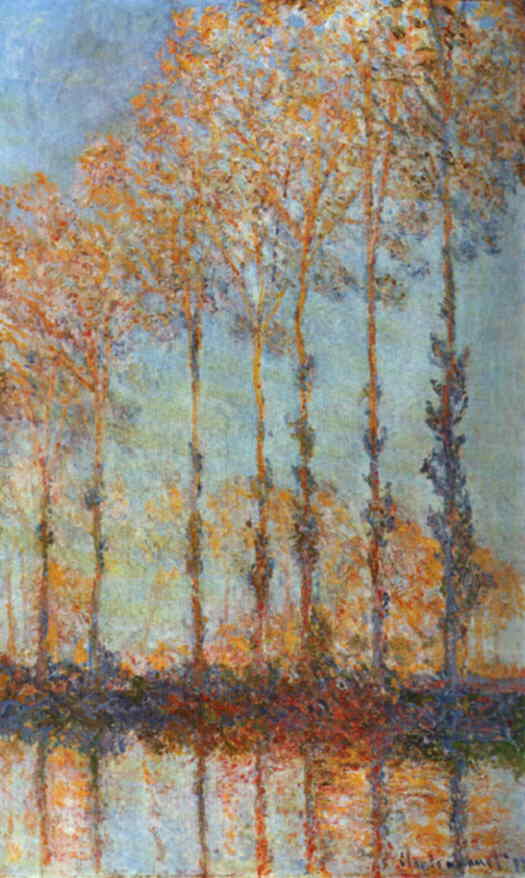
>>  Here, for example,  are “7” poplars:
>>
>>
>> http://www.ibiblio.org/wm/paint/auth/monet/poplars-epte/monet.poplars-epte.jpg
>>
>>  They do not classify as common elements. Each poplar is a different and
>> individual form.  They do not form a pattern.
>>
>>  Concepts create the “illusion” of referring to common elements/objects
>> (and therefore patterns) because of their apparent, *intrinsic* form - the
>> way they are spelled or numbered.
>>
>>  C-H-A-I-R is always spelled the same way therefore surely there must be
>> an essential chair or chair pattern as Plato thought.
>>
>>  “9” is always spelled/numbered the same way, therefore surely there
>> must be an essential number or pattern.
>>
>>  (In fact, even that is an untrue illusion because all concepts can be
>> spelled and/or numbered with many diverse fonts!).
>>
>>  To counter this, instead of an abstract “9”, try thinking in terms of
>> a graphic representation of the concept,  such as    “ l l l l l l l l l”
>> - (all concepts can and should be depicted graphically).
>>
>>  Now it’s easier to see that while a concept may appear patterned
>> intrinsically,  its REFERENTS are not.   “Nine” or “seven” real poplar
>> trees will come in diverse, unpatterned forms, like those of Monet, not in
>> identically patterned lines like those of maths. Ditto nine or seven rocks,
>> snakes, apples etc.
>>
>>  The real world referents of concepts and numbers don’t come in neatly
>> patterned forms let alone patterned groups.
>>
>>  And each concept can refer to “all kinds of things” -   all kinds of
>> poplars/trees, all kinds of chairs, rocks, streams, clouds etc. – which can
>> come in “all shapes, sizes and forms” not in uniform patterns..
>>
>>  Ben and Boris and you probably, don’t realise that concepts don’t refer
>> to a patterned real world, because you all live and breathe this artificial
>> logicomathematical world of perfectly patterned numbers and letters cut off
>> from the real world -   at a metacognitive level, you never really apply
>> your concepts to the real world
>>
>>
>>
>>   *From:* Aaron Hosford <[email protected]>
>> *Sent:* Friday, August 24, 2012 8:02 PM
>>  *To:* AGI <[email protected]>
>> *Subject:* Re: [agi] Pattern: definition & incremental syntax.. P.S.
>>
>>  "9" *is* the pattern. The rest of the details are parameters to that
>> pattern. I don't know if you program or not, but if you do, "9" would be a
>> class, and all the examples would be instances. You state the name of a
>> pattern, and then look at the context surrounding it and ask where it is.
>> You're subtracting out what you're looking for before you look for it, so
>> it's no wonder you can't see it.
>>
>>
>> On Fri, Aug 24, 2012 at 1:55 PM, Mike Tintner
>> <[email protected]>wrote:
>>
>>> Those are really conceptual complexes.
>>>
>>> But it doesn't matter.
>>>
>>> Let's start with the obvious, "simple" concept of  "9"  .
>>>
>>> Which can refer to nine *abstract entities*, *trees*, *snakes*,
>>> *boxes*  -
>>>
>>> or a "broken nine",  or a "an inflated nine"  or *nine diverse objects*
>>> or *a mixed-up nine*
>>>
>>> or * ......... *  or  " ^ /. h k < X ,@ "
>>>
>>> or
>>>
>>> Where's the pattern?
>>>
>>> [The same reasoning/examples applies to all the equations taken as
>>> wholes].
>>>
>>> All the equations you cite, like the whole of maths and logic, are
>>> patterned, specific *applications*/examples of given concepts.
>>>
>>> But maths does not and cannot use concepts wholly/ properly with their
>>> open-ended realms of reference.
>>>
>>> Concepts like "Line" and "number" in ordinary language can embrace
>>> infinite examples, which are non-mathematical and which mathematics
>>> wouldn't go near.
>>>
>>>
>>>
>>> -----Original Message----- From: Matt Mahoney
>>> Sent: Friday, August 24, 2012 7:29 PM
>>> To: AGI
>>> Subject: Re: [agi] Pattern: definition & incremental syntax.. P.S.
>>>
>>>
>>> On Fri, Aug 24, 2012 at 2:19 PM, Mike Tintner <[email protected]>
>>> wrote:
>>>
>>>> show one single concept in the whole of *MATHEMATICS* or *LOGIC* that is
>>>> patterned.
>>>>
>>>
>>> 9 x 9 + 7 = 88
>>> 98 x 9 + 6 = 888
>>> 987 x 9 + 5 = 8888
>>> 9876 x 9 + 4 = 88888
>>> 98765 x 9 + 3 = 888888
>>> 987654 x 9 + 2 = 8888888
>>> 9876543 x 9 + 1 = 88888888
>>>
>>>
>>> -- Matt Mahoney, [email protected]
>>>
>>>
>>> ------------------------------**-------------
>>> AGI
>>> Archives:
>>> https://www.listbox.com/**member/archive/303/=now<https://www.listbox.com/member/archive/303/=now>
>>> RSS Feed: https://www.listbox.com/**member/archive/rss/303/**
>>> 6952829-59a2eca5<https://www.listbox.com/member/archive/rss/303/6952829-59a2eca5>
>>> Modify Your Subscription:
>>> https://www.listbox.com/**member/?&;<https://www.listbox.com/member/?&;>
>>>
>>> Powered by Listbox: http://www.listbox.com
>>>
>>>
>>> ------------------------------**-------------
>>> AGI
>>> Archives:
>>> https://www.listbox.com/**member/archive/303/=now<https://www.listbox.com/member/archive/303/=now>
>>> RSS Feed: https://www.listbox.com/**member/archive/rss/303/**
>>> 23050605-bcb45fb4<https://www.listbox.com/member/archive/rss/303/23050605-bcb45fb4>
>>> Modify Your Subscription: https://www.listbox.com/**member/?&id_**
>>> secret=23050605-07077db3 <https://www.listbox.com/member/?&;>
>>> Powered by Listbox: http://www.listbox.com
>>>
>>
>>   *AGI* | Archives <https://www.listbox.com/member/archive/303/=now>
>> <https://www.listbox.com/member/archive/rss/303/6952829-59a2eca5> |
>> Modify <https://www.listbox.com/member/?&;> Your Subscription
>> <http://www.listbox.com>
>>   *AGI* | Archives <https://www.listbox.com/member/archive/303/=now>
>> <https://www.listbox.com/member/archive/rss/303/10561250-164650b2> |
>> Modify <https://www.listbox.com/member/?&;> Your Subscription
>> <http://www.listbox.com>
>>
>
>   *AGI* | Archives <https://www.listbox.com/member/archive/303/=now>
> <https://www.listbox.com/member/archive/rss/303/6952829-59a2eca5> |
> Modify<https://www.listbox.com/member/?&;>Your Subscription
> <http://www.listbox.com>
>   *AGI* | Archives <https://www.listbox.com/member/archive/303/=now>
> <https://www.listbox.com/member/archive/rss/303/23050605-bcb45fb4> |
> Modify <https://www.listbox.com/member/?&;> Your Subscription
> <http://www.listbox.com>
>    *AGI* | Archives <https://www.listbox.com/member/archive/303/=now>
> <https://www.listbox.com/member/archive/rss/303/10561250-164650b2> |
> Modify<https://www.listbox.com/member/?&;>Your Subscription
> <http://www.listbox.com>
>


-------------------------------------------
AGI
Archives: https://www.listbox.com/member/archive/303/=now
RSS Feed: https://www.listbox.com/member/archive/rss/303/21088071-c97d2393
Modify Your Subscription:
https://www.listbox.com/member/?member_id=21088071&id_secret=21088071-2484a968
Powered by Listbox: http://www.listbox.com