I remember how it was when I was starting to dance. It was tremendous
information overload. So much to remember and perform, seemingly all at once.
\Bob

> On Jul 8, 2019, at 18:30, jim saxe via Callers
> <[email protected]> wrote:
>
> On May 18, 2019, at 11:28 AM, Rich Dempsey via Callers
> <[email protected]> wrote, regarding flat-hand allemanders:
>
>> ... I still don't understand what those people are thinking.
>
> The question of "what those people are thinking" often comes to my mind in
> relation to dance style points in general.  A caller (whether myself or
> someone else) describes something in terms that seem crystal clear; the thing
> they are suggesting is something simple (e.g., "straight wrist, bent
> fingers", as contrasted to, say, a complicated choreographic pattern or a
> long footwork sequence in 11/8 time); perhaps they even do a demonstration
> and specifically call dancers' attention to the details they mean to
> demonstrate ("Notice how my fingers ..."); and yet, once the music starts, a
> large number of dancers do something different from what the caller
> suggested.  What on earth are all those people thinking?
>
> When a caller's attempt to put something across to a group of dancers isn't
> very successful, it seems to me that figuring out *why* can be an important
> first step toward coming up with a better approach to teaching that thing in
> the future--or toward having better judgment in the future about whether or
> not to attempt to teach that particular thing  (whether it's a styling
> nuance, an unfamiliar figure, a complete dance sequence, or whatever) in any
> particular situation.
>
> So I'd like to get your thoughts about figuring out what's going on when a
> caller's attempt to teach a style point fall flat.  What sorts of things do
> you think the nonconforming dancers might be thinking?  How do you try to
> judge what the most significant issues are in any particular case, so that
> you can decide what to do differently next time?  (I'm pretty sure it
> wouldn't be productive to go around cornering different dancers and saying,
> "Hey, <name>, I noticed that in that dance where I made a big point of
> teaching people to do such-and-such, you kept doing so-and-so. What's up with
> that?")  Can you offer any specific stories about how you diagnosed a
> difficulty in putting across a particular style point (whether about
> allemandes or anything else) and how you improved your presentation later?
>
> For anyone who feels like wading through more of my musings, below are some
> possible reasons I've thought of that dancers might not follow a caller's
> styling advice.  Some of them may overlap or interact with others, and
> perhaps some of you can think of other important possibilities that I've
> omitted.  I don't have any great ideas to offer about how to judge which of
> the possibilities listed below apply in any particular situation.  I welcome
> your comments.
>
> --Jim
>
> 1. *Intentional rebellion*:  Some dancers may get the vibe that "the caller
> is criticizing us" or "the caller thinks (s)he knows our idea of fun better
> than we do."  They may find this presumption on the part of the caller
> extremely off-putting and may decide to show the pompous twit who's boss by
> visibly disobeying.  [While it may be tempting to assume intentional
> rebellion as the explanation when you see dancers apparently making no effort
> to follow a very clearly explained suggestion from the caller, I think that
> such instances of outright contrariness are actually quite rare.]
>
> 2. *Informed dissent*:  The dancers in question really, truly understand the
> styling the caller is recommending and have really, truly given it a fair
> try--perhaps more than once, and with a variety of different partners and/or
> neighbors at one or more previous dance events--but have concluded that they
> personally prefer a different styling from what the caller is suggesting.
> Furthermore, they have judged, after due consideration, that they will not
> impose awkwardness or discomfort on other dancers by using their own
> preferred styling.  [I certainly must grant respect to the preferences of
> dancers in this category--and most especially so when they have some frailty
> or injury that would make it painful to dance in the style recommended by the
> caller.  However, there are times when informed dissent strikes me as an
> unlikely explanation for dancer behavior.  In particular, it seems unlikely
> to me that most of the dancers who allemande with flat hands, straight
> fingers, and sharply be
 nt
>  wrists can really have given a fair try to the styling with gently curled
> fingers and straight wrists and found it wanting.  Of course I haven't lived
> in all those people's bodies.]
>
> 3. *Genuine ambiguity*:  The caller's words may have been ambiguous, and some
> dancers may have followed an interpretation that never occurred to the caller
> but that is just as plausible as the one that the caller intended.  [This
> situation can occur not only for style suggestions, but also in cases
> involving the basic choreography of a dance.  To give just one of many, many
> possible examples, a caller who identifies the role of "first corner" in
> Contra Corners as "the person to the right of your partner" may think the
> meaning is obvious, but a new dancer could quite plausibly interpret "the
> person to the right of your partner" to mean "the person adjacent to your
> partner's right shoulder".]
>
> 4. *Weak attention, but with good intention*:  Some dancers might genuinely
> believe that they are being completely cooperative with the caller when in
> fact they have not paid careful attention to hearing and interpreting the
> caller's words.  For example, when some experienced dancers hear a caller
> start to go into details of styling for some figure, they might assume that
> the caller is addressing only newer dancers and that they themselves already
> know how to do whatever it is.  So they may turn their attention to modeling
> (their idea of) standard styling with the new dancers around them and
> meanwhile not fully attend to the actual words coming over the P.A. system.
> [It's easy to dismiss such dancers with expressions like "smug" or
> "overconfident" or "dancers who imagine themselves to be 'experienced'", but
> I think we humans have a natural tendency to be only as attentive as we
> imagine circumstances to warrant.  And our idea of how much attentiveness a
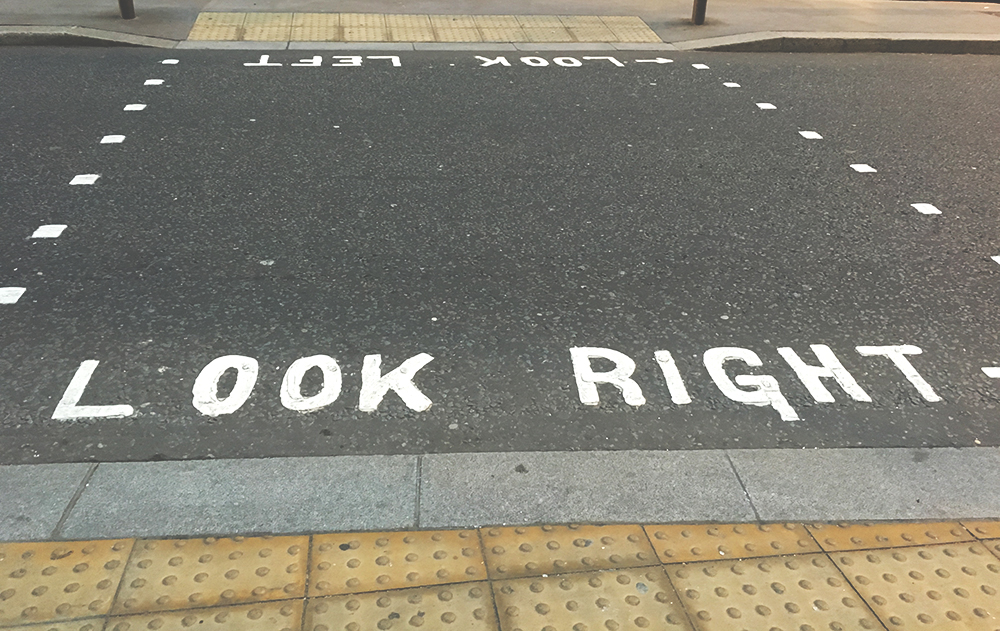
> situation warrants may be ba
 se
> d more on habit than on careful intellectual consideration.  Numerous street
> crossings in London are painted with the words "LOOK RIGHT" just off the curb
> (or "LOOK LEFT" just off center islands of divided streets) as shown in these
> photos:
>
>
> https://image1.masterfile.com/getImage/600-08639271em-look-right-sign-at-crosswalk-and-speeding-double-decker-bus.jpg
>     https://www.flickr.com/photos/tracyg/4523412014
>     http://www.packingmysuitcase.com/wp-content/uploads/2015/11/lookleft.jpg
>
> That's for the benefit of tourists who genuinely imagine that we're in the
> habit of looking both ways before crossing a street, when our actual habit
> may be to look in the direction that we normally expect traffic to come from
> and then to take a few steps into the street before we look the other way.
> If people can be less than hyper-vigilant in situations where it can
> literally be a matter of life and death, it's hardly surprising that we can
> tune out a little when we imagine that a dance caller is about to go over
> familiar ground.  By the way, notice the arrows in the photos cited above.
> Perhaps those are primarily for the benefit of non-English-speaking tourists,
> but I also think they're a useful addition to the words even for literate
> native speakers of English.]
>
> 5. *Verbal/spatial processing issues*:  Some dancers may find it more
> difficult than others to make sense of a caller's verbal description of a
> spatial situation.  [As an example, a pair of dancers might have their hands
> in an allemande hold where the tips of each dancer's fingers are near the
> other dancer's index finger, approximately as shown in the supposed depiction
> of arm wrestling at
>
>
> http://lowres.cartoonstock.com/property-supply_and_demand-demand-arm_wrestling-real_estate-industrial-bmm0122_low.jpg
>
> and when the caller says something about each dancer curving their fingers
> around the other dancer's hand "between the base of the thumb and the wrist",
> they may simply not make sense of what that could mean.  Similarly, to give
> an example involving basic choreography rather than styling, when a caller
> talks about one person in a courtesy turn backing up while the other goes
> forward, the person who is told to "back up" may be unable to imagine what
> that could mean except to back completely away from the other dancer.  And if
> the caller tries to clarify by talking about a "common axis of rotation" or
> some such thing, it might be like expecting someone who has never seen the
> inside of a jet engine, or the outside of kangaroo, to make a recognizable
> drawing of one based on a verbal description.]
>
> 6. *Mental overload and reversion to habit*:  Some dancers may need to devote
> so much of their attention to the basic choreography of the dance that they
> don't have any left over for details of styling, which therefore revert to
> the habitual.  [I've sometimes danced with new dancer partners who have had a
> tendency to press their thumb against the back of my hand, for example during
> circles.  When an opportunity presents--say, while we're waiting out at the
> top or the bottom of the set--I might tell/show them about how pressing with
> the thumb is unnecessary, and a bit painful.  The result is sometimes that
> they keep the thumb out of play for a round or two of the dance but soon go
> back to pressing it against the back of my hand.  I presume that their
> attention is all taken up dealing with things like what to do next and who to
> do it with and the unfamiliarity of things being turned around 180 degrees
> now that we've come back in after being out at the end, and the thing about
> what (n
 ot
> ) to do with their thumbs is what ends of getting dropped.]
>
> 7. *Acoustic issues*: Perhaps the caller chose excellent words to explain a
> particular style point but some combination of acoustic issues rendered the
> callers words unintelligible to some of the dancers.  [Issues could include
> poor room acoustics, poor adjustment of the P.A. system, noise from fans
> and/or from conversations on the sidelines, poor enunciation, or  poor mic
> technique.  There could also be dancers who have various degrees of hearing
> deficits.  Acoustic difficulties can interact with issuers attention (item 4
> above) and verbal processing (item 5).  One source of distracting noise can
> be other dancers who begin talking among themselves as soon as they detect
> that the caller has stopped teaching the essentials of the dance sequence and
> begun to prattle about styling.]
>
> 8. *Unseen demo*:  During a demonstration, people might have crowded around
> so that only the nearest ones had ha clear view.
>
> 9-?. *???*: What possibilities have I missed?
>
> ============ (end) ============
>
>
> _______________________________________________
> List Name:  Callers mailing list
> List Address:  [email protected]
> Archives:  https://www.mail-archive.com/[email protected]/

_______________________________________________
List Name:  Callers mailing list
List Address:  [email protected]
Archives:  https://www.mail-archive.com/[email protected]/