maaaay-be...if that is what he indeed said, then he's a physicist after all,
and I am not. But I got the impression from the class I took on special
relativity that he's primarily known for explaining astrophysics very well
to a lay audience, not for his own contributions. I could be wrong.
If what you say is so, it would be because of the effect of the enormous
gravitational force on photons and other possible means of detection such as
radio emissions . But afaik you would not be able to communicate with a
spaceship or satellite that has gone into the event horizon as by definition
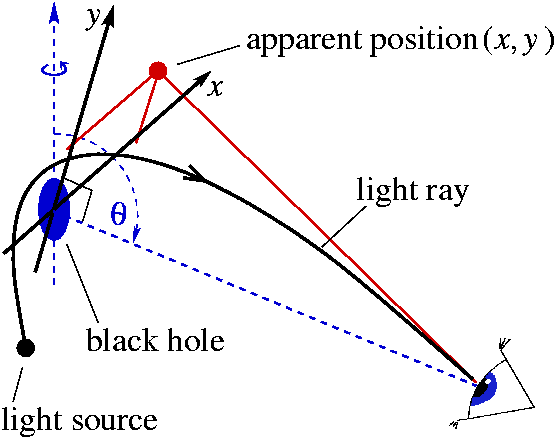
it's the point of no return. Now, would an event horizon distort perceptions
in its vicinity, yes:

http://www.perceptions.couk.com/uef/imgs/eh-action.gif

http://math-it.org/Mathematik/Astronomie/koordin.gif

These images seem to be saying that. But not that you can test the theory by
sending a probe into the event horizon, which is what I am hearing from you.


On Thu, Sep 22, 2011 at 1:11 PM, Sam <[email protected]> wrote:

>
> Hawkins changed his theory from gravity pulls things in a black hole
> and they are forever gone to there's a copy reflecting out and we can
> see into the past by viewing it, or something like that.
>
> .
>
> On Thu, Sep 22, 2011 at 3:53 PM, Dana <[email protected]> wrote:
> >
> > But you can't. I have not studied this in a while but I doubt this point
> has
> > changed -- an event horizon is a limit, used here in the mathematical
> sense
> > of the word. Anything that goes encounters it goes *in* and there's no
> way
> > to perceive it from the outside after that, because of the nature of the
> > process of perception.
> >
> > This going-inward-ness can be visualized -- and the professor did show my
> > physics class something that demonstrated this -- but the proof is
> > mathematical not empirical.
> >
> > I looked for a link that shows this, but everything I found assumes
> > knowledge of calculus. My recollection though supports the statement that
> a
> > limit that goes to infinity like that will get closer and closer to zero
> but
> > never reach it. There is no limit to the number of digits that can go
> after
> > a decimal point after all.
> >
> > Empirical evidence would require that something measurable return out. It
> > doesn't because there is no end to a limit. Cosmology is another area
> where
> > mathematical proofs may exist but empirical evidence cannot.
> >
>
>

~~~~~~~~~~~~~~~~~~~~~~~~~~~~~~~~~~~~~~~~~~~~~~~~~~~~~~~~~~~~~~~~~~~~~|
Order the Adobe Coldfusion Anthology now!
http://www.amazon.com/Adobe-Coldfusion-Anthology/dp/1430272155/?tag=houseoffusion
Archive:
http://www.houseoffusion.com/groups/cf-community/message.cfm/messageid:342958
Subscription: http://www.houseoffusion.com/groups/cf-community/subscribe.cfm
Unsubscribe: http://www.houseoffusion.com/groups/cf-community/unsubscribe.cfm