Hi Steve,
This was indeed our argument in the past. May be we should revise this
position.
I'd argue that the separation of built structure from shaping
foundations is so fluent,
that is is normally undecidable as a criterion. I'd argue that any
"moving" of buildings
should be regarded as a "reconstruction" or "resurrection" at another
side, which had to be shaped anew for that purpose to receive the
building, and implies destructive actions at the foundations of the
original building at least, and does not follow "natural boundaries" of
the building
against the ground. I'd argue that we should by rule define such a
building as new, regardles how much simiarity and old substance it
carries. It was designed to be immobile. Intention is important in our
discourse. I'd argue, truely mobile homes are technologically very
clearly distinct.
I believe such a decision will make the CRM much clearer...?

Cheers,

Martin
On 24/3/2015 5:36 μμ, Stephen Stead wrote:
Stephen Stead

Tel +44 20 8668 3075

Mob +44 7802 755 013

E-mail [email protected] <mailto:[email protected]>

LinkedIn Profile http://uk.linkedin.com/in/steads

*From:*Stephen Stead [mailto:[email protected]]
*Sent:* 24 March 2015 14:52
*To:* 'Athina Kritsotaki'; '[email protected]'
*Subject:* RE: [Crm-sig] new CIDOC CRM issue
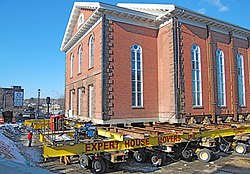
Buildings that are not carved out of bedrock are considered mobile
because experience has shown that we do indeed move them; for example
http://upload.wikimedia.org/wikipedia/commons/thumb/a/a3/Salem_Church_Relocation.JPG/250px-Salem_Church_Relocation.JPG
Hydraulically powered dollies move a historic 19th century brick
church in Salem, Massachusetts
Stephen Stead

Tel +44 20 8668 3075

Mob +44 7802 755 013

E-mail [email protected] <mailto:[email protected]>

LinkedIn Profile http://uk.linkedin.com/in/steads

-----Original Message-----
From: Crm-sig [mailto:[email protected]] On Behalf Of
Athina Kritsotaki
Sent: 24 March 2015 13:13
To: [email protected] <mailto:[email protected]>
Subject: [Crm-sig] new CIDOC CRM issue

New CIDOC CRM issue

Dear all,
Immobile buildings (graves, rock cut churches, chambers and generally
immobile monuments) are defined as features since they cannot be
separated from earth and the surrounding matter. The question is
should we regard all the immobile buildings as E25 Man-made Feature?
If the answer is positive, at that case it is contrary to the
examples of the Coliseum and the palace of Knossos, which in CRM are
referred as instances of E22 Man-Made Object and E19 Physical Object
respectively.
So, think about this

Regards,

Athina Kritsotaki

----------------------------

Athina Kritsotaki

Information System Laboratory

Institute of Computer Science

Foundation of Research & Technology

e-mail:[email protected]

Tel: 2810 391639

_______________________________________________

Crm-sig mailing list

[email protected] <mailto:[email protected]>

http://lists.ics.forth.gr/mailman/listinfo/crm-sig


_______________________________________________
Crm-sig mailing list
[email protected]
http://lists.ics.forth.gr/mailman/listinfo/crm-sig
--

--------------------------------------------------------------
 Dr. Martin Doerr              |  Vox:+30(2810)391625        |
 Research Director             |  Fax:+30(2810)391638        |
                               |  Email: [email protected] |
                                                             |
               Center for Cultural Informatics               |
               Information Systems Laboratory                |
                Institute of Computer Science                |
   Foundation for Research and Technology - Hellas (FORTH)   |
                                                             |
               N.Plastira 100, Vassilika Vouton,             |
                GR70013 Heraklion,Crete,Greece               |
                                                             |
             Web-site: http://www.ics.forth.gr/isl           |
--------------------------------------------------------------