Klemen -

You'll no doubt shortly get questions about how fast you want to scan, and
that EMC may not be appropriately fast enough for both axes. Since graphical
laser scanning is a persistence-of-vision process, the graphical image must
be continuously rescanned. How fast? In the laser graphics industry (oh,
right - 10 year+ veteran here - 20 watt mixed gas, 150watt YAGs - big
side-of-the-mountain type shows - lots of 480volt camlock cable!)....we
measured vector graphics in points per second. When I started, a LaserMedia
Z80 processor could do about 12000 pps with closed loop galvos (General
Scanning's G120 were the defacto standard). Now a Pangolin or similar
PC-driven system can do over ten times that. You absolutely must have closed
loop scanning to do anything better than 20,000 pps with mirrors of mass
more than 1.25 grams. The inertial mass of the mirrors and the rotor doesn't
stop on a dime, and closed-loop scanning provides a
reverse-kick-in-the-pants to prevent the rotor from overshooting the target.
You will also not get sharp corners open-loop at faster than 1000 pps on
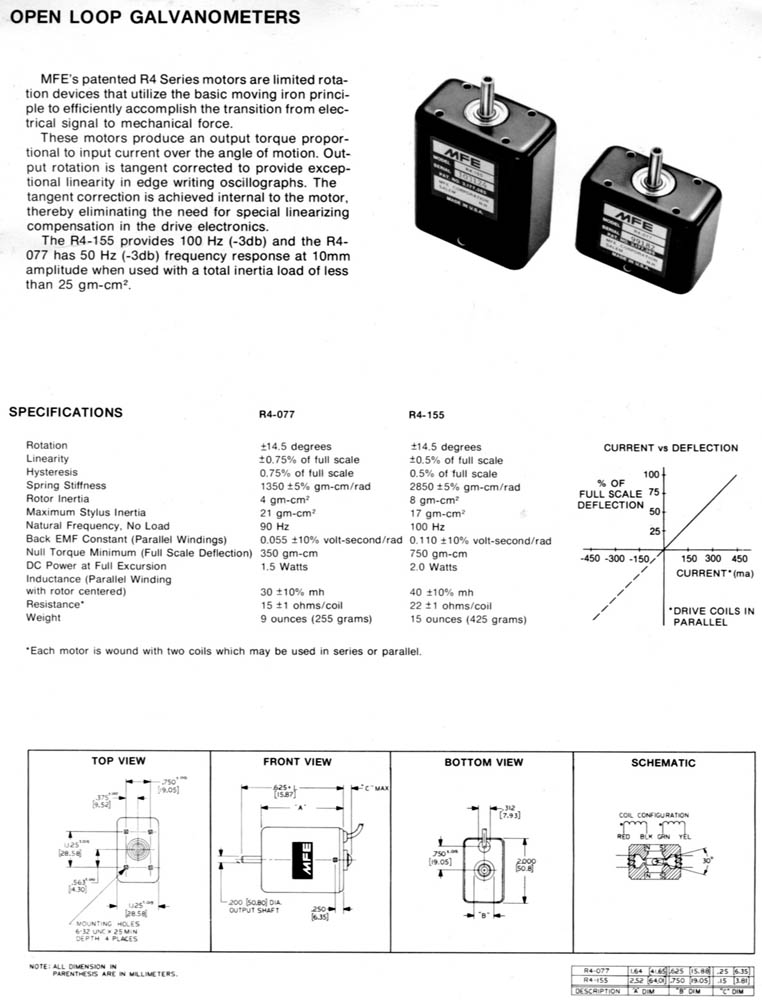
those units. Physics just sucks that way. Finally, the MFE galvos (old
workhorses that are still in use currently) are slow devices; check out the
resonant frequency - 90-100 Hz - that's really as fast as you can accurately
go before the rotor mass affects performance. This rating is exclusive of
any mirror you attach - and the mirrors are small for a reason - a 1" square
glass will shatter on its own from internal stresses if you wiggle it too
much. That 100 Hz freq will go down as you increase the mirror mass. A
high-performance scanning mirror is about 3-5mm square and 0.25grams
mounted. Even the drop of acrylate glue was precision dispensed for balance.
I should probably mention that points per second does not necessarily equal
Hz; if you have a graphic with lots of anchors, corners, etc - you have a
lot of points, thus to try and retain those corners, you have to go through
the loop slower; if you have a 2 point line, you can get really zippy.
This however should not discourage you from your development - I started out
the same way and would recommend everyone experiment that way too - in fact,
most of the major players in the laser entertainment industry started out
the same way, less than 30 years ago. The eye will maintain vision on a 30
degree field with about a 20Hz refresh - so a 20-30Hz circle is a good
graphic to start scanning. It's a good test and will let you get the phasing
tuned in on your PID loop.

Having a known "envelope" to work with is important - you may not get text
and corporate logos (you didn't mention blanking) - but you'll easily
accomplish lissajous patterns and good beam effects (with a powerful enough
laser and atmospheric haze) that will be a good compliment to any show.

The EMC challenge is how comfortable are you to interrupting the HAL
translation to push in the vector data? I expect that the gcode parser may
not behave quickly enough to continuously refresh without getting bogged
down. A step/direction setup will be of no value here, and straight PWM will
work, but you'll severely restrict your beam/projection angle.

The early "el-cheapo" pattern scanners of yesteryear used +/-15v supplies
and drivers, and not always variable drive signals - not PWM either - just
-15, 0 and +15 with an RC network and clever timing. The RC network locked
in your scanning speed, unfortunately, but it was cheap, sturdy and
reproducible. Even recent closed-loop scanners still use bipolar supplies
(your MFE unit can too - the torsion bar will self-center with zero-current
applied). Your R2R ladder will work - and will be faster than a
serially-commanded DAC.

If you can take a PWM from EMC and make it bipolar (a few opamps here, an
H-bridge there...) you'll have the basis for a good driver. The top speed of
EMC processing on the HAL-side (PWM generation, etc) will likely not be a
factor - again your top scanning speed with the galvos you have will be
around 1000-5000 pps, once you mount mirrors.

I would recommend highly, especially for the instant gratification aspect,
to build the servo amps and get the galvos moving first (just put in a
line-level audio signal - it's fun) so you have a known working baseline
instead of trying to hunt down unknown peculiarities.

Cheers,

Ted.


>>>Original Msg>>>>>>>>
Date: Sat, 1 Dec 2007 06:13:17 -0800 (PST)
From: Klemen Dovrtel <[EMAIL PROTECTED]>
Subject: [Emc-users] open loop galvanometer control
To: [email protected]
Message-ID: <[EMAIL PROTECTED]>
Content-Type: text/plain; charset=iso-8859-1

I have two open loop galvanometers (
http://www.laserfx.com/Backstage.LaserFX.com/Systems/Pinouts/MFEdataLG.jpg
) which i would like to use emc controlled laser show
(similar to this one:
http://elm-chan.org/works/vlp/report_e.html ).

I will use a hardware encoder for measuring the angle
of galvanometer. I will configure hal using
hal-encoder and hal-pid. I think i will manage to do
this (i checked the etch-servo sample configuration).
<snip>

No virus found in this outgoing message.
Checked by AVG Free Edition.
Version: 7.5.503 / Virus Database: 269.16.12/1162 - Release Date: 11/30/2007
9:26 PM


-------------------------------------------------------------------------
SF.Net email is sponsored by: The Future of Linux Business White Paper
from Novell.  From the desktop to the data center, Linux is going
mainstream.  Let it simplify your IT future.
http://altfarm.mediaplex.com/ad/ck/8857-50307-18918-4
_______________________________________________
Emc-users mailing list
[email protected]
https://lists.sourceforge.net/lists/listinfo/emc-users