On Wed, 11 Jan 2017, Gene Heskett wrote:

> Date: Wed, 11 Jan 2017 21:50:19 -0500
> From: Gene Heskett <[email protected]>
> Reply-To: "Enhanced Machine Controller (EMC)"
>     <[email protected]>
> To: [email protected]
> Subject: Re: [Emc-users] Two questions.
>
> On Wednesday 11 January 2017 13:34:50 Peter C. Wallace wrote:
>
>> On Wed, 11 Jan 2017, Jon Elson wrote:
>>> Date: Wed, 11 Jan 2017 10:36:18 -0600
>>> From: Jon Elson <[email protected]>
>>> Reply-To: "Enhanced Machine Controller (EMC)"
>>>     <[email protected]>
>>> To: "Enhanced Machine Controller (EMC)"
>>> <[email protected]> Subject: Re: [Emc-users] Two
>>> questions.
>>>
>>> On 01/10/2017 10:45 PM, Gene Heskett wrote:
>>>> On Tuesday 10 January 2017 23:02:28 Jon Elson wrote:
>>>>> On 01/10/2017 08:39 PM, Gene Heskett wrote:
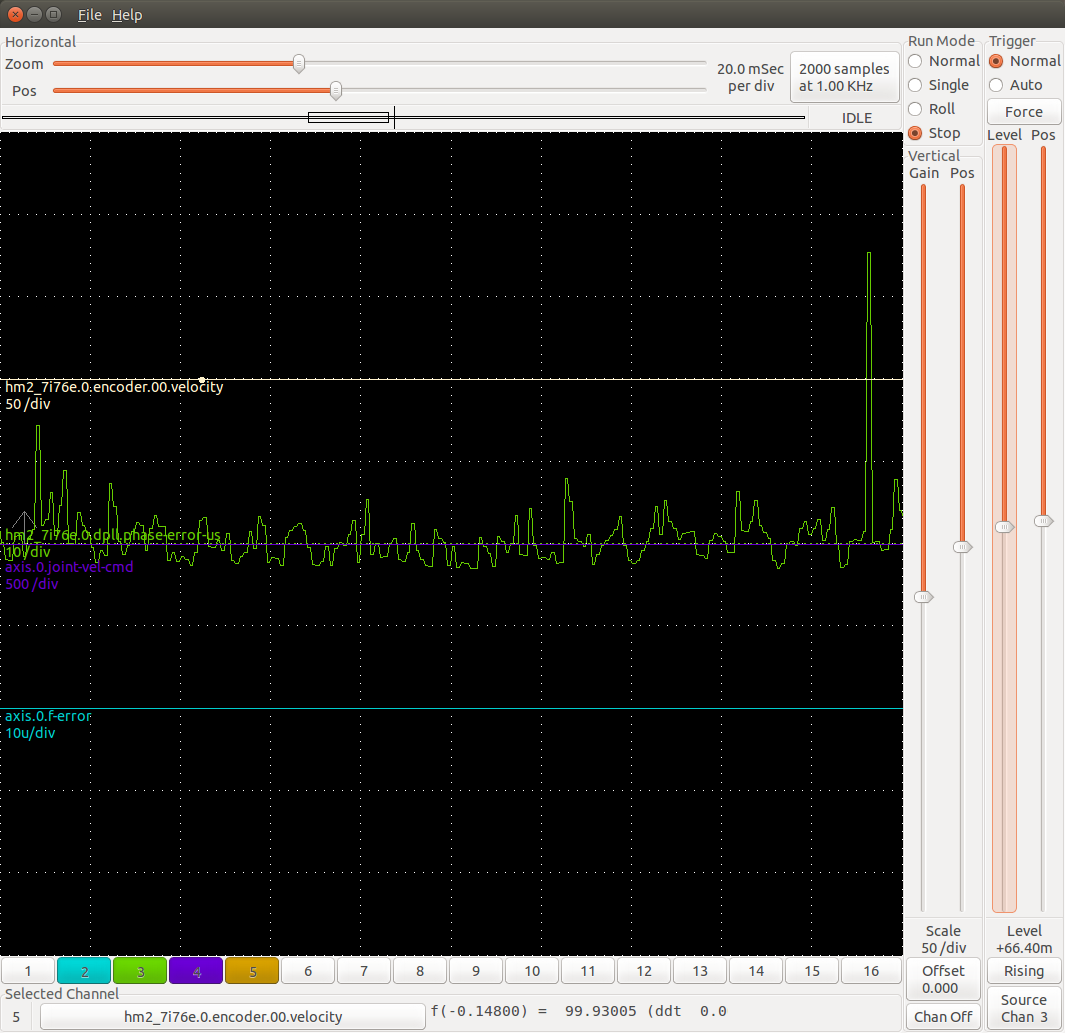
>>>>>> But if I hook up the halscope, the apparent quadrature error is
>>>>>> worthless due to the 1KHz servo-loop timing limiting the
>>>>>> bandwidth.
>>>>>
>>>>> Well, that's why we use hardware encoder counters, as
>>>>> sampling the quadrature at 1 KHz just isn't fast enough.
>>>>>
>>>>> Jon
>>>>
>>>> Plz elucidate Jon. Something has got to be better than this. See
>>>> the pix I posted with the last reply to Peter & the list.  The top,
>>>> white trace in the halscope screen is the quadrature noise, easily
>>>> 10x the timing wibbles I see on the hitachi's screen.
>>>
>>> If you are looking at the quadrature signals at a 1 KHz
>>> sampling rate, then unless the encoder is moving quite
>>> slowly, the sampling will be too coarse.  That screen shot
>>> is kind of small (you can take just a single window as the
>>> screenshot, by the way) but it looks like the duty cycle of
>>> the encoders is not 50%.  That may well be aliasing, as the
>>> quadrature signals seem to be moving much too close to 1000
>>> Hz.  You'd get much better results below 100 Hz.  Or, with
>>> Mesa hardware, you can sample these with the base thread.
>>>
>>> I can't comment on the velocity output from the Mesa, as I
>>> don't know their gear (or driver).  But, the scale is 2/div,
>>> meaning the scaled velocity output is jumping around 2 user
>>> units up and down at a KHz rate.  Clearly, not good.
>>>
>>> Jon
>>
>> The velocity output is calculated by using the number of counts
>> divided by the time between the counts (time measured via a 1 MHz
>> timestamp). If you have less than 2 counts per servo period the
>> velocity estimation accuracy depends heavily the quadrature
>> phase/symmetry since the edge spacing entirely determines the
>> estimated velocity at this speed range.
>>
>> I suspect what Genes plot shows is that he has significant quadrature
>> phase/symmetry errors at the FPGA inputs.
>>
>>
>> Again here is a velocity plot of a accurate 100 Hz quadrature signal:
>>
>> http://freeby.mesanet.com/100_Hz_quadrature_velocity.png
>
> I've not played with the stepgen type 2 yet, but I have adjusted the
> quadrature a few thousandths and reduced it by about 1/3rd. Thats
> helpfull as I can filter to smooth a tach dial once I have defeated the
> noise.
>
> But I have another concern. I have had to do a full powerdown reset to
> clear a watchdog bite. The original config was I think intended to clear
> it by re-enabling the machine, but I could nolinuxcnct, so I disconnected
that
> reset in the hal file I started with as the logic was self feeding,
> locking out the ability to reset the disabled machine.  And I couldn't
> even do it from the halconfig as it claimed another signal was driving
> it when I tried to setp that pin.
>
> Do you, Peter, have a logic diagram I can re-construct for that, that
> actually works?
You need to restart linuxcnc to clear a watchdog bite

>>
>>
>>
>> Peter Wallace
>> Mesa Electronics
>>
>> (\__/)
>> (='.'=) This is Bunny. Copy and paste bunny into your
>> (")_(") signature to help him gain world domination.
>>
>>
>> ----------------------------------------------------------------------
>> -------- Developer Access Program for Intel Xeon Phi Processors
>> Access to Intel Xeon Phi processor-based developer platforms.
>> With one year of Intel Parallel Studio XE.
>> Training and support from Colfax.
>> Order your platform today. http://sdm.link/xeonphi
>> _______________________________________________
>> Emc-users mailing list
>> [email protected]
>> https://lists.sourceforge.net/lists/listinfo/emc-users
>
>
> Cheers, Gene Heskett
> --
> "There are four boxes to be used in defense of liberty:
> soap, ballot, jury, and ammo. Please use in that order."
> -Ed Howdershelt (Author)
> Genes Web page <http://geneslinuxbox.net:6309/gene>
>
> ------------------------------------------------------------------------------
> Developer Access Program for Intel Xeon Phi Processors
> Access to Intel Xeon Phi processor-based developer platforms.
> With one year of Intel Parallel Studio XE.
> Training and support from Colfax.
> Order your platform today. http://sdm.link/xeonphi
> _______________________________________________
> Emc-users mailing list
> [email protected]
> https://lists.sourceforge.net/lists/listinfo/emc-users
>

Peter Wallace
Mesa Electronics

(\__/)
(='.'=) This is Bunny. Copy and paste bunny into your
(")_(") signature to help him gain world domination.


------------------------------------------------------------------------------
Developer Access Program for Intel Xeon Phi Processors
Access to Intel Xeon Phi processor-based developer platforms.
With one year of Intel Parallel Studio XE.
Training and support from Colfax.
Order your platform today. http://sdm.link/xeonphi
_______________________________________________
Emc-users mailing list
[email protected]
https://lists.sourceforge.net/lists/listinfo/emc-users