On Wed, Oct 10, 2018 at 9:05 PM Manu Bhardwaj <[email protected]> wrote:
[...]
> Your Google logo is of The Mother (
> https://en.wikipedia.org/wiki/Mirra_Alfassa)! Are you also an alumnus of
> Sri Aurobindo Memorial School, Bangalore? I remember/realised that Udhay
is
> one too, so this list might have many more.
I was not a student there, I connected with The Mother about 11 or 12 years
ago when I visited her Samadhi in Pondicherry, though obviously I had heard
of her before, as many have, at least in this region of India.

As to why I added her photo to my DP, that was merely an act of intuition,
or inspiration. For many years now most of my life isn't led with thought
or logic, if I feel inspired to do something I do it.

If I had to supply a post-hoc logic to it, it would go something like this.

I generally don't have any photo on my profile. While messing around with
my Google profile settings the other day a thought occurred that rather
than having that space remain empty there might be a way to make it useful.
I looked around in my device and found The Mother's picture, which I
promptly added.

In every photograph or creative work of a person, something of the
consciousness of the person is present. This may not be immediately
apparent, but this is often why humans pay millions for some paintings that
look like a disaster. Something stirs deep inside when we look at powerful
images, hear powerful sounds, experience powerful vibrations, and this
photo of The Mother can do that.

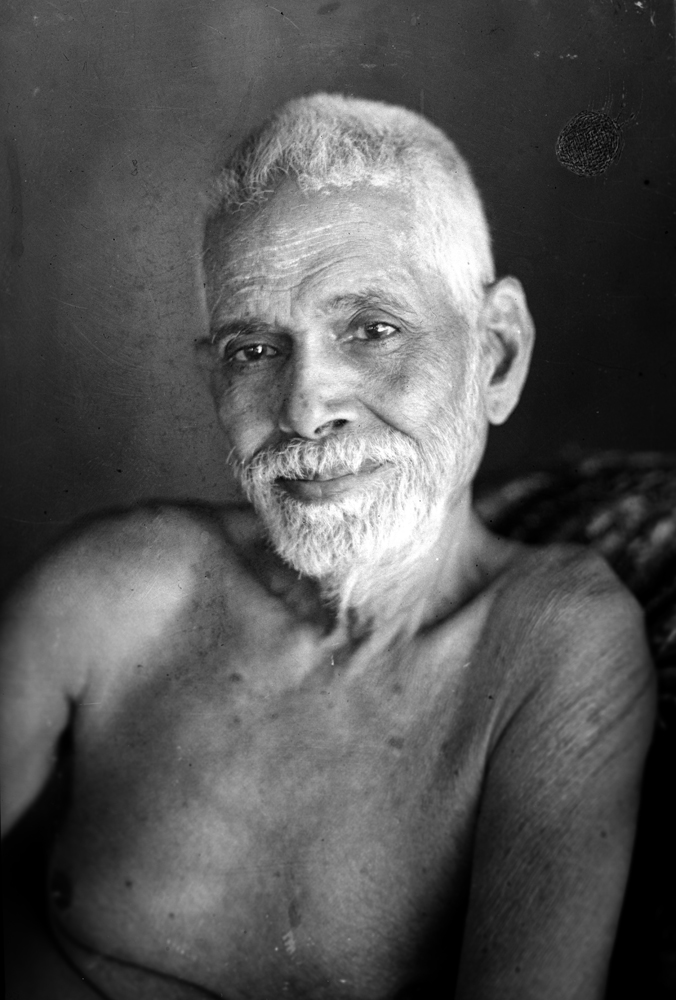
Many Saints carry such an aura, Bhagawan Ramana Maharshi
<https://upload.wikimedia.org/wikipedia/commons/4/4c/Sri_Ramana_Maharshi_-_Portrait_-_G._G_Welling_-_1948.jpg>
for example, is another image I could have used. I didn't want an image
that triggered religious or sectarian pre-conceptions. We lose our
innocence when we approach things with a preconception of what it is. Those
unfamiliar with The Mother I hoped would be able to look at the image with
a curiosity, maybe they'd assume she's my grand mother? In that moment of
innocence something remarkable can happen.

When I didn't know as much about these things, I would be struck by some
experiences, unable to explain them logically. Many years ago I was in
Amsterdam, and I used to spend hours in front of a single painting by Van
Gogh, and mere minutes in front of the works of Rembrandt. I couldn't tell
you exactly why then, but it was clear to me that Van Gogh put his heart
into his paintings. Now Rembrandt was not a bad painter by any means, but
he didn't care about his work like Van Gogh, he did care, very much, about
being successful. This intuition I learned much later was true when I read
his life history, he liked to make money off his paintings, and so cared
about customer satisfaction. Van Gogh died in poverty.

I had the same experience years earlier in graduate school. I was at
Carnegie Mellon, a top school for computer science, better in every
materialistic measurement, but it just failed to inspire me like my days in
the early Linux/FLOSS community. I found not many actually cared about the
ideas they worked on, their primary focus was success, ambition and a
desire to be unrivalled among peers. Their creative energies lacked heart.
Of course, I did learn valuable lessons from this fierce energy of success
too. All the same, it was not what I came to CMU to learn.

I later made this heart centered approach to life the very essence of my
life, and this led me to radically change my life, though again it was less
a conscious choice, and more an inspired movement. This is also the essence
of Yoga.

When we even need watches to tell us our heart rate, which is a very
obvious grossly sensate mechanical event, most people will be dull to
subtler realities such as the quality of consciousness.

I come across some stirrings in the logical world
<https://www.linkedin.com/pulse/can-consciuosness-measured-trust-ed-gerck-phd/>
about this now and then, but materialistic proof always needs an instrument
with dials and switches to tell people what they already can feel. Maybe
someday such consciousness can be measured, but until then, I urge everyone
to look within, the answers are already there.


> We received a LOT of (what I now consider) propaganda about her teachings
> while we were at that school. We also received delicious laddoos on her
> birthday every year, so overall, I have no complaints.

Firstly, she existed in an age before media management, where every word
she uttered has been recorded by those around her and reproduced later with
varying degrees of accuracy.

Secondly, most people, especially devotees confuse the person with the
consciousness. They assume praising the Guru, lionizing the individual is
the way to convince people to look  at greater Truths. This only forms
religion, and religions become political forces, surviving on propaganda
and measuring success mostly by the number of unquestioning followers and
impressive buildings. Religions are not useless, they can do many good
things, like for example when they end up running schools, hospitals and
charities. However for many people that remains a plateau in their
ascension they never leave.

The Guru is as the Buddhists say, the finger pointing to the moon. The
Awakening Force, or Guru Tattva is present in everything. The seemingly
inert mountains can teach one something, the birds and insects too, the
flowing river, the setting sun, just about everything in life can carry the
Guru Force, connecting one to larger truths, ascending the individual to
superior states of consciousness. The human Guru is useful in that he or
she is a conscious channel of the omnipresent Force, the SatChitAnanda.

The Guru need not be a perfect individual (perfection is also like beauty
largely in the eye of the beholder), but the moments that they are
channeling the Sat Force, they are divine. Any good Guru is constantly
perfecting him/herself to be a channel for this force 24x7, but they are
also humans, they need to eat, sleep, rest, they are subject to the
vagaries of nature's forces, and they can have moments of lower
consciousness energy.