Possibly you can advantageously use the symmetry to simplify this.
If there is 100° at the steam inlet and 30° at the water side, then
there must be (100+30)/2 = 65° in the middle.
If figure A) is realistic, then the temperature at the thermoelement
must be larger than (65+30)/2=47.5 degrees, if we neglect the water
flow and the steam flow.
The actual temperature must be somewhat smaller because the coupling to
the water flow is tight, but there clearly must be some not-neglectable
thermal crosstalk.
The temperatures superimpose linear, like the voltages in a resistor
network, so the problem can be solved by adding partial solutions.
Im not so interested in more precise calculations, as long as no
precise construction details are known.
Am 14.10.2011 20:38, schrieb Alan J Fletcher:
The vortex mailer truncated the changed link in the message. Sorry
--- I'll re-send the whole thing:
I've put up a couple of sketches to explain Horace's/my resistor
thermal model
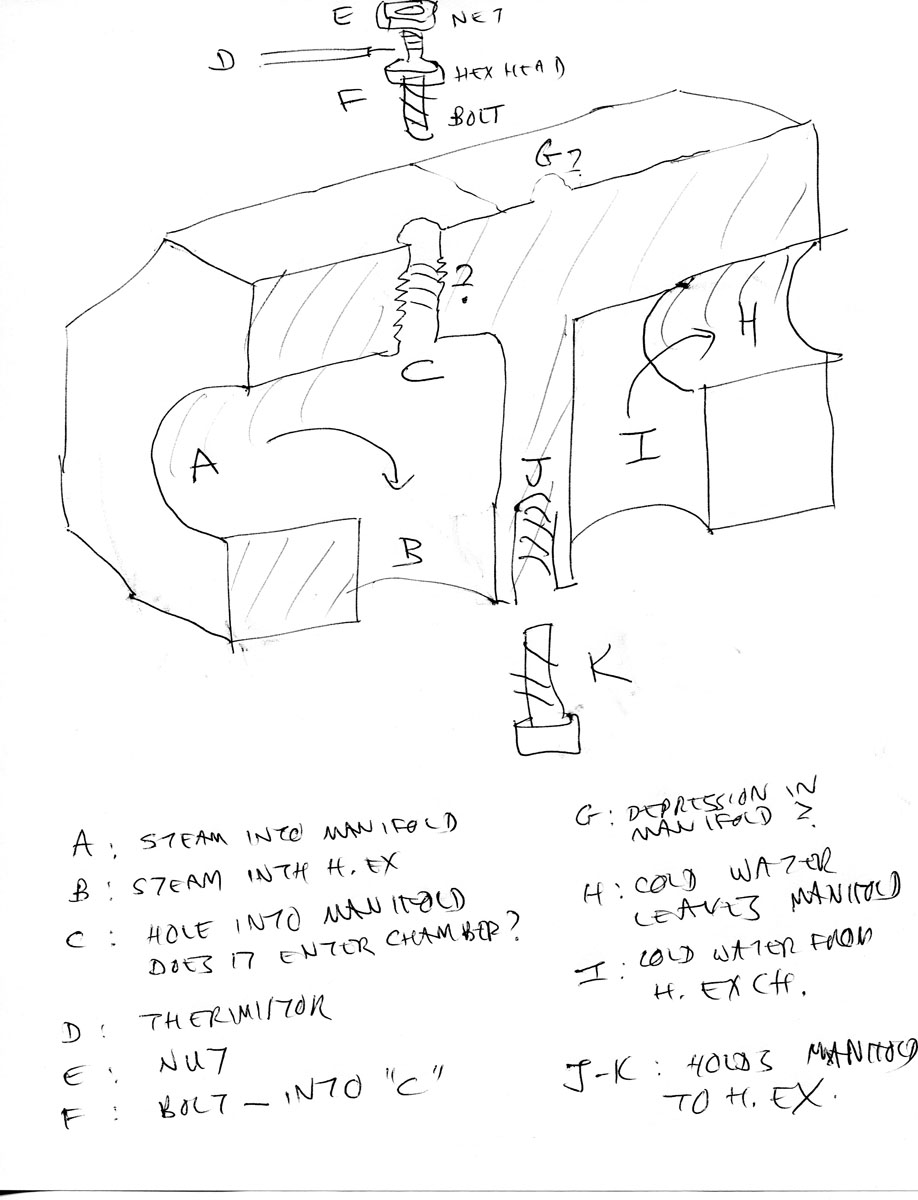
Detailed manifold schematic -- but the thermocouple isn't on THAT nut.
http://lenr.qumbu.com/111010_manifold_001_h1200.jpg

http://lenr.qumbu.com/111010_pics/111014_manifold_001.jpg

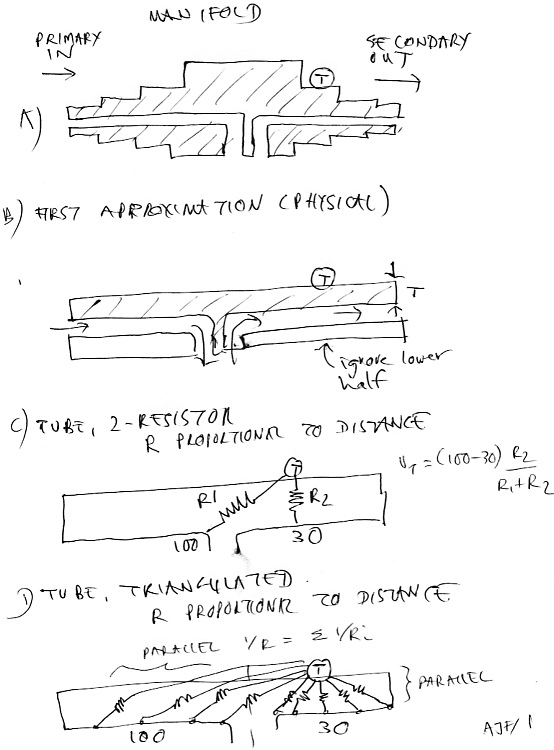
A) A rough diagram of the manifold, ignoring junctions between sections
    (which I think are 2nd or 3rd order).
B) A first physical approximation as a tube with wall thickness T
C) 2-resistor model Vt = (100-30) * R2 / (R1 + R2) ... R proportional
to distance.
D) Triangulated model (21 R's in my spreadsheet) .. with the lower
ends of the resistor stepped along the tube
One group connects to 100C, the other to 30C
Each group of resistors has a value 1/R = sum(1/R) .. which can
be plugged into the 2-resistor model.
To do :

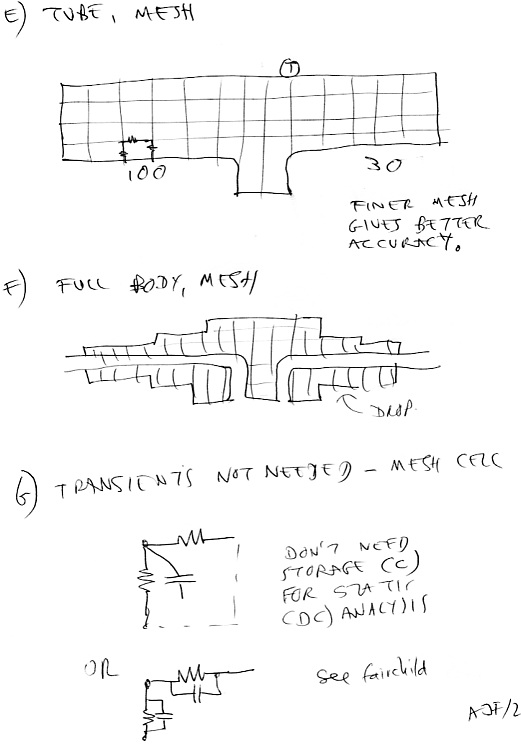
http://lenr.qumbu.com/111010_pics/111014_manifold_002.jpg

E) Tubular mesh
F) Full-body mesh
G) Mesh with heat storage
I've seen models with one capacitor to ground, and models with a
capacitor across each resistor.
I have Spice installed on my system, and I can easily generate a mesh
network for it.
I also have an idea on how to model the heat transfer for laminar
fluid flow in each arm.
There's at least a 40:1 (600:15 litres/hour) difference in flow.
(I also have the free Elmer FE software on my system, but I'm learning
how to use it. I'll check their examples.)
ps Off to print my tax forms ....
pps added a googlable signature