On 31 May 2012, at 18:29, Jason Resch wrote:
On Wed, May 30, 2012 at 3:27 AM, Bruno Marchal <[email protected]>
wrote:
On 29 May 2012, at 22:26, Jason Resch wrote:
On Tue, May 29, 2012 at 12:55 PM, Bruno Marchal <[email protected]>
wrote:
To see this the following thought experience can help. Some guy won
a price consisting in visiting Mars by teleportation. But his state
law forbid annihilation of human. So he made a teleportation to
Mars without annihilation. The version of Mars is very happy, and
the version of earth complained, and so try again and again, and
again ... You are the observer, and from your point of view, you
can of course only see the guy who got the feeling to be infinitely
unlucky, as if P = 1/2, staying on earth for n experience has
probability 1/2^n (that the Harry Potter experience). Assuming the
infinite iteration, the guy as a probability near one to go quickly
on Mars.
Bruno,
Thanks for your very detailed reply in the other thread, I intend
to get back to it later, but I had a strange thought while reading
about the above experiment that I wanted to clear up.
You mentioned that the probability of remaining on Earth is
(1/2)^n, where n is the number of teleportations.
Not really. I pretend that this is the relative probability inferred
by the person in front of you. But he is wrong of course. Each time
the probability is 1/2, but his experience is "harry-Potter-like".
I can see clearly that the probability of remaining on earth after
the first teleportation is 50%, but as the teleportations continue,
does it remain 50%?
Yes.
Let's say that N = 5, therefore there are 5 copies on Mars, and 1
copy on earth. Wouldn't the probability of remaining on Earth be
equal to 1/6th?
You cannot use absolute sampling. I don't think it makes any sense.
While I can see it this way, I can also shift my perspective so
that I see the probability as 1/32 (since each time the teleport
button is pressed, I split in two). It is easier for me to see how
this works in quantum mechanics under the following experiment:
I choose 5 different electrons and measure the spin on the y-axis,
the probability that I measure all 5 to be in the up state is 1 in
32 (as I have caused 5 splittings),
OK.
but what if the experiment is: measure the spin states of up to 5
electrons, but stop once you find one in the up state.
That is a different protocol. The one above is the one corresponding
to the earth/mars experience.
In this case it seems there are 6 copies of me, with the following
records:
1. D
2. DU
3. DDU
4. DDDU
5. DDDDU
6. DDDDD
However, not all of these copies should have the same measure.
The way I see it is they have the following probabilities:
1. D (1/2)
2. DU (1/4)
3. DDU (1/8)
4. DDDU (1/16)
5. DDDDU (1/32)
6. DDDDD (1/32)
I suppose what is bothering me is that in the Mars transporter
experiment, it seems the end result (having 1 copy on earth, and 5
copies on mars) is no different from the case where the transporter
creates all 5 copies on Mars at once.
This is ambiguous.
What I mean is me stepping into the teleporter 5 times, with the net
result being 1 copy on Earth and 5 copies on Mars, seems just like
stepping into the teleporter once, and the teleporter then creating
5 copies (with delay) on Mars.
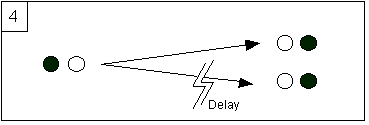
Like the diagram on step 4 of UDA:
http://iridia.ulb.ac.be/~marchal/publications/SANE2004MARCHAL_fichiers/image012.gif
Except there is no annihilation on Earth, and there are 4 copies
created with delay on Mars (instead of one with delay).
When stepping into the teleporter once, and having 5 copies created
on Mars (with various delays between each one being produced) is the
probability of remaining on Earth 1/6th?
Yes.
That would be a good idea to enhance the probability to be the one, or
a one, finding himself of mars. But again, the guy on earth will be in
front of the "looser", even if you multiply by 20. billions your
delayed copies on mars.
Is the difference with the iterated example receiving the knowledge
that the other copy made it to Mars before stepping into the
Teleporter again?
I don't understand the sentence. It looks like what is the difference
between 24.
In this thought experience you were supposed to be an external
observer on earth, not the candidate doing the duplication.
In your diary, you will always write things like, "he try to multiply
the copy on mars, push on the button and told me "this fails again".
Bruno
In that case, it is clear that the chance of remaining on Earth
should be (1/6th)
Yes. In that case.
but if the beginning and end states of the experiment are the same,
why should it matter if the replication is done iteratively or all
at once? Do RSSA and ASSA make different predictions in this case?
RSSA has to be applied. Your first protocol is faithful, isomorphic,
to the experience I was describing. Te second is not.
OK?

Bruno


http://iridia.ulb.ac.be/~marchal/


--
You received this message because you are subscribed to the Google
Groups "Everything List" group.
To post to this group, send email to [email protected].
To unsubscribe from this group, send email to [email protected]
.
For more options, visit this group at http://groups.google.com/group/everything-list?hl=en
.
--
You received this message because you are subscribed to the Google
Groups "Everything List" group.
To post to this group, send email to [email protected].
To unsubscribe from this group, send email to [email protected]
.
For more options, visit this group at http://groups.google.com/group/everything-list?hl=en
.
http://iridia.ulb.ac.be/~marchal/


--
You received this message because you are subscribed to the Google Groups
"Everything List" group.
To post to this group, send email to [email protected].
To unsubscribe from this group, send email to
[email protected].
For more options, visit this group at
http://groups.google.com/group/everything-list?hl=en.