On Thu, May 31, 2012 at 2:09 PM, Bruno Marchal <[email protected]> wrote:
>
> On 31 May 2012, at 18:29, Jason Resch wrote:
>
>
>
> On Wed, May 30, 2012 at 3:27 AM, Bruno Marchal <[email protected]> wrote:
>
>>
>> On 29 May 2012, at 22:26, Jason Resch wrote:
>>
>>
>>
>> On Tue, May 29, 2012 at 12:55 PM, Bruno Marchal <[email protected]>wrote:
>>
>>>
>>> To see this the following thought experience can help. Some guy won a
>>> price consisting in visiting Mars by teleportation. But his state law
>>> forbid annihilation of human. So he made a teleportation to Mars without
>>> annihilation. The version of Mars is very happy, and the version of earth
>>> complained, and so try again and again, and again ... You are the observer,
>>> and from your point of view, you can of course only see the guy who got the
>>> feeling to be infinitely unlucky, as if P = 1/2, staying on earth for n
>>> experience has probability 1/2^n (that the Harry Potter experience).
>>> Assuming the infinite iteration, the guy as a probability near one to go
>>> quickly on Mars.
>>>
>>>
>> Bruno,
>>
>> Thanks for your very detailed reply in the other thread, I intend to get
>> back to it later, but I had a strange thought while reading about the above
>> experiment that I wanted to clear up.
>>
>> You mentioned that the probability of remaining on Earth is (1/2)^n,
>> where n is the number of teleportations.
>>
>>
>> Not really. I pretend that this is the relative probability inferred by
>> the person in front of you. But he is wrong of course. Each time the
>> probability is 1/2, but his experience is "harry-Potter-like".
>>
>>
>>
>>
>> I can see clearly that the probability of remaining on earth after the
>> first teleportation is 50%, but as the teleportations continue, does it
>> remain 50%?
>>
>>
>> Yes.
>>
>>
>>
>> Let's say that N = 5, therefore there are 5 copies on Mars, and 1 copy on
>> earth.  Wouldn't the probability of remaining on Earth be equal to 1/6th?
>>
>>
>> You cannot use absolute sampling. I don't think it makes any sense.
>>
>>
>>
>>
>> While I can see it this way, I can also shift my perspective so that I
>> see the probability as 1/32 (since each time the teleport button is
>> pressed, I split in two).  It is easier for me to see how this works in
>> quantum mechanics under the following experiment:
>>
>> I choose 5 different electrons and measure the spin on the y-axis, the
>> probability that I measure all 5 to be in the up state is 1 in 32 (as I
>> have caused 5 splittings),
>>
>>
>> OK.
>>
>>
>> but what if the experiment is: measure the spin states of up to 5
>> electrons, but stop once you find one in the up state.
>>
>>
>> That is a different protocol. The one above is the one corresponding to
>> the earth/mars experience.
>>
>>
>>
>> In this case it seems there are 6 copies of me, with the following
>> records:
>>
>> 1. D
>> 2. DU
>> 3. DDU
>> 4. DDDU
>> 5. DDDDU
>> 6. DDDDD
>>
>> However, not all of these copies should have the same measure.   The way
>> I see it is they have the following probabilities:
>>
>> 1. D (1/2)
>> 2. DU (1/4)
>> 3. DDU (1/8)
>> 4. DDDU (1/16)
>> 5. DDDDU (1/32)
>> 6. DDDDD (1/32)
>>
>> I suppose what is bothering me is that in the Mars transporter
>> experiment, it seems the end result (having 1 copy on earth, and 5 copies
>> on mars) is no different from the case where the transporter creates all 5
>> copies on Mars at once.
>>
>>
>> This is ambiguous.
>>
>
>
> What I mean is me stepping into the teleporter 5 times, with the net
> result being 1 copy on Earth and 5 copies on Mars, seems just like stepping
> into the teleporter once, and the teleporter then creating 5 copies (with
> delay) on Mars.
>
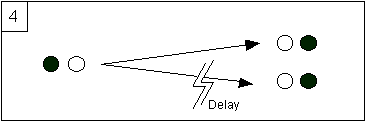
> Like the diagram on step 4 of UDA:
>
> http://iridia.ulb.ac.be/~marchal/publications/SANE2004MARCHAL_fichiers/image012.gif
>
> Except there is no annihilation on Earth, and there are 4 copies created
> with delay on Mars (instead of one with delay).
>
> When stepping into the teleporter once, and having 5 copies created on
> Mars (with various delays between each one being produced) is the
> probability of remaining on Earth 1/6th?
>
>
> Yes.
> That would be a good idea to enhance the probability to be the one, or a
> one, finding himself of mars. But again, the guy on earth will be in front
> of the "looser", even if you multiply by 20. billions your delayed copies
> on mars.
>
>
>
> Is the difference with the iterated example receiving the knowledge that
> the other copy made it to Mars before stepping into the Teleporter again?
>
>
> I don't understand the sentence. It looks like what is the difference
> between 24.
>


I apologize for not being clear.  There are two different experiments I am
contrasting:

1. A person steps into a teleporter, and 5 copies (with varying delays) are
reproduced on Mars.

2. A person steps into a teleporter, and a duplicate is created on Mars.
 To increase the chance of subjectively finding himself on Mars, he does it
again (when he fails) and the copy on Earth does so 5 times before giving
up.

For experiment 1, you and I seem to agree that subjectively, that person
person has a 1 in 6 chance of experiencing a continued presence on earth,
and a 5/6 chance of finding himself on mars.

For experiment 2, I believe you suggested there is a 1 in 32 (subjective
chance) of going through this exercise and not having the subjective
experience of ending up on Mars.  Have I understood this correctly thus far?

If so, what accounts for these different subjective probabilities?  How can
it be that there is a 31/32 chance of finding oneself on mars if there are
just 5 copies there?

I hope I have been clear enough.  Thanks again.

Jason


>
> In this thought experience you were supposed to be an external observer on
> earth, not the candidate doing the duplication.
> In your diary, you will always write things like, "he try to multiply the
> copy on mars, push on the button and told me "this fails again".
>
>

--
You received this message because you are subscribed to the Google Groups
"Everything List" group.
To post to this group, send email to [email protected].
To unsubscribe from this group, send email to
[email protected].
For more options, visit this group at
http://groups.google.com/group/everything-list?hl=en.