On Wednesday, February 20, 2019 at 9:14:35 AM UTC-6, PGC wrote:
>
>
>
> On Tuesday, February 19, 2019 at 11:39:21 PM UTC+1, Bruno Marchal wrote:
>>
>>
>> On 15 Feb 2019, at 20:43, Philip Thrift <[email protected]> wrote:
>>
>>
>>
>> On Friday, February 15, 2019 at 12:01:26 PM UTC-6, Bruno Marchal wrote:
>>>
>>>
>>> On 15 Feb 2019, at 16:12, Philip Thrift <[email protected]> wrote:
>>>
>>>
>>>
>>> On Friday, February 15, 2019 at 5:35:02 AM UTC-6, Bruno Marchal wrote:
>>>>
>>>>
>>>> On 15 Feb 2019, at 08:25, Philip Thrift <[email protected]> wrote:
>>>>
>>>> On Wednesday, February 13, 2019 at 10:40:32 PM UTC-6, cdemorsella wrote:
>>>>
>>>>> Two fascinating (and very different) approaches are presented to
>>>>> derive Quantim Mechanics main practical tool (e.g. Born's rule). Wonder
>>>>> what some of the physicists on here think about this research?
>>>>>
>>>>> I find the argument that no laws is the fundamental law... and that
>>>>> the universe and its laws are emergent guided by subtle mathematical
>>>>> statistical phenomena, at the same time both alluring and annoying.... it
>>>>> is somehow unsatisfactory.... like being served a quite empty plate with
>>>>> nice garnish for dinner.
>>>>>
>>>>> One example of emergence from chaotic conditions is how traffic jams
>>>>> (aka density waves) can emerge from chaotic initial conditions, becoming
>>>>> self re-enforcing within local domains of influence... for those unlucky
>>>>> to
>>>>> be stuck in them. Density wave emergence is seen across scale, for
>>>>> example
>>>>> the spiral arms of galaxies can be explained as giant gravitational pile
>>>>> ups with some fundamentally similar parallels to say a rush hour traffic
>>>>> jam, except on vastly different scales of course and due to other
>>>>> different
>>>>> factors, in the galactic case the emergent effects of a vast number of
>>>>> gravitational inter-actions as stars migrate through these arms on their
>>>>> grand voyages around the galactic core.
>>>>>
>>>>> This paired with the corollary argument that any attempt to discover a
>>>>> fundamental law seems doomed to the infinite regression of then needing
>>>>> to
>>>>> explain what this foundation itself rests upon.... leading to the "it's
>>>>> turtles all the way down" hall of mirrors carnival house... head-banger.
>>>>>
>>>>> Perhaps, as Wheeler argued, the world is a self-synthesizing system,
>>>>> and the seeming order we observe, is emergent... a law without law.
>>>>>
>>>>> Here is the link to the article:
>>>>>
>>>>>
>>>>> https://www.quantamagazine.org/the-born-rule-has-been-derived-from-simple-physical-principles-20190213/
>>>>>
>>>>>
>>>>
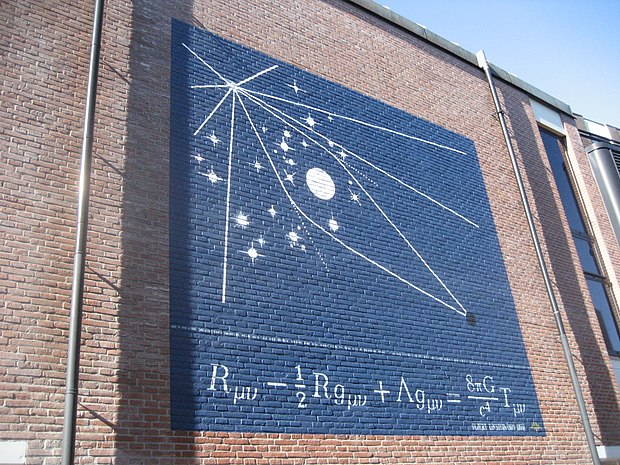
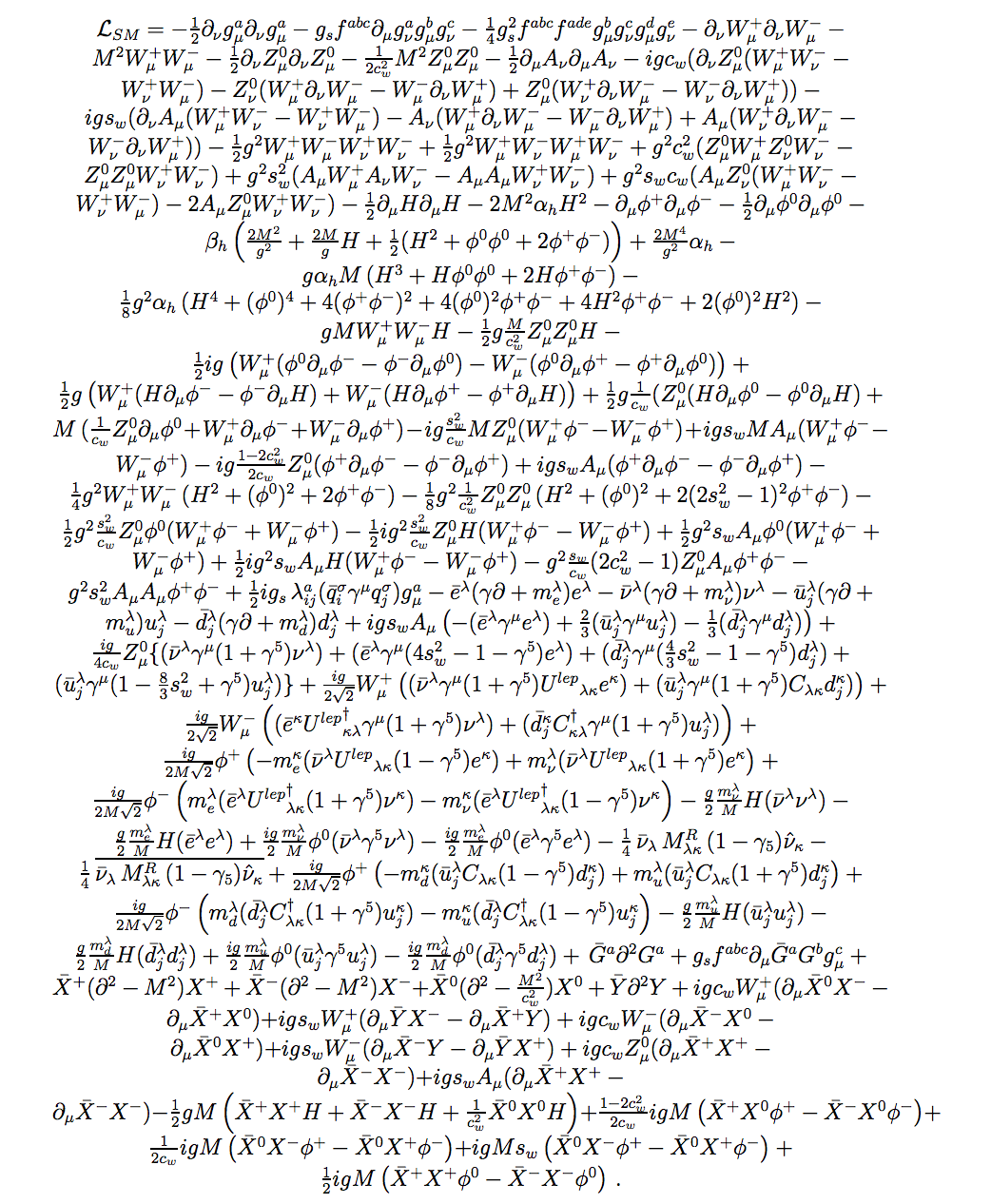
>>>> One can (sort of) write all "physics" in a couple of equations: the
>>>> Einstein Field Equation (EFE) and the Standard Model Equation (SME):
>>>>
>>>> EFE:
>>>> https://upload.wikimedia.org/wikipedia/commons/thumb/4/45/EinsteinLeiden4.jpg/620px-EinsteinLeiden4.jpg
>>>> +
>>>> SME:
>>>> https://www.sciencealert.com/images/Screen_Shot_2016-08-03_at_3.20.12_pm.png
>>>>
>>>> What caused *this particular arrangement* of expressions in these to
>>>> be the "law" of our universe I suppose can be "explained" by it's being
>>>> one
>>>> of any number of possible arrangements.
>>>>
>>>>
>>>>
>>>> The tiny (sigma_1) arithmetical reality contains all “combinations” of
>>>> all programs, and your explanation is a bit like digital physics, where
>>>> the
>>>> physical universe would be one special universal number, say U. That is
>>>> possible, but this can explain the origin of the physical laws, in a
>>>> coherent way with respect to the mind-body problem (the hard problem of
>>>> consciousness) only in presence of an explanation of why that program U is
>>>> winning, that is how such U can “multiply” you so much in the relative way
>>>> that the laws of physics get stabilised. Arithmetical self-reference
>>>> explains consciousness “easily”, but at the price of forcing us to derive
>>>> the physical laws from any universal machinery.
>>>> The physical reality is not a mathematical reality among others, it is
>>>> the projective border of the universal mind, which is just the mind of the
>>>> universal machine. It is a complex many-dreams structure, and its quantum
>>>> aspects explain why negative amplitude of probability can play a role in
>>>> making the aberrant histories relatively rare, despite them being also in
>>>> that sigma_1 arithmetic.
>>>>
>>>> With mechanism, the idea that there is anything more than the sigma_1
>>>> arithmetical truth is absolutely undecidable. The sigma_1 truth emulates
>>>> the sigma_n believers for all n, and beyond. If the physics which is in
>>>> the
>>>> head of the universal numbers departs too much from what we see, it will
>>>> be
>>>> time to suspect that there is indeed something more. But not only there
>>>> are
>>>> no evidence for that, but there are strong evidence for the completeness
>>>> of
>>>> the sigma_1 truth with respect to the metaphysical questions.
>>>>
>>>> Bruno
>>>>
>>>>
>>>>
>>>>
>>> Whatever brand of scientist - physicist, chemist, biologist, even
>>> psychologist - it seems that they see any theory of whatever is within
>>> their domain is to be composed of a finite number of sentences (e.g.
>>> equations, for physicists).
>>>
>>>
>>> Yes, like a brain use a finite number of molecules, and mechanism
>>> eventually only assumes the finite number 0, s(0), s(s(0)), …, which
>>> actually will be used to code the finite things we are interested in.
>>>
>>> But the meaning of those things are formalised by infinite structure,
>>> like the model (N, +, x), or like hide that a computable function associate
>>> any number to a number. The understanding of “red” should make you able to
>>> recognise *all* red things. With mechanism, such meaning are captured by
>>> nameable, and non nameable, number relations.
>>>
>>> All theories assumes such potential, phenomenological, infinities. The
>>> concept of understanding is itself infinite, and more or less well captured
>>> by the comprehension axiom in set theories, or the abstraction Operation in
>>> Lambda calculus. Compute science is concerned by the behaviour of finite
>>> entities confronted to finite or infinite entities.
>>>
>>>
>>>
>>>
>>>
>>>
>>> To have a theory that is composed of an infinite number of sentences is
>>> sort of outside of their way of thinking.
>>>
>>>
>>> All theories contains an infinite set of sentences. Classical
>>> propositional logic contains as theorem “p -> p”,
>>> “p -> (p -> p)”, “p -> (p -> (p -> p)), etc. Elementary arithmetic
>>> contains infinite propositions: 1+1= 2, 2+2=4, 4+4=8, 8+8=16, etc. That is
>>> why we use variables to say generalities, like Ax(x=x), that is, for all x
>>> it is the case that x = x. Or we use scheme of axioms.
>>> No need to put any ontology on this, with mechanism we need only 0,
>>> s(0), …
>>> Mechanism explains, using only the laws of addition and multiplication
>>> (and succession) how finite numbers get able to hallucinate other numbers,
>>> and why some sheaves of hallucination can become persistent and associated
>>> to deep and complex lawful histories.
>>>
>>> I might disagree with you, everyone’s theory is infinite, but what you
>>> are perhaps saying is that at any moment of time, we consult only finite
>>> part of those theories, to figure out some reality we bet on. But that is
>>> not unlike the Turing machine, which consulte only finite portion of its
>>> tape, and asks only a finite number of query to some Oracle.
>>>
>>> F=ma assumes already many infinite theories. Infinite theories are far
>>> simpler to use than finite theories, due especially to the abundance of
>>> very similar types of things, like photons, electro, water molecules, but
>>> also numbers, functions, relations, space, etc.
>>>
>>> Digital Mechanism is a finitisme, not an ultrafinitism, to be clear. It
>>> also an indexical, it concerns your willingness to say yes to a digitalist
>>> doctor, or yes to a digital teleportation experience. I just show that in
>>> that case the mind-body problem reduce to a body illusion problem in
>>> arithmetic. It is more a problem asked in a theory of consciousness than in
>>> physics. Here the theory of consciousness is basically the whole theology
>>> of the universal machine, or the one common to all sound consistent
>>> extension of a little one like PA. PA assumes induction, which we can put
>>> already in the phenomenology. From the putself, we assume only RA(*).
>>>
>>> Bruno
>>>
>>> RA = Robinson’s Arithmetic (often called Q):
>>>
>>> 1) 0 ≠ s(x)
>>> 2) x ≠ y -> s(x) ≠ s(y)
>>> 3) x ≠ 0 -> Ey(x = s(y))
>>> 4) x+0 = x
>>> 5) x+s(y) = s(x+y)
>>> 6) x*0=0
>>> 7) x*s(y)=(x*y)+x
>>>
>>> An even cuter TOE is (without logic!):
>>>
>>> 1) If A = B and A = C, then B = C
>>> 2) If A = B then AC = BC
>>> 3) If A = B then CA = CB
>>> 4) KAB = A
>>> 5) SABC = AC(BC)
>>>
>>> Both are finite theories, or can be easily viewed as shemes of
>>> proposition.. The second theory is purely equational.  We cannot prove that
>>> SK = KI in that theory, but that is not needed in the ontology, where they
>>> are indeed different.
>>>
>>>
>>> Both theories emulate all Löbian machines, which you can define by any
>>> machine believing one of those  axioms, + logic, + corresponding axioms of
>>> induction. They are the machines we can interview on the theology, and the
>>> key proper theological proposition, well they can communicate them only
>>> conditionally to the computationalist hypothesis (of course), and some
>>> “dangerous” self-soundness implicit assumption. It is here that there is a
>>> theological trap (consistent in claiming that G* would necessarily apply to
>>> us).
>>>
>>> Bruno
>>>
>>>
>>>
>>>
>>>
>> I was really talking about every theory considered has a *finite
>> specification*. In Robinson Arithmetic (*RA*) above there are only 7
>> sentences listed. Of course an infinite number of sentences can can be
>> produced from these via rules of the specification.
>>
>> One can have the axioms of True Arithmetic (*TA*):
>>
>>    A sentence S is an axiom of *TA* if S is evaluates to be true over
>> the natural numbers.
>>
>> That would be an "infinite" theory.
>>
>>
>> Or better: an infinite “theory”. In the frame of Mechanism, I prefer to
>> consider such necessary infinite, and not recursively enumerable “theory”
>> as kind of model, instead of theory. I consider that a theory has to be
>> effective. Its theorems has to be recursively enumerable, its axioms has to
>> be recursive.
>> The set of all true sentences of any Turing-complete theory is not
>> recursively enumerable, and is better to be seen as a type of
>> model/semantics.
>>
>> Initially I identify words, numbers, machines, finitely presentable
>> thing, code, software/hardware, as opposed to meaning, infinities, models,
>> realities, …
>>
>> Nuances are then brown au fur et à mesure.
>>
>>
>>
>>
>>
>>
>> (Consider a theory of physics that just accumulated all sentences S that
>> passed an experiment.)
>>
>>
>> That is more like facts, than theorems or potential beliefs of a person.
>>
>>
>>
>>
>>
>> But also what I am talking about are theories with *non-quantitative
>> domains* (are not numerical at all, but are experiential).
>>
>>
>> The experiential (qualitative) domain is obtained from the relation
>> between (fixed point) semantics, but the one I used are intensional fixed
>> point (like in the second recursion theorem) than extensional or
>> denotational one. In particular the modes with “& p” is their definition
>> provide the logic of first person experience, which have a form of
>> knowledge which are not definable, indubitable, not provable, etc.
>>
>
> This doesn't hold even as a general theoretical explanation of experience,
> except for people that need certainty of some self-imposed solipsism or
> consistent negative mental state. This is a form of joy eliminativism. "Not
> definable" is way too strong: Everybody shares experiences and the
> knowledge arising from them.
>
> Take dancing, similar to music, which is more of a first/second/third
> person experience which is definable: entities moving their bodies for joy,
> whether alone or shared, whether with music or without. And it can be
> doubted: for example if Bruno proposes to teach somebody how to dance with
> Bp & p, everybody is right to refuse to pay him as a dance instructor. And
> this is provable when they see Bruno dance: there is considerable certainty
> in the assertion that many students would refuse him as a dance instructor
> upon seeing his moves. With the exception of course of making a copy of
> Bruno, who would definitely find refuge in this bloodless, lifeless
> metaphysics and be the first in line for a lesson, with a notepad, taking
> everything extremely literally, which is all well and good, but evidently
> misses the point of dancing almost entirely.
>
> So nope, not even of use on its own terms as a general account of
> experience. Sexuality, altered states, cooking, laughter, discourse of
> various types etc. would be other areas in which this alleged account that
> Bruno tries to pass on as experience, fails to the nth degree. And the
> metaphysics it points towards is just as bleak.
>
> The old Shaw cliché quote comes to mind:
>
> *“This is the true joy in life, being used for a purpose recognized by
> yourself as a mighty one. Being a force of nature instead of a feverish,
> selfish little clod of ailments and grievances, complaining that the world
> will not devote itself to making you happy. I am of the opinion that my
> life belongs to the whole community and as long as I live, it is my
> privilege to do for it what I can. I want to be thoroughly used up when I
> die, for the harder I work, the more I live. I rejoice in life for its own
> sake. Life is no brief candle to me. It is a sort of splendid torch which I
> have got hold of for the moment and I want to make it burn as brightly as
> possible before handing it on to future generations.”*
>
> Shaw metaphysics from this quote is more solid, clear, and fun than
> quasi-solipsism of intuitionist make. That said, I have no problems with
> numbers having qualities and relations to form other qualities. Music is
> full of that. PGC
>
>
>
*joy eliminativism*

Great new expression!

- pt

--
You received this message because you are subscribed to the Google Groups
"Everything List" group.
To unsubscribe from this group and stop receiving emails from it, send an email
to [email protected].
To post to this group, send email to [email protected].
Visit this group at https://groups.google.com/group/everything-list.
For more options, visit https://groups.google.com/d/optout.