Eric,

But does this mean that Tsonis is wrong?  Tsonis explains much of the
decadal variation of the of temperature and rainfall in terms of
'synchonised chaos' - but this has no validity unless there is a
improved explanation of observed realities.
The realclimate post was actually -

http://www.realclimate.org/index.php/archives/2009/07/warminginterrupted-much-ado-about-natural-variability/

'If this hypothesis is correct, the era of consistent record-breaking
global mean temperatures will not resume until roughly 2020' -
Swanson.  Very roughly.

And please - of course it is a hypothesis.  Anything prediction about
the future is a hypothesis.

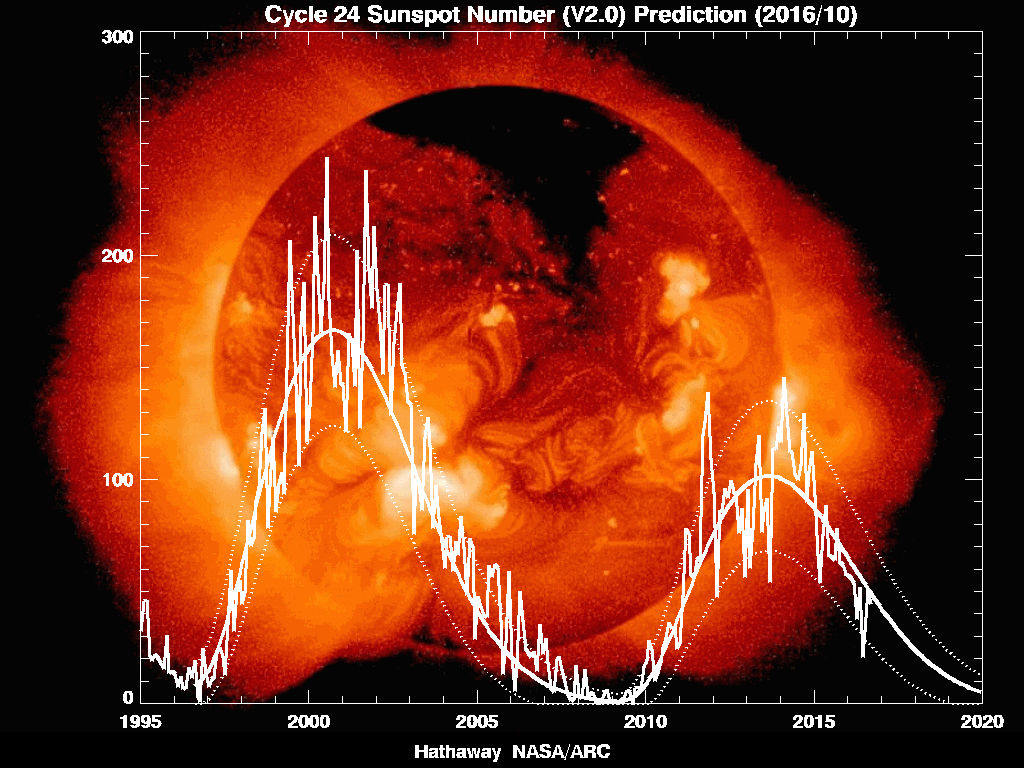
Yep – sunspots are definitely picking up.  That is going to make a
huge difference in surface temperature this year – not.  You need a
lot longer to make an appreciable difference.  What is it – about 0.1
W/m2 difference between solar max and min in the Schwabe cycle?

http://solarscience.msfc.nasa.gov/images/ssn_predict_l.gif

It does point to another model problem – the assumption of more or
less constant solar activity (sometimes over 11 years) at a 1000 year
high over this century.

The biggest interannual influence on surface temperature by far is
ENSO and the current El Niño is fading.  January was a warm month
because of ENSO primarily. Snow and ice? What snow and ice.  Places in
Australia have had record temps but I wouldn't make much of that
either.  No I am afraid your best bet for a 1998 repeat is the solar
max around 2014 in conjunction with a big El Niño - just keep your
fingers crossed that should work for you.

ENSO, just like the PDO, has a 20 to 30 year periodicity – funny about
that.  In fact it is a global thing as Tsonis and colleagues show with
their network approach to ocean and atmospheric indices.  I would
anticipate a reduced frequency and intensity of El Niño and an
increased frequency and intensity of La Niña over the next decade or 2
- always remembering that abrupt climate change is very
unpredictable.

Verdon and Franks (2006) used ‘proxy climate records derived from
paleoclimate data’ to investigate the long-term behaviour of the PDO
and ENSO. They found that ‘during the past 400 years, climate shifts
associated with changes in the PDO are shown to have occurred with a
similar frequency to those documented in the 20th Century.
Importantly, phase changes in the PDO have a propensity to coincide
with changes in the relative frequency of ENSO events, where the
positive phase of the PDO is associated with an enhanced frequency of
El Niño events, while the negative phase is shown to be more
favourable for the development of La Niña events.’

Verdon, D. and Franks, S. (2006), Long-term behaviour of ENSO:
Interactions with the PDO over the past 400 years inferred from
paleoclimate records, Geophysical Research Letters 33:
10.1029/2005GL025052.


Cheers
Robert


On Mar 4, 8:28 am, Eric Swanson <[email protected]> wrote:
> Robert,
>
> We see that your infatuation with Tsonis et al. continues.
>
> Perhaps it is a bit premature to claim no warming for the next 10 or
> 20 years.  After all, the Arctic sea-ice is still melting.  The latest
> data on sea-ice extent shows that the cycle is running nearly
> identical to that of 2007.  The maximum extent is due this month and
> then we will then have about 6 months to watch the recession during
> the annual melt season.
>
> While we are at it, have you noticed that the UAH and NOAA data
> indicates January to be a rather warm month?  That in spite of the
> cold and snow over the Eastern US and also over Northern Europe.  Then
> too, it looks like the solar cycle is beginning to pick up, with more
> sunspots being reported, as happened just before 1998.  I would not be
> surprised if 2010 comes in as a rather warm year, maybe even warmer
> than 1998.
>
> E. S.
> -------------------------------
> On Mar 3, 4:46 pm, Robert I Ellison <[email protected]>
> wrote:
>
> > The thread was about 'sensitive dependence' in the sense of chaos
> > theory - abrupt and major climate shifts on decadal timescales in
> > particular as a result of small changes in initial conditions.  We are
> > talking about abrupt 'major climate shifts' around 1910, the mid
> > 1940's the late 1970's and 1998/2001.
>
> > See for instance Tsonis et al (2007) 'A new dynamical mechanism for
> > major climate shifts' - find it
> > athttps://pantherfile.uwm.edu/aatsonis/www/2007GL030288.pdf
> > - and Swanson et al (2009) "Has the climate recently shifted.  You can
> > find a discussion under 'warming interrupted: much ado about nothing'
> > at realclimate.  2 to 3 decades of no warming from 1998 is fairly
> > significant I would have thought - but I am not
> > realclimate.
>
> > It is foolish to continue to ignore this and concentrate on one
> > statement for which you think you have a 'simple' answer.
>
> > On Mar 3, 8:52 pm, Bart Verheggen <[email protected]> wrote:
>
> > > In the trend of global average temperature over the past 35 years
> > > (0.17 degrees per decade for HadCRU, GISS and NCDC) there is no sign
> > > of a change in such trend during the past 10-12 years.
>
>

--
You received this message because you are subscribed to the Google Groups
Global Change ("globalchange") newsgroup. Global Change is a public, moderated
venue for discussion of science, technology, economics and policy dimensions of
global environmental change.

Posts will be admitted to the list if and only if any moderator finds the
submission to be constructive and/or interesting, on topic, and not
gratuitously rude.

To post to this group, send email to [email protected]

To unsubscribe from this group, send email to
[email protected]

For more options, visit this group at
http://groups.google.com/group/globalchange