> OK, now I've got it.  I wasn't seeing the humps as being many slight
> variations
> around the 50ps points.  Just had my mental scaling all wrong.
> In other words, the TICC's resolution is "blurred" around the nominal value
> rather
> than being aligned to a precise increment.
John,

Yes, that summary works. Also, TBD is if this accidental dithering might
actually be a good thing. Re-read Bob's recent SDR comment.

Note that counter resolution can be described by an rms value; a number
computed from a calibrated noise floor test. Given a large set of samples, the
rms noise is not due to the picket fence vs. camel hump effect, but by the
Gaussian envelope that encloses those effects.

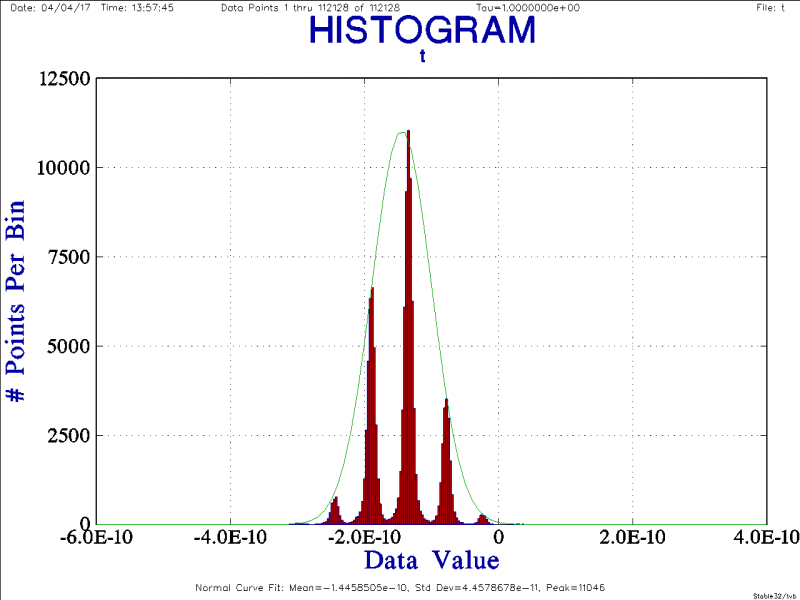
To see what I mean about the Gaussian envelope that encloses those effects:

http://leapsecond.com/pages/ticc/ticc-log5342-hist.gif

I'm talking about the outer envelope; the green trace. Stable32 calculates a
stdev of 45 ps. So you could say: in this test the TICC has the "equivalent of"
45 ps rms resolution. Some hand-waving required, but you get the idea.

> I wonder if it would help to round (or truncate) the TICC output to 10 ps,
> since the
> last digit is noise anyway.  Or go even further and round to the nearest 50
> ps.

Yes, change from 1 ps to 10 ps. 1 ps was handy during development to make sure
output formatting was not a limiting factor. But once all the math was sorted
out that 1 ps digit was excessive. I would not go to 50 ps, however. At that
point numerical / decimal quantization effects get in the mix.

/tvb
_______________________________________________
time-nuts mailing list -- [email protected]
To unsubscribe, go to
http://lists.febo.com/mailman/listinfo/time-nuts_lists.febo.com
and follow the instructions there.