The U.S. Nuclear Regulatory Commission

The NRC is the Federal agency responsible protecting the health and safety
of the public and the environment by licensing and regulating the civilian
uses of the following radioactive materials:
   - Source material
<http://www.nrc.gov/materials/srcmaterial.html>(uranium and thorium)
   - Special nuclear
material<http://www.nrc.gov/materials/sp-nucmaterials.html>(enriched
uranium and plutonium)
   - Byproduct material
<http://www.nrc.gov/materials/byproduct-mat.html>(material that is
made radioactive in a reactor, and residue from the
   milling of uranium and thorium)

The NRC regulates the use of these radioactive materials through Title 10,
Part 10, of the *Code of Federal Regulations* (10 CFR Part
20<http://www.nrc.gov/reading-rm/doc-collections/cfr/part020/>),
"Standards for Protection Against Radiation," which spells out the agency's
requirements for the following aspects of radiation protection:

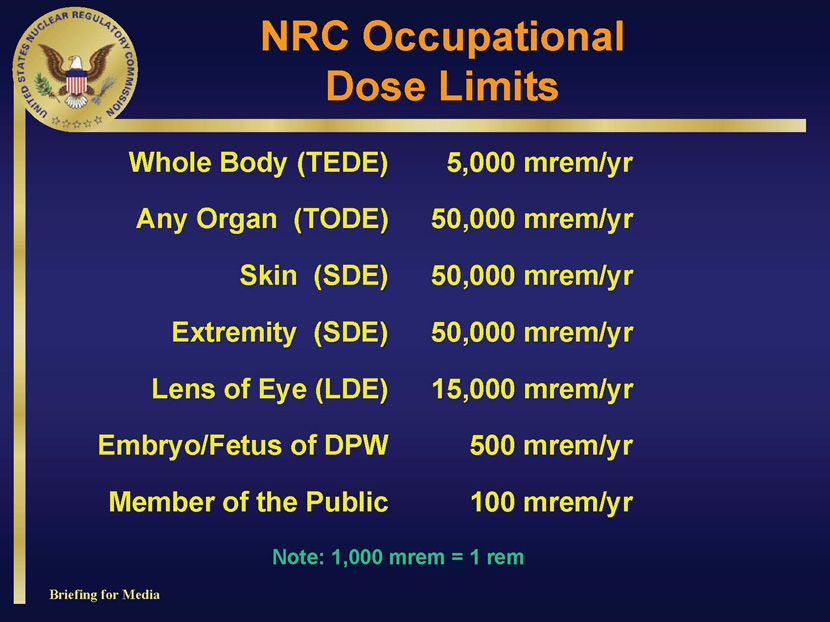
   - Dose
limits<http://www.nrc.gov/images/about-nrc/radiation/dose-limits.jpg>for
radiation workers and members of the public
   - Exposure limits for individual radionuclides
   - Monitoring and labeling radioactive materials
   - Posting signs in and around radiation areas
   - Reporting the theft or loss of radioactive material
   - Penalties for not complying with NRC regulations

Of more than 20,000 active source, byproduct, and special nuclear materials
licenses in place in the United States, about a quarter are administered by
the NRC, while the rest are administered by 35 Agreement
States<http://www.nrc.gov/about-nrc/radiation/protects-you/reg-matls.html#states>
.

On Fri, Aug 31, 2012 at 4:07 PM, Axil Axil <[email protected]> wrote:

> "Chemical transmutation," is what is going on. The physics commumity must
> come to terms with this reality.
>
> Chemically Assisted Transmutation Reaction (CATR) reactions are produced
> through the action of electrons not neutrons.
>
> The NRC regulates the use of neutrons not electrons.
>
> If no neutrons are produced, there is no need for NRC regulation.
>
> High powered LASERs and electric arcs can produce transmutation of
> isotopes. These methods are not regulated, or from a practical standpoint,
> how could they be.
> The action of a catalyst directing the action of electrons cannot be
> regulated by the NRC.
> Cheers:  Axil
>
> On Fri, Aug 31, 2012 at 3:49 PM, Jed Rothwell <[email protected]>wrote:
>
>> Axil Axil <[email protected]> wrote:
>>>
>>> Chemically Assisted Transmutation Reaction (CATR) expert:  Yes, certain
>>> chemical reactions are known to produce tritium. Those reactions should be
>>> regulated by the NRC or band. Those reactions use the hydrogen isotope
>>> deuterium.
>>
>> A chemical reaction cannot produce tritium. That is a transmutation; a
>> change to the nucleus. The definition of chemistry is a reaction limited to
>> the electrons.
>>
>> That is the present definition, anyway. "Chemical transmutation" is a
>> contradiction of terms, like "a living corpse" or "a solid gas."
>>
>> If cold fusion with deuterium can cause transmutations with products such
>> as tritium, then it stands to reason that cold fusion with hydrogen might
>> also cause transmutations. There is already experimental evidence that it
>> can cause bursts of neutrons.
>>
>> There is no way -- absolutely, positively, no way on God's green earth --
>> that experts testifying before Congress any time in the next decade will
>> claim that the theory is settled, and we know for sure this is a benign
>> chemical effect that should not be under the purview of the NRC or other
>> nuclear regulators. That question can only be settled after thousands of
>> researchers replicate the effect and assess it in far greater detail than
>> anyone has done until now. It cannot be settled until the theorists reach
>> some sort of consensus about the nature of the reaction. They need a
>> working model, if not a theory. We are far from that. Probably hundreds of
>> millions of dollars away from that, if not billions.
>>
>> The physics establishment is not going to throw away the definitions of
>> chemistry versus nuclear physics, and accept unconditionally that there is
>> such a thing as "chemical transmutation," and that we should not worry
>> about the effects of that mysterious new phenomenon. It should not accept
>> that! It would be the height of irresponsibility for physicists to accept
>> this. We know practically nothing about cold fusion. The research has
>> barely begun. As I said at ICCF17, in the whole history of the field, we
>> have spent roughly as much money as people spend on semiconductor R&D *in
>> a single day*. I repeat: by the standards of industrial R&D, cold fusion
>> is one day old.
>>
>> - Jed
>>
>>
>