> On 18 Apr 2019, at 21:10, Philip Thrift <[email protected]> wrote:
>
>
>
> On Thursday, April 18, 2019 at 8:56:54 AM UTC-5, Bruno Marchal wrote:
>
>> On 18 Apr 2019, at 12:17, Philip Thrift <[email protected] <javascript:>>
>> wrote:
>>
>>
>>
>> On Thursday, April 18, 2019 at 4:53:36 AM UTC-5, Bruno Marchal wrote:
>>
>>> On 16 Apr 2019, at 15:06, Philip Thrift <[email protected] <>> wrote:
>>>
>>>
>>>
>>> On Tuesday, April 16, 2019 at 6:39:28 AM UTC-5, Bruno Marchal wrote:
>>>
>>>> On 15 Apr 2019, at 11:04, Philip Thrift <[email protected] <>> wrote:
>>>>
>>>>
>>>> If our physics is in a number, is Game of Thrones physics
>>>>
>>>> The physics of Game of Thrones
>>>> https://winteriscoming.net/2017/09/29/neil-degrasse-tyson-cant-stop-talking-physics-game-thrones/
>>>>
>>>> <https://winteriscoming.net/2017/09/29/neil-degrasse-tyson-cant-stop-talking-physics-game-thrones/>
>>>
>>> That would be the mistake of Dgital Physics/Physicalism.
>>>
>>> It is like saying that some program u generate the physical universe. That
>>> is not entirely excluded from the mechanist hypothesis, but even if that is
>>> the case, such an u (and of course all the u’ such that phi_u = phi_u’
>>> extensionally) must be derived from elementary arithmetic, if mechanism is
>>> correct.
>>>
>>> But that can be shown to be not quite plausible, as this would make our
>>> substitution level so low that the only “artificial brain” possible would
>>> be the entire physical universe. In that case, most of our biology and
>>> physics would be false. It is such a weakening of Mechanism, that it would
>>> make Mechanism wrong FAPP, contradicting all the evidences that we have for
>>> Mechanism, like evolution, molecular biology or quantum physics.
>>>
>>>
>>>
>>>
>>>>
>>>> in another number?
>>>>
>>>> Or: Is there a a GoT reality?
>>>
>>> Sure there is, but not a fundamental one, capable of explaining
>>> (every)thing.
>>>
>>> Bruno
>>>
>>>
>>>
>>> Assume "our physics" is the Standard Model.
>>
>> I can’t. If that “model” (theory) is the correct fundamental physics, then
>> it has to be deduced from arithmetic (and Mechanism).
>>
>>
>>
>>
>>>
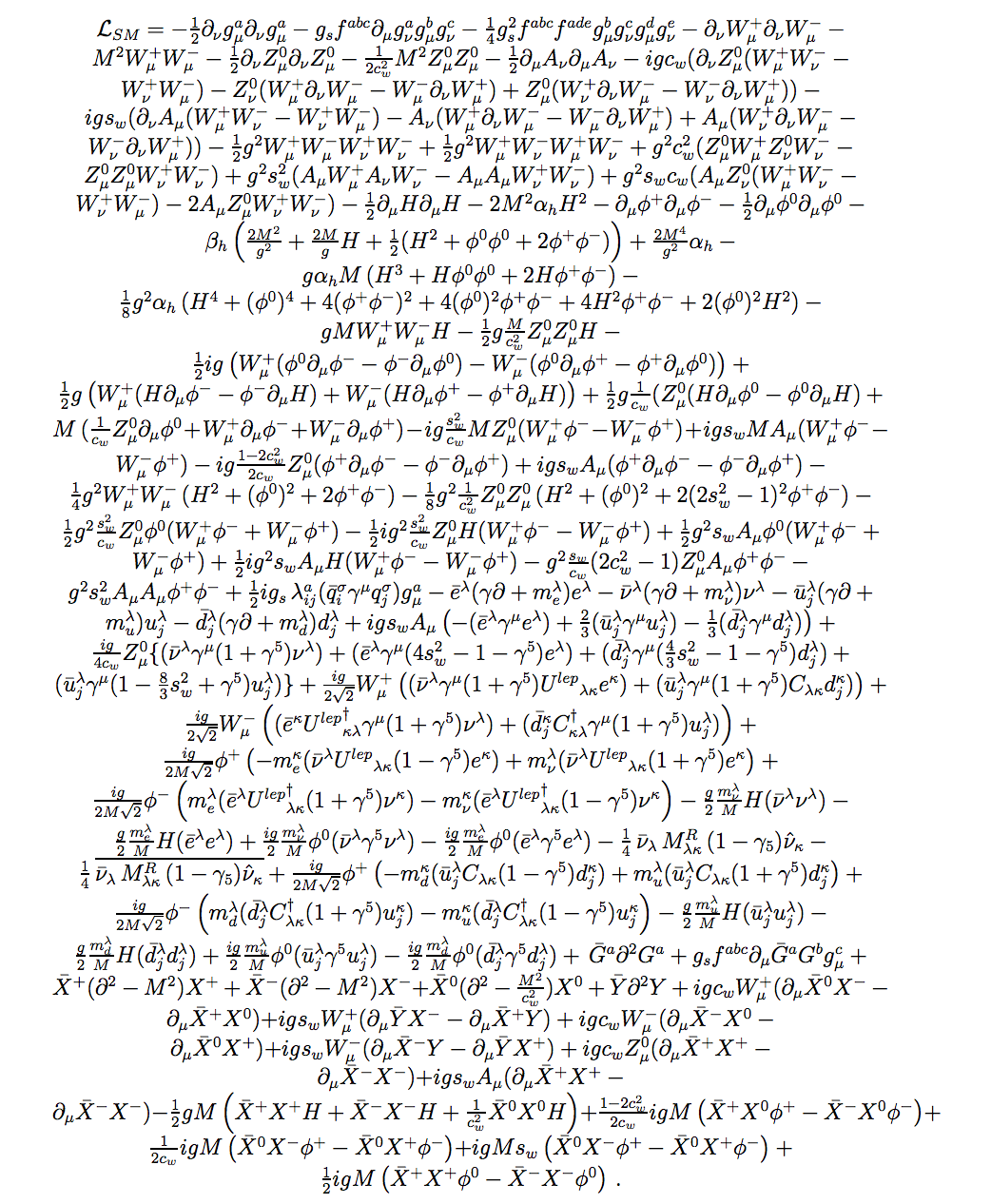
>>>      Here it is in a few hundred characters (Lagrangian_{SM}):
>>>
>>>
>>> https://www.sciencealert.com/this-is-what-the-standard-model-of-physics-actually-looks-like
>>>
>>> <https://www.sciencealert.com/this-is-what-the-standard-model-of-physics-actually-looks-like>
>>>
>>> How does one "derive" this Lagrangian_{SM} from the logic of elementary
>>> arithmetic (Logic_{EA}) -- even given the translation of the language of
>>> Lagrangians into the language of Logic_{EA}.
>>
>> Yes, formalising a theory is not the same as deriving it.
>>
>> How, to derive it? By studying the “material modes of self-reference, that
>> the mode of the first person self, or the first person plural self. How, and
>> why is explained in most of my papers.
>>
>>
>>
>>
>>> Why should our SM be the one, and not an alternative SM?
>>
>> Because the sum on all computations is unique.
>>
>> That is the nice thing with Mechanism. It justifies why there is an apparent
>> physical universe, having the same law for any universal numbers. It justify
>> the existence of physics, and its unicity, even if it take the shape of a
>> mutilverse, or even some multi-multiverses.
>>
>>
>>
>>
>>> If every SM equation is possible (not just the one equation above), what is
>>> "explained”?
>>
>> Only one SM equation can be possible (assuming mechanism of course, which I
>> do all along).
>>
>>
>>
>>>
>>> It makes more sense that Lagrangian_{SM} and Logic_{EA} are completely
>>> contingent hypotheses written in languages created by us humans to model
>>> reality.
>>
>> That would identify physics and geography, but with mechanism, we know
>> already that geography is contingent, where the physical reality is lawful.
>> Would all material mode of self-reference have collapsed into propositional
>> calculus, there would be no physical laws, only geographical laws.
>>
>> Bruno
>>
>>
>>
>>
>> The puzzle is that if one looks at the literal SM formula shown here:
>>
>>
>> https://www.sciencealert.com/images/Screen_Shot_2016-08-03_at_3.20.12_pm.png
>> <https://www.sciencealert.com/images/Screen_Shot_2016-08-03_at_3.20.12_pm.png>
>>
>
> It is somehow justified by the data, and some theoretical ideas, in the book
> by Alain Connes and Matilde Marcolli: Non Commutative Geometry, Quantum Filed
> and Motives. That is page 167 of that book, and I am not up there.
> Yet, the main ideas are rather well explained in the more readable book by
> Vic. Stenger.
>
> But both Alain Connes and Vic Stenger are doing physics, and so they assumes
> much more than what is permitted when we assume computationalism, where even
> the starting ideas of Vic Stenger have to be derived from arithmetic (using
> also the mechanist principle of the invariance of consciousness for some
> digital functional substitution made at some level).
>
> Now, having said that, it is clear that Alain Connes suspect that equation to
> be related at least to the arithmetical reality of the prime numbers, and his
> work is among those work in fundamental physics which illustrates deep
> relations between physics and number theory.
>
> For a logician, that insight makes sense. Elementary arithmetic is Turing
> universal, and is thus an acceptable “theory” of Everything. But there are
> some reason to believe that the distribution of the prime numbers encodes the
> full complexity of the marriage between addition and multiplication, which is
> responsible for that Turing universality, and this should be captured by the
> Riemann zeta function, as it contains global information on all primes.
>
> Unfortunately, even if the correct universal quantum field theory is
> successfully extracted from the elementary arithmetic of the prime number, or
> other sort of numbers, that would still be not quite satisfactory, for a
> computationalist, because that theory should still be extracted from
> arithmetic through the mathematics of arithmetical self-reference to get
> right the distinctions and the relations between the first person plural
> quanta and the first person singular quanta, beyond to get right the reason
> of the physical observations existence.
>
>
>
>
>
>
>
>
>
>> what if all the "2"s were changed to "3"s (or any "editing" like that).
>
> The theory will no more predict what we observe. (Physicist answer)
>
> But that is independent of the fact that with Mechanism, we have to derive
> the correct physics from arithmetical (or theoretical computer science)
> self-reference theory. See my papers for an explanation of the why, and the
> how, and what has been already be done.
>
> In a nutshell, it can be shown that a digital machine (in the non material
> sense of Turing, Church, Post, Gödel, Kleene, etc.) is unable to distinguish
> introspectively (to feel) the difference between processed by a this or that
> universal number/machine. This leads to a first person indeterminacy, “lived”
> by the machine concerned, on all its consistent accessible continuations in
> the arithmetical computations, or in the universal dovetailing on all
> computations, and the physical reality has to be recovered by a statistics on
> those computations.
>
> That is very hard to do in any brute direct way, but it is easy to extract
> the logic of the “measure one” (and zero) by using the fact that
> incompleteness makes it impossible to see that []p, []p & p (knowledge), []p
> & <>t, (observation, bet) and []p & <>t & p are equivalent extensionally. And
> indeed, on the partial computable propositions (the sigma_1 arithmetical
> propositions) this gives different quantum logics, with a semantic of
> “alternate histories”, close to the “consistent histories” of Omnes and
> Griffith, but also Gell-Man & Hartle.
>
> The little textbook by Chris J. Isham  (Lecture on Quantum theory, the
> Mathematical and Structural Relations, Imperial College Press, 1995, London)
> provides some explanation on the relation between quantum logic and
> “many-world” (QM without collapse). Another quite useful and a bit older book
> on this is the book by Richard Hugues: The Structure and Interpretation of
> Quantum Mechanics, Harvard University Press, Massachusetts, 1989). Of course
> they do not address the mind-body issue, which enforces a “many-histories”
> interpretation of elementary arithmetic, on which a theorem similar to
> Gleason theorem is expected, unless mechanism is wrong.
>
> You might perhaps study my papers:
>
> Marchal B. The computationalist reformulation of the mind-body problem. Prog
> Biophys Mol Biol; 2013 Sep;113(1):127-40
> https://www.ncbi.nlm.nih.gov/pubmed/23567157
> <https://www.ncbi.nlm.nih.gov/pubmed/23567157>
>
> Marchal B. The Universal Numbers. From Biology to Physics, Progress in
> Biophysics and Molecular Biology, 2015, Vol. 119, Issue 3, 368-381.
> https://www.ncbi.nlm.nih.gov/pubmed/26140993
> <https://www.ncbi.nlm.nih.gov/pubmed/26140993>
>
> B. Marchal. The Origin of Physical Laws and Sensations. In 4th International
> System Administration and Network Engineering Conference, SANE 2004,
> Amsterdam, 2004.
> http://iridia.ulb.ac.be/~marchal/publications/SANE2004MARCHALAbstract.html
> <http://iridia.ulb.ac.be/~marchal/publications/SANE2004MARCHALAbstract.html>
> (sane04)
>
>
>
>
>>
>> One gets from L_{SM(2)}) (the one above) to L_{SM(3)}, where the 2s have
>> been replaced by 3s.
>>
>> Why would L_{SM(2)})  be the "necessary" theory, or could L_{SM(3)} "work"
>> as a different physics?
>
>
> Of course, today we don’t know. If the “2 or 3” is not settled by the “unique
> physics”, it would mean that such number are geographical/contingent
> differences, and that we can access consistent extensions with 2, and
> consistent extensions with 3 in arithmetic.
>
> Bruno
>
>
>
>
> I know of the Vic Stenger (laws-from-symmetry) approach (from the old Atoms
> and the Void group).
>
> The Comprehensible Cosmos: Where Do the Laws of Physics Come From?
> https://books.google.com/books/about/The_Comprehensible_Cosmos.html?id=09sPAQAAMAAJ
>
> <https://books.google.com/books/about/The_Comprehensible_Cosmos.html?id=09sPAQAAMAAJ>
>
>
> It's possible that the "laws" of nature - physics, chemistry, biology,
> psychology, ..- can come from a single simplicity,
>
> or that it's more of a babel - like the theoretical sciences suggest - with
> theoretical physics, chemistry, biology having separate vocabularies,
> frameworks, and theories.
The whole point of the fundamental research consists in finding a theory which
account for all theories. The goal is to unify the different knowledge/belief,
without dismissing data (like physics do with respect to consciousness and
qualia).

The laws of nature are reduce to a statistics of number dream, where a dream is
a computation supporting one, or a collection of Löbian machine(s).

Bruno


>
> - pt
>
> --
> You received this message because you are subscribed to the Google Groups
> "Everything List" group.
> To unsubscribe from this group and stop receiving emails from it, send an
> email to [email protected]
> <mailto:[email protected]>.
> To post to this group, send email to [email protected]
> <mailto:[email protected]>.
> Visit this group at https://groups.google.com/group/everything-list
> <https://groups.google.com/group/everything-list>.
> For more options, visit https://groups.google.com/d/optout
> <https://groups.google.com/d/optout>.

--
You received this message because you are subscribed to the Google Groups
"Everything List" group.
To unsubscribe from this group and stop receiving emails from it, send an email
to [email protected].
To post to this group, send email to [email protected].
Visit this group at https://groups.google.com/group/everything-list.
For more options, visit https://groups.google.com/d/optout.