There is a relevance and importance to understanding the connection between
early western music and early eastern music, including  islamic sources.
Unfortunately, there are the problems of translations and availability.
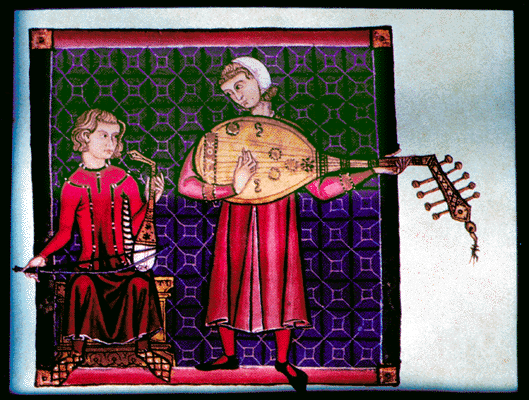
Concerning instruments, of course there is an exciting field of making our own
connections, for which there is an excellent source - Cantigas de Santa Maria
illuminations. The copy can be found here:
http://www.3to4.com/Cantigas/e_index.html
We can see for ourselves if the ouds of the time (11 c. AC) had the
frets, like here:
http://www.3to4.com/Cantigas/image/170L.gif
The noticeable difference to the western music history, framed mostly
in "sacred versus secular", is the triangle science-sacred-secular of sorts.
The oriental music can not be understood without realization that the music was
- the science, as important and developed as mathematics. As a matter of fact,
the same, well, philosophers had written on the music as on the mathematics and
physics (a good starting list of names:
 http://en.wikipedia.org/wiki/Mathematics_in_medieval_Islam )
The oud itself was (and by a certain contingent still is) perceived as the
(mathematical) perfection of form - material - sound. Very much worth pondering
on.
Such a subject of course can not be framed in sound bites. It's much easier to
colonize them and then denigrate their culture.
Some links:
http://www.statemaster.com/encyclopedia/Persian-music
http://www.uga.edu/islam/IslArt.html#Music
http://www.bestmp3links.com/musicstyles/persian-music.php
The books by Sheldon Pollock make for a good reading, this one in particular:
http://muse.jhu.edu/login?uri=/journals/comparative_studies_of_south_asia_africa_and_the_middle_east/v024/24.2pollock.html

alexander r.

>    Hi Daniel,
>
>    I am sorry that you felt addressed by my not so polite remark - it was
>    actually a (too) quick reaction to Roman's answer to my original
>    question. I felt somewhat mistreated by simply getting the message that
>    all my assumptions on which the question were fallacious, full stopp -
>    with no further explanations. That style felt like a slap in the face
>    instead of an answer, telling me mainly how ignorant I am (in infinite
>    contrast to him) instead of giving me the chance to learn better.
>
>    Maybe I misunderstood his intention. Actually I would very much like to
>    understand his very interesting statements better and to judge them. I
>    am an amateur, and having not all the time in the world, I always hope
>    that experts might be willing and able to give me some directions, be
>    it in explanations be it in hints what to read best to get an idea what
>    is discussed and how to weigh the arguments. (I myself am a scientist,
>    and I often write in popular magazines, give seminars for a general
>    audience etc. to support that kind of non-expert education which is -
>    among other things - important for a democratic and broad
>    culture). Recently I was fascinated by early music, and the lute in
>    connection, and would like to understand better how our occidental
>    idiom was formed as well as learn about the history of the lute... I
>    read this and that so far, with serious interest but, unfortunately,
>    limited time. So hints are more than welcome.
>
>    Thanks and best
>    Franz
>
>


To get on or off this list see list information at
http://www.cs.dartmouth.edu/~wbc/lute-admin/index.html