“Does not Buddhaist practice drawing maldula's --drawing a circle and
with-in that circle-and everything on has a meaning on ones life---and
There is a book I can't remenber the name of it which you throw a coin
and it is kind of like telling you of your good fortune or not...It is
very important---If you do not know what I am talking about than I
would not know what kind of belief  that you practice--this is very
old Buddha” - DR
Doris, yes, some schools of Buddhism use mandalas. Tibetan Buddhism in
particular uses mandals extensively. Some of these I have been
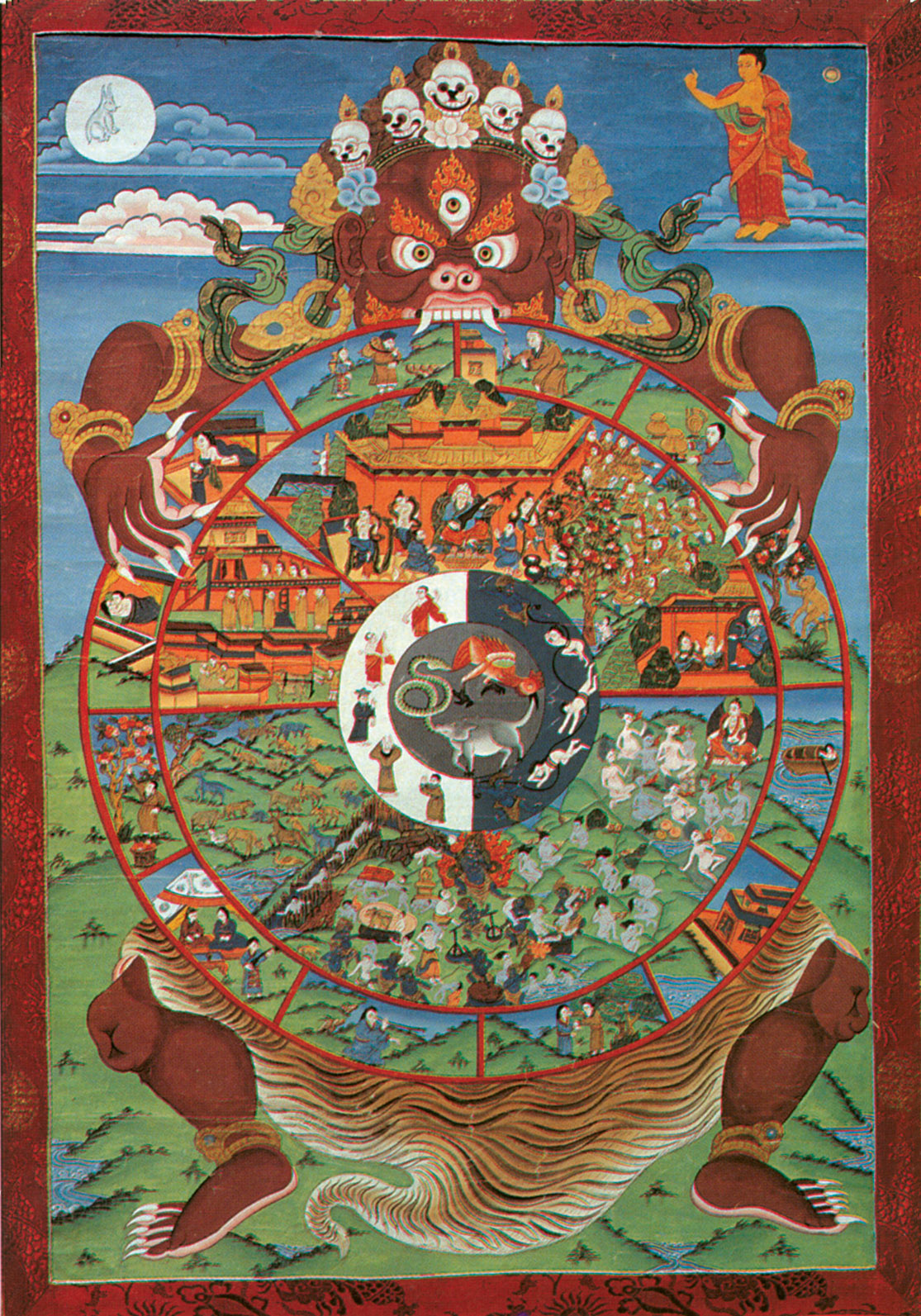
initiated into. And, many do use a circle architecture. One of the
better known ones today is the Wheel of Life and is associated with
the Kalachakra Tantra and practice.
http://kennybeal.files.wordpress.com/2008/02/wheeloflife.jpg

And, yes each item, symbol and each color etc. all have specific
meanings. Also, much of it is associated with specific states of being/
consciousness.

The associated two dimensional mandala is visualized as a three
dimensional ‘house’ in meditation. Here is one online representation
of this process, something quite new since advances in internet
technology have been developed.
http://www.youtube.com/watch?v=rx4mdjMIqNo&NR=1
Kalachakra Mandala – 3d

More information if interested.
http://kalachakranet.org/mandala_kalachakra.html
Kalachakra Mandala info.

Here is a nice video about the process of the creation of a sand
mandala for the Guhyasamaja, one of the Tantras in which I was
initiated in the mid 1980s by the then spiritual head of the Yellow
Hat order. It was about a two week initiation process.
http://www.youtube.com/watch?v=sfSDQXnwPKs
Process of sand mandala creation – Guhyasamaja, part 1

In general, all Buddhist iconography, including what is commonly known
as Thangkas have deep associations and are used for inner journeys and
inner 'work'.
http://www.youtube.com/watch?v=BlAk10Y72qw

Later you mention a book and coins. That is the I-Ching and is a very
ancient Chinese method of divination and more. It has been associated
with Taoism as well as Confucianism. Normally it is not directly
associated with Buddhism. However, like most systems of knowledge,
older ones are sometimes incorporated into newer practices. I started
throwing the sticks and/or coins for the I-Ching back in the early
1960s. I was skeptical as I am with most things and, after a little
personal ‘scientific inquiry’, I determined that the system might have
some merit. I will leave that up to you to find out. Here is one
online way to test it for yourself.
http://www.ichingonline.net/

Doris, one thing, please do not associate most of this with my
personal ‘beliefs’. Although I do have some experience and practice in
these things, they are not at the center of my ongoing practice. On
the other hand, I do use a different system of mandalas and yantras
for my current practice along with mantra, visualization, mudras etc.


On Nov 11, 8:25 pm, Doris Ragland <[email protected]> wrote:
> Does not Buddhaist practice drawing maldula's --drawing a circle and with-in
> that circle-and everything on has a meaning on ones life---and There is a
> book I can't remenber the name of it which you throw a coin and it is kind
> of like telling you of your good fortune or not...It is very important---If
> you do not know what I am talking about than I would not know what kind of
> belief  that you practice--this is very old Buddha
> --On Wed, Nov 11, 2009 at 6:51 PM, ornamentalmind
> <[email protected]>wrote:
>
>
>
>
>
> > Doris, IF your question is directed to me, I have no idea what
> > 'medalua's' means. It doesn't even exist on god google! :-0
>
> > Sorry....
>
> > On Nov 11, 6:44 pm, Doris Ragland <[email protected]> wrote:
> > > I want to ask you a question?  Do you throw coins and draw medalua's--
>
> > > On Wed, Nov 11, 2009 at 6:28 PM, ornamentalmind <
> > [email protected]>wrote:
>
> > > > …
> > > > What is the nature of that mind that knows this? - orn
> > > > “Empty” – e
> > > > Would you like to share anything about your experience(s) and/or
> > > > direct apprehension of emptiness? Is this possible?
> > > > What is at the base (underneath) all words and concepts? - orn
> > > > “.Nothing (see * below). There is no base where consciousness lands.
> > > > Consciousness releases. Buddha used the metaphor of fire unbound. When
> > > > the fuel (of grasping) is exhausted, where does the fire go when it
> > > > goes out? The question is nonsensical. In this unbound analogy, we
> > > > cannot speak of luminosity et al.” – e
>
> > > > Here I am not talking about either a place ‘where consciousness lands’
> > > > nor the process of consciousness. I am looking at that which doesn’t
> > > > move. And, while consciousness can be seen as a container, (see below
> > > > ***) here too this is not exactly what I am pointing toward. So, as
> > > > far as I understand it, the notion of grasping isn’t involved.
>
> > > > If something is “conceived” as being permanent, is that conception
> > > > itself permanent? - orn
>
> > > > "Of course not, wait around long enough and it will disappear." - e
>
> > > > (I asked the question about ‘conceived’ due to your post of: “…
> > > > EVERYTHING is seen as impermanent and let go of. Not to then land on
> > > > some other thing that is conceived as permanent but just let go at
> > > > grasping for permanence.” e, in case you were interested. )
>
> > > > Overall, I agree with your analysis of non-permanence in this context.
>
> > > > “What in your experience is permanent Orn? “ – e
>
> > > > Specific states…again, words belie the experience. I’ve pointed at
> > > > Gautama’s indictive to “Look for that which does not move.”, this
> > > > would be one example.
>
> > > >  “…I agree it is not thinking. However, I don’t know about this
> > > > eternalism. Buddha was emphatic about the 2 extremes of eternalism and
> > > > annihilationism to be avoided for the middle way to be found. He did
> > > > not say they needed to be avoided to then find some other kind of uber
> > > > eternalism.” – e
>
> > > > As I understand that tenet system, Gautama was talking about the
> > > > GRASPING of those extremes. No? - orn
>
> > > > “http://www.accesstoinsight.org/tipitaka/sn/sn12/sn12.015.than.html
> > > > Nagarjuna mentions this sutra in MMK XV. Is the permanent basis of the
> > > > mind (the minds true nature) an eternal essence? If it is, are we
> > > > still talking about Buddhism?” - e
>
> > > > e, as much as I appreciate this sort of comparison and analysis of
> > > > cannons, since the majority of Nagarjuna is lost and the words of
> > > > Gautama were not penned that we know of until hundreds of years after
> > > > his death, I equate this sort of study with similar Christian studies
> > > > and only observe and/or play it on occasion. In general, I don’t hold
> > > > much importance when it comes to texts. There are exceptions however
> > > > this is not one of them. And, as I’ve said, I’m not as keen on the
> > > > middle way as I am on mind only. The latter appears to be more
> > > > accurate to me. In any case, we both know how unmonolithic Buddhism
> > > > is. As said, while I appreciate scholarship and do study some, I do
> > > > not embrace revelation by using any ‘holy-text’. I more adhere to what
> > > > I find in practice. This is a long winded “I don’t know.” To your last
> > > > two questions above and have no interest in concocting an ontology
> > > > around it.
>
> > > > I read the entire link and remain perplexed as to your intention in
> > > > posting it.
>
> > > > When you said “ *Right but the way I see it, they just disappear, they
> > > > don’t disappear into some large container called mind.” - e
>
> > > > Yes, that is one type of experience. I find they return on occasion
> > > > too. *** I’m more talking about Alaya Consciousness. The notion of a
> > > > container is quite compatible with some Buddhist Schools.
>
> > > > Again, thanks for the opportunity to learn e.!!!
>
> > > > On Nov 11, 3:11 pm, e <[email protected]> wrote:
> > > > > Is true nature a state of an impermanent mind? In what way is it not
> > > > > (if any)? If the true nature is empty and impermanent, how can there
> > > > > be eternalism? It seems Buddha proffered a radical impermanence so
> > > > > that EVERYTHING is seen as impermanent and let go of. Not to then
> > > > > land
> > > > > on some other thing that is conceived as permanent but just let go at
> > > > > grasping for permanence.” – e
>
> > > > > All excellent questions and areas to explore e. And, I’m not sure I
> > > > > can answer them well. I will say that you appear to be taking a
> > > > > dialectical stance here…more accurately, using formal logic when it
> > > > > comes to permanent/impermanent.  - orn
>
> > > > > I am only trying to talk about Buddhism as clearly and simply as
> > > > > possible.
>
> > > > > Continuing a commentary on your query, I will use some Socratic
> > > > > questions. When all is apprehended as being impermanent, what is
> > > > > apprehending? - orn
>
> > > > > Apprehension
>
> > > > > What is the nature of that mind that knows this? - orn
>
> > > > > Empty
>
> > > > > What is at the base (underneath) all words and concepts? - orn
>
> > > > > Nothing (see * below). There is no base where consciousness lands.
> > > > > Consciousness releases. Buddha used the metaphor of fire unbound.
> > When
> > > > > the fuel (of grasping) is exhausted, where does the fire go when it
> > > > > goes out? The question is nonsensical. In this unbound analogy, we
> > > > > cannot speak of luminosity et al.
>
> > > > > If something is “conceived” as being permanent, is that conception
> > > > > itself permanent? - orn
>
> > > > > Of course not, wait around long enough and it will disappear.
>
> > > > > -
>
> > > > > “Yes but there is a state of mind that is permanent? Really? …” – e
>
> > > > > Yes.  - orn
>
> > > > > What in your experience is permanent Orn?
>
> > > > > -
>
> > > > >  “…I agree it is not thinking. However, I don’t know about this
> > > > > eternalism. Buddha was emphatic about the 2 extremes of eternalism
> > > > > and
> > > > > annihilationism to be avoided for the middle way to be found. He did
> > > > > not say they needed to be avoided to then find some other kind of
> > > > > uber
> > > > > eternalism.” – e
>
> > > > > As I understand that tenet system, Gautama was talking about the
> > > > > GRASPING of those extremes. No? - orn
>
> > > > >http://www.accesstoinsight.org/tipitaka/sn/sn12/sn12.015.than.html
> > > > > Nagarjuna mentions this sutra in MMK XV. Is the permanent basis of
> > the
> > > > > mind (the minds true nature) an eternal essence? If it is, are we
> > > > > still talking about Buddhism?
>
> > > > > -
>
> > > > >  “…I really am just exploring and looking for some new meaning and
> > > > > not
> > > > > trying to destroy any old ones, etc. Lately I have come to see that
> > > > > everything is an interpretation so I am only questioning the old
> > > > > interpretations and seeing if they still hold up, etc. Thanks for
> > > > > going along!! “ – e
>
> > > > > The metaphor of exploring is quite appropriate and accurate. While
> > > > > one
> > > > > is ‘on the path’, differing levels of understanding will arise, stay
> > > > > for a bit and then recede… and finally disappear. - orn
>
> > > > > *Right but the way I see it, they just disappear, they don’t
> > disappear
> > > > > into some large container called mind.- Hide quoted text -
>
> > > - Show quoted text -- Hide quoted text -
>
> - Show quoted text -
--~--~---------~--~----~------------~-------~--~----~
You received this message because you are subscribed to the Google Groups
""Minds Eye"" group.
To post to this group, send email to [email protected]
To unsubscribe from this group, send email to
[email protected]
For more options, visit this group at
http://groups.google.com/group/minds-eye?hl=en
-~----------~----~----~----~------~----~------~--~---