On 03/30/2010 05:26 PM, Jones Beene wrote:
> -----Original Message-----
> From: Stephen A. Lawrence
>
>> That's certainly true -- it looks suspicious.  But again, it's not
> conclusive, and it doesn't point to any specific error.
>
> Thinking back on it, there was never a "smoking gun" or specific error IIRC,
> but the most convincing thing now, in retrospect, is that the group which
> would benefit the most (Moller) has dropped all reference to the high
> number. In my book that is tantamount to an admission.
And, after digging through more of the Vortex archives, I found what I
think is the key in these messages:

http://www.mail-archive.com/[email protected]/msg06367.html
http://www.mail-archive.com/[email protected]/msg06375.html

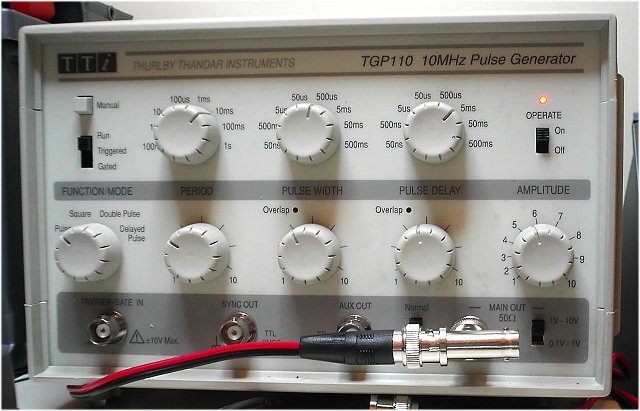
and in this photo of the pulse generator:

http://jlnlabs.online.fr/mahg/tests/mahg2r76c.jpg

Pulse DC is applied to a filament of unknown resistance (unknown,
because the resistance varies by an order of magnitude as the filament
is heated).  We have "true RMS" graphs of volts and amps but no raw
readings, so we can't easily confirm the "true RMS" values, which could
be in error.  But by looking at the pulse generator and doing a little
calculating we can get a very rough check.

In the photo of the pulse generator, above, note the settings.  It's set
up for somewhat wider pulses than were used during the actual runs (as
confirmed by another meter reading); OK, so those settings were changed
later.  But note the voltage -- it's set to about 5.8 volts amplitude.
We don't know for sure what it was set to during the real runs, but
there's no particular reason to assume it was *REDUCED* from that
setting.  So, let's assume the voltage was actually left unchanged, and
see where we get.

At 5.8 volts peak-to-peak, square pulses with a 5% duty cycle have an
RMS voltage of 5.8/sqrt(20) = 1.3 volts.

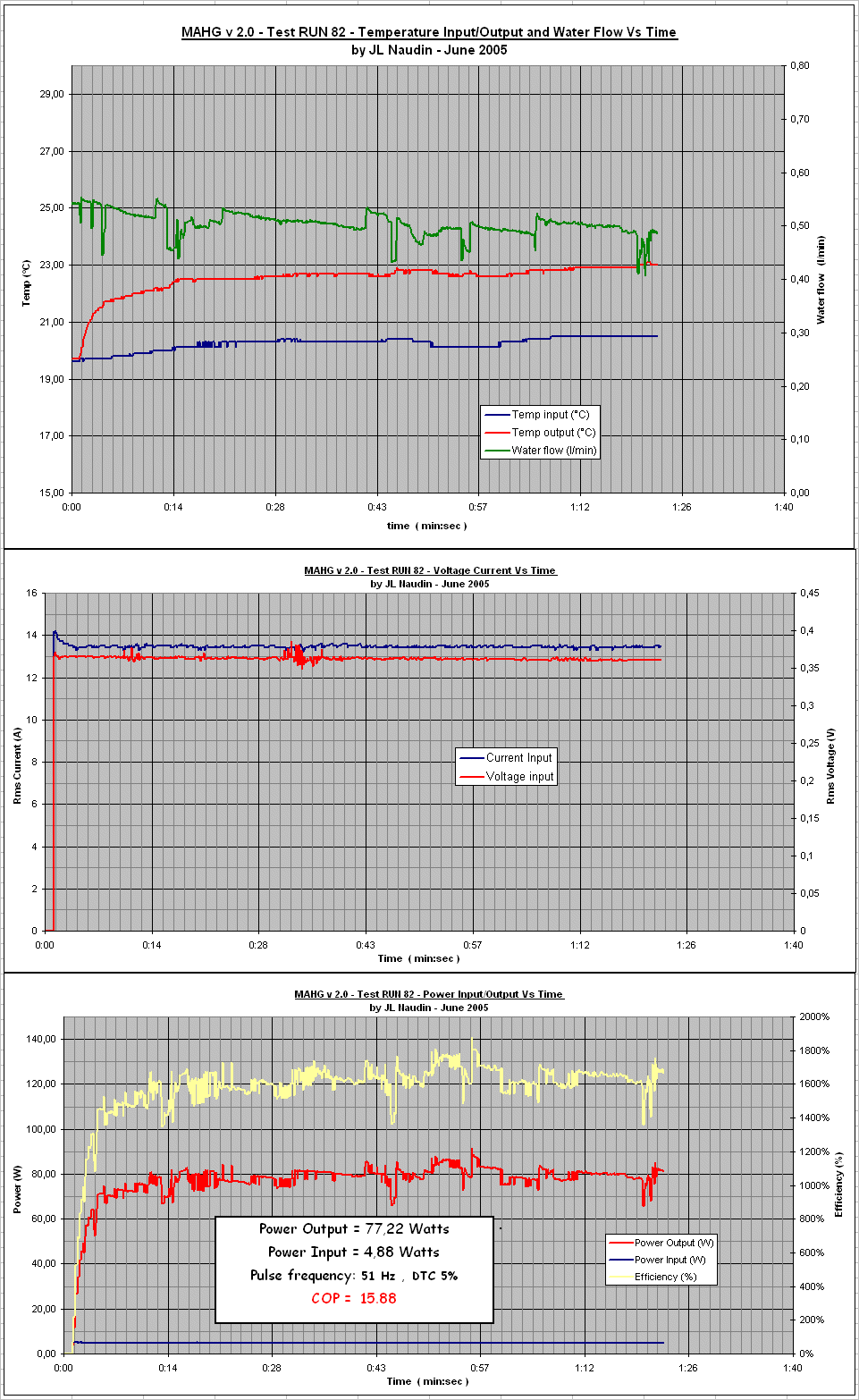
The graphs of the runs include the RMS volts; for example, see the
following, from run 82 (second graph shown in the GIF):

http://jlnlabs.online.fr/mahg/tests/mahg2r82dat.gif

RMS voltage is shown as about 0.37 volts.  Our back of the envelope
value was about 3.5 times larger than that.  This suggests that the
Fluke 123 may be giving an inaccurate RMS reading for pulsed DC -- the
value shown is closer to the *average* voltage than it is to the *RMS*
voltage.  If the "current" RMS value is off by a similar factor, then
the measured input power is off by a factor 3.5^2 -- it's about 12 times
too small.

The RMS reading of 0.37 volts corresponds to a pulse height of 1.65
volts.  It's conceivable that JLN actually cranked down the pulse
generator output to that value during the test runs, so this isn't
absolute proof that something is wrong with the RMS readings, but it
seems unlikely that he did so.

If this were a recent experiment I'd write to him, but this is stuff
from 4 years ago, so I think I'll just let it drop at this point.